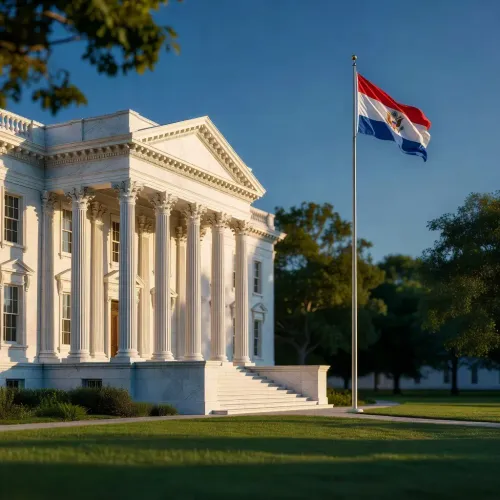
White House Posts Cryptic 'Don't Act Like I Never Told Ya' Message
Synopsis
The White House posted a one-line cryptic message on X on June 4, 2026 — 'Don't act like I never told ya' — alongside a video and no policy caption. The terse post fits a broader pattern of informal, social-media-native messaging from the official US executive account.
Key Takeaways
The White House posted 'Don't act like I never told ya' on X at 00:49 IST on June 4, 2026 .
The post included one video and no images or policy caption.
The phrasing is colloquial and offers no explicit reference to a prior statement.
No verifiable upcoming event or action is linked to the post.
Such terse posts typically gain weight only when paired with a formal readout.
The White House, the official communications arm of the Executive Office of the President of the United States, posted a brief and cryptic message on X in the early hours of June 4, 2026. The single-line post, accompanied by a video, read: 'Don't act like I never told ya.' The message carried no policy reference, named recipient, or contextual caption.
Context
The post, published at 00:49 IST on the official @WhiteHouse handle, is unusual for its colloquial register but consistent with a broader trend of the account adopting informal, social-media-native phrasing. The accompanying video was the only media attached; the text itself offered no link to a speech, executive order, or press briefing.
The phrase 'Don't act like I never told ya' reads as a rhetorical jab, suggesting the post is framed as a reminder of a prior position. However, the message does not specify which statement, audience, or policy it refers back to.
Policy backdrop
Official White House social media accounts have historically mixed formal readouts — on legislation, foreign visits, and executive actions — with shorter, punchier posts designed for viral reach. Brief messages of this kind have, in past administrations, accompanied video clips highlighting earlier remarks by the president or senior officials, typically to underscore a 'we said so' narrative on an unfolding event.
Without an explicit caption, the substantive content of such posts rests in the attached video. The text functions as a hook rather than an announcement, and any policy weight depends on the clip's content rather than the line itself.
Stakeholders and impact
For Indian readers, posts from the @WhiteHouse handle are watched closely for cues on trade, immigration, defence cooperation, and the broader India-United States strategic partnership. A message of this nature, absent a clear policy anchor, is unlikely to move markets or diplomatic conversations on its own.
It does, however, feed into a wider pattern in which official US government communication increasingly borrows the tone of personal social media, blurring the line between institutional messaging and political rhetoric. That stylistic shift has implications for how foreign governments, including New Delhi, parse signals from Washington.
Diplomatic desks typically treat such posts as background noise unless paired with a substantive readout. Analysts watching the US-India relationship will look to follow-up statements from the State Department, the Office of the United States Trade Representative, or the National Security Council for any concrete policy thread the post may be hinting at.
What's next
No verifiable upcoming event or action has been formally linked to the post. The next signal will likely come from the White House press briefing schedule and from any clarification the account itself issues in subsequent posts.
If the attached video is later cited in a formal statement — for instance, in support of a trade measure, sanctions decision, or domestic policy push — the cryptic post will retrospectively gain weight. Until then, it stands as a stylistic marker of how the executive branch is choosing to communicate in 2026: terse, informal, and built for the timeline rather than the wire.
For observers in India, the practical takeaway is to monitor the official video and any official transcript that may accompany it, rather than read excessive intent into the one-line caption.
Point of View
Including New Delhi, this raises the cost of signal interpretation — a cryptic line attached to a video can either be a throwaway or a deliberate marker. The neutral read is to wait for the formal readout. The sharper read is that tone itself has become policy, and allies are expected to keep up.
NationPress
20 Oct 2026
Frequently Asked Questions
What did the White House post on June 4, 2026?
The White House posted a single line on X — 'Don't act like I never told ya' — attached to one video, with no policy caption or named recipient.
Does the White House post refer to a specific policy?
No specific policy, legislation, or event is referenced in the text of the post. Any substantive content rests in the attached video rather than the caption.
Why is the White House using such informal language on X?
Official US government social media accounts have increasingly adopted informal, viral-friendly phrasing alongside formal readouts, a trend that predates this particular post.
Does this post affect India-United States relations?
On its own, a cryptic one-line post is unlikely to shift India-US ties. Diplomatic desks typically wait for formal statements from the State Department or the National Security Council.
Where can the original White House post be viewed?
The post is available on the official @WhiteHouse handle on X, timestamped 00:49 IST on June 4, 2026.