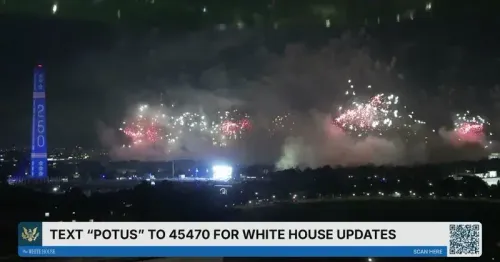
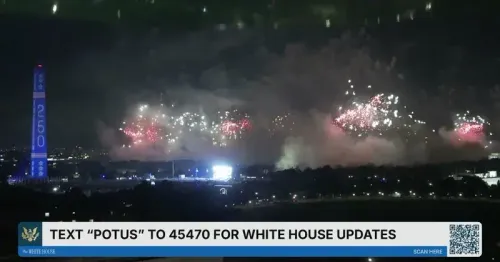
White House Marks Flag Day, Cites 250 Years of American Freedom

Synopsis
The White House marked Flag Day on June 14, 2026, invoking 250 years of American freedom and calling on citizens to honour fallen heroes. The message fits a long executive tradition of patriotic statements and gains added weight as the US approaches its semiquincentennial on July 4, 2026.
Key Takeaways
The White House posted a Flag Day message on June 14, 2026 , marking the annual commemoration of the adoption of the Stars and Stripes in 1777 .
The post cited 250 years of American freedom, directly referencing the US semiquincentennial milestone.
It called on Americans to 'stand in unity,' 'honor our fallen heroes,' and 'salute the greatest mark of freedom anywhere in the world.' Flag Day was first proclaimed by President Woodrow Wilson in 1916 and made a permanent national observance by President Harry S.
The message aligns with a continuous executive tradition of patriotic statements on national holidays, spanning multiple administrations.
The July 4, 2026 Independence Day — the formal 250th anniversary of the Declaration of Independence — is the next major milestone in this commemorative arc.
The White House, the official communications account of the Executive Office of the President of the United States, marked Flag Day on Sunday, June 14, 2026, with a message calling on Americans to stand in unity, honour fallen heroes, and salute what it described as the greatest symbol of freedom in the world.
Context
Flag Day is observed every year on June 14 to commemorate the adoption of the Stars and Stripes as the national flag of the United States by the Second Continental Congress on June 14, 1777 — nearly two and a half centuries ago. The White House post drew directly on that historical arc, stating that the American flag 'represents freedom, liberty, justice, and the will of a nation to become something greater for 250 years and counting.'
The message called on citizens to 'stand in unity with our homeland, honor our fallen heroes, and salute the greatest mark of freedom anywhere in the world' — language consistent with the solemn, unifying tone that executive offices have traditionally adopted on patriotic observances.
Policy Backdrop
Flag Day's status as a formal national observance has deep legislative roots. In 1916, President Woodrow Wilson issued a proclamation designating June 14 as Flag Day, recognising the date's symbolic importance. The observance was later codified when, in 1949, President Harry S. Truman signed a congressional resolution making it a permanent national commemoration.
Unlike federal holidays such as Independence Day (July 4) or Memorial Day, Flag Day does not carry a mandatory day-off status for federal employees, yet it occupies a consistent place in the White House's annual calendar of patriotic messaging. Statements on Flag Day have been issued across multiple administrations, underscoring its role as a non-partisan civic touchstone.
Stakeholders and Impact
The message speaks directly to U.S. citizens, military veterans, and active armed forces personnel, groups for whom the national flag carries particular resonance as a symbol of service and sacrifice. The reference to 'fallen heroes' situates Flag Day within a continuum that links it thematically to Memorial Day and broader veterans' commemorations.
The 250-year framing is notable: it places the 2026 observance within the United States' semiquincentennial — the 250th anniversary of American independence, a milestone that has prompted a range of national programming and reflection across civic institutions. Flag Day 2026 thus carries added symbolic weight as the country approaches July 4, 2026, the official 250th anniversary of the Declaration of Independence.
What's Next
Attention will now turn to Independence Day, July 4, 2026, when the United States formally marks 250 years since the signing of the Declaration of Independence. Large-scale federal and civic programming is expected around that milestone, with congressional resolutions, veterans' tributes, and public commemorations likely to amplify the themes raised in the Flag Day message. Any flag-protection legislation or veterans' honours bills moving through Congress in the coming weeks will be watched as a legislative complement to the executive branch's ceremonial messaging.
Point of View
A milestone that the executive branch is clearly building a sustained patriotic narrative around. Issued ahead of July 4, 2026, it signals that the administration intends to use the anniversary year as a unifying civic theme. For Indian observers, the messaging is a reminder of how the American executive branch deploys national symbols to project continuity and cohesion, a practice with clear parallels in Indian Republic Day and Independence Day communications. The emphasis on 'fallen heroes' also keeps military service at the centre of American civic identity — a framing that tends to enjoy bipartisan resonance.
NationPress
13 Sept 2026
Frequently Asked Questions
What is Flag Day in the United States?
Flag Day is observed every year on June 14 in the United States to mark the adoption of the Stars and Stripes as the national flag by the Second Continental Congress on June 14, 1777 . It was made a permanent national observance by President Harry S. Truman in 1949 .
Why did the White House mention 250 years on Flag Day 2026?
The reference to 250 years reflects the United States' semiquincentennial — the 250th anniversary of American independence. Flag Day 2026 falls just weeks before July 4, 2026 , when the US formally marks 250 years since the Declaration of Independence.
Is Flag Day a federal holiday in the US?
No, Flag Day is a national observance but not a federal public holiday, meaning federal employees do not automatically receive the day off. It was designated by President Woodrow Wilson in 1916 and made a permanent observance by Congress in 1949 .
What did the White House say on Flag Day 2026?
The White House stated that the American flag 'represents freedom, liberty, justice, and the will of a nation to become something greater for 250 years and counting,' and called on Americans to 'stand in unity,' honour fallen heroes, and salute the flag.
What comes after Flag Day in the US commemorative calendar?
Independence Day on July 4, 2026 is the next major milestone, marking the 250th anniversary of the signing of the Declaration of Independence. Large-scale federal programming and civic events are expected around that date.