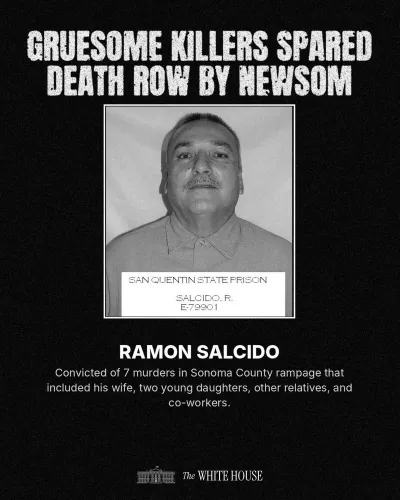
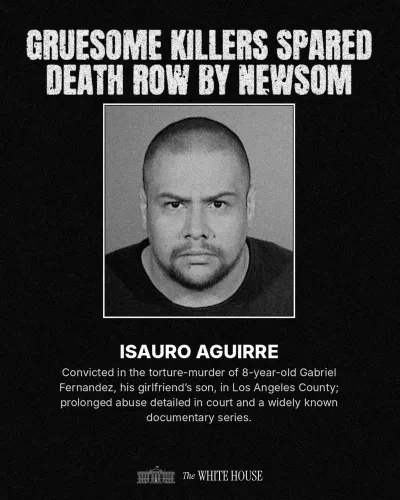
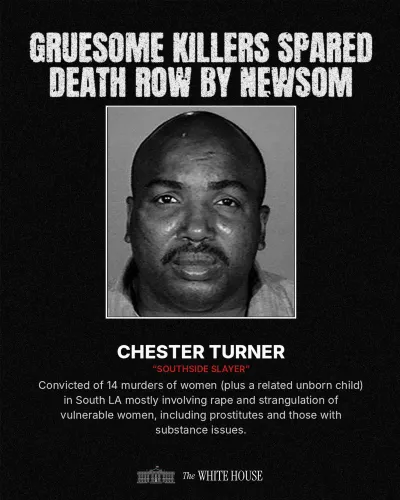
White House slams Newsom over death-sentence claims

Synopsis
The White House accused California Governor Gavin Newsom of commuting hundreds of death sentences, citing victims' families. The clash revives a long fight over California's stalled capital punishment system.
Key Takeaways
The White House on 28 November 2026 accused Governor Gavin Newsom of commuting death sentences at scale.
The post claimed a figure of 548 commutations; that number is the White House's claim, not independently confirmed here.
In 2019 , Newsom issued an executive order imposing a moratorium on executions and directing the closure of California's death row.
California holds the nation's largest death-row population; executions have been halted in practice since 2006 because of legal challenges.
The White House framed the dispute around video accounts from victims' families.
The next documented test is whether Sacramento publicly confirms, denies or legislates around the commutation claim.
The White House has gone straight at California Governor Gavin Newsom, accusing him of commuting death sentences for hundreds of inmates it called among the worst people who have ever lived. The official communications account of the Executive Office of the President posted on Saturday, 28 November 2026, and pointed viewers to video testimony from victims' families. A state fight over capital punishment is now a national political confrontation.
The post named Newsom directly: ‘Gavin Newsom, he wants to champion serial killers... so he's commuting the death sentences of hundreds - 548 - individuals who are literally among the worst people who have ever lived.’ It added: ‘Don't turn away. Victims' families share their heartbreaking stories.’
White House cites a figure of 548 commutations
That 548 number is the claim inside the White House post. It is not independently confirmed in the public record available for this report. What is on the record is Newsom's long campaign to keep California's execution chamber dark.
A commutation is not a pause. It rewrites the sentence. The White House is treating Newsom as having done that at scale, and it is using family testimony as the moral centre of the argument.
Newsom's 2019 order froze California's death chamber
In 2019, Governor Gavin Newsom issued an executive order declaring a moratorium on executions in California and directing the closure of the state's death row. California still holds the nation's largest death-row population. A separate legal freeze had already halted executions there since 2006.
That 2006 stall came from court challenges, not from the governor's later order. Newsom then turned a de facto stop into an explicit one. Reformers called it overdue. Opponents called it a veto of juries who had already spoken.
Victims' families versus a stalled death row
By attaching family stories, the White House is arguing that relief for the condemned is a second sentence on the bereaved. California's death-penalty politics have run on that fault line for years: relatives seeking an end to decades of appeals, and a reform camp that calls the penalty costly, error-prone and irreversible.
The inmates at issue are among the most serious offenders in the American system. How their sentences are finally resolved is a state power. That is why a federal communications account hammering a sitting governor is more than colour commentary. It is a bid to nationalise a Sacramento choice.
Sacramento's answer on capital sentences
The exchange sits inside a longer partisan fight over who controls criminal sentencing in the United States — states or the federal political centre. Watch for any official statement from the California Governor's office addressing the commutation claim, and for legislative moves that would either lock in or unwind death-penalty policy.
Washington has chosen the sharpest possible words. California still has to say whether those sentences have actually changed — or whether a long pause is being recast as a mass rewrite of punishment.
Point of View
With victims' families as the witness box. Newsom's 2019 moratorium already froze a system courts had stalled since 2006; commutation language, if accurate, would turn a pause into a permanent rewrite of sentences. Capital punishment in the United States is now mostly a state-level, highly partisan contest rather than a uniform federal practice. The pressure point is whether Sacramento answers with a legal clarification or lets the charge stand unanswered.
NationPress
28 Nov 2026
Frequently Asked Questions
What did the White House say about Gavin Newsom and the death penalty?
The White House accused California Governor Gavin Newsom of commuting the death sentences of hundreds of inmates, using the figure 548 in its post, and pointed to stories from victims' families. It described those inmates as among the worst people who have ever lived. The 548 figure is the White House's own claim.
Did Gavin Newsom halt executions in California?
Yes. In 2019 he issued an executive order declaring a moratorium on executions and directing the closure of the state's death row. Executions in California had already been frozen in practice since 2006 because of legal challenges.
What is the difference between a moratorium and a commutation?
A moratorium pauses carrying out a death sentence; the sentence itself remains. A commutation changes the sentence, typically to life imprisonment. The White House is alleging the latter at scale; Newsom's documented 2019 action was a moratorium.
Why does California still have a death row if executions are stopped?
California retains the nation's largest death-row population even though executions have not been carried out for years. Legal challenges from 2006 and Newsom's 2019 executive order have kept the death chamber unused while sentences remain on the books unless separately altered.
Can the US President overrule California's death-penalty policy?
Capital sentencing for state crimes is primarily a state power. A White House communications attack can raise political pressure, but changing California sentences still runs through Sacramento — the governor, the courts and the legislature.