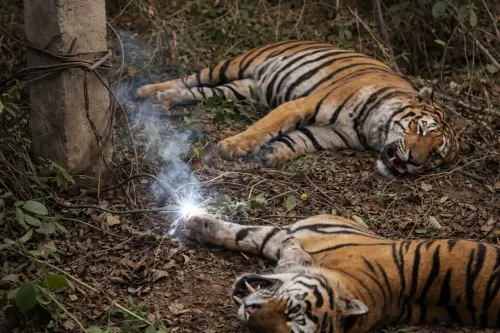
Maharashtra Reports 41 Tiger Deaths in 2025; 8 from Accidents

Synopsis
In a troubling report, Maharashtra's Forest Minister announced that 41 tigers succumbed in 2025 due to various reasons. Measures are underway to curb these fatalities, including construction of wildlife-friendly railway infrastructure.
Key Takeaways
41 tigers died in Maharashtra in 2025.
Major causes include natural causes , accidents , electrocution , and poaching .
Measures are being implemented to enhance wildlife safety.
Government is focusing on railway safety and patrolling against poaching.
Opposition is advocating strict laws against illegal prenatal sex determination.
Mumbai, Feb 25 (NationPress) Maharashtra's Forest Minister, Ganesh Naik, revealed in the Legislative Assembly that the state witnessed the demise of 41 tigers in 2025 due to various factors. These include natural causes, accidents, electrocution, and poaching.
In a written response to an Assembly inquiry, Minister Naik detailed that out of the total fatalities, 28 were linked to natural causes, 8 resulted from accidents, 4 were due to electrocution, and 1 tiger fell victim to poaching.
The inquiry aimed to uncover the specifics of tiger fatalities in Maharashtra and the government’s strategies to mitigate deaths caused by accidents, electrocution, and poaching.
Naik confirmed that numerous initiatives have been enacted to safeguard wildlife, especially from railway-related incidents.
He mentioned that the Railways has been directed to develop underpasses and overpasses in forested areas alongside newly proposed railway routes.
Moreover, a speed limit of 40 km/h has been instituted for trains traversing forest regions to lower the chances of wildlife collisions.
To combat poaching, the minister noted that ongoing patrols are conducted by the Special Tiger Protection Force.
Informants have been designated at the range level to collect intelligence on poaching activities, while communication systems have been established in sensitive areas to enhance surveillance.
Checkpoints have been set up in critical areas to inspect vehicles and monitor suspicious movements.
A bi-weekly monitoring initiative is underway to observe the movements of tigers and leopards at the range.
The minister added that temporary camps of nomadic groups near villages are also monitored as a part of these preventive efforts.
Camera traps have been placed along tiger corridors, at waterholes, and other vital locations to observe wildlife movements and detect any dubious activities.
Water sources within forest territories are routinely checked to avert poisoning incidents, he stated.
Meanwhile, members of the Opposition in the Legislative Assembly have called for stringent actions against those involved in illegal prenatal sex determination and female foeticide, advocating for the application of the Maharashtra Control of Organised Crime Act (MCOCA).
During a calling attention motion, NCP (SP) MLA Jitendra Awhad raised alarms regarding the declining gender ratio and urged the government to categorize illegal sex determination as organized crime.
He argued that these activities are orchestrated by coordinated networks and should be addressed under strict legal frameworks such as MCOCA.
In a written response, Public Health Minister Prakash Abitkar outlined the government’s actions, which include enhanced registration and inspection of sonography centers, toll-free helplines, complaint portals, rewards for informants, sting operations, awareness campaigns, and prosecution of offenders.
While several Opposition MLAs, including Babasaheb Deshmukh of the Peasants and Workers Party and Congress MLA Jyoti Gaikwad, voiced support for tougher legal measures, Abitkar clarified that the Maharashtra Regulation of Use of Prenatal Diagnostic Techniques Act, 1988, has sufficient provisions to tackle such offenses.
He noted that the government would persist in strengthening enforcement but did not commit to invoking MCOCA for these cases.
Point of View
The persistence of poaching and accidents highlights the need for more robust strategies. A concerted effort involving stricter laws and community engagement is crucial for the protection of these endangered species.
NationPress
19 Sept 2026
Frequently Asked Questions
What were the main causes of tiger deaths in Maharashtra in 2025?
The main causes of tiger deaths included natural causes, accidents, electrocution, and poaching. Specifically, 28 were due to natural causes, 8 from accidents, 4 from electrocution, and 1 from poaching.
What measures is the government taking to protect tigers?
The government is constructing underpasses and overpasses for railways, implementing a speed limit for trains, conducting regular patrols by the Special Tiger Protection Force, and installing camera traps to monitor wildlife.
How is the government addressing poaching?
The government is enhancing surveillance through informants, establishing check posts, and conducting regular monitoring of vulnerable areas to combat poaching.
What actions are being taken against illegal prenatal sex determination?
The government is enforcing stricter regulations on sonography centers, providing toll-free helplines, and launching awareness campaigns to combat illegal prenatal sex determination and female foeticide.
Is MCOCA being invoked for illegal prenatal sex determination?
While there have been calls for invoking MCOCA, the government has stated that existing laws are adequate to address such offenses.