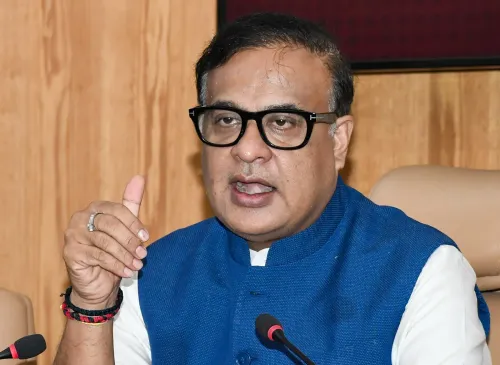
CM Himanta's Push: 5 Assam Medical Colleges Win NABH Accreditation
Synopsis
Assam Chief Minister Himanta Biswa Sarma announced that five government medical colleges — GMCH Guwahati, Tezpur, Dibrugarh, Barpeta, and Jorhat — have received NABH accreditation, fulfilling his directive to standardise quality across the state's public hospitals.
Key Takeaways
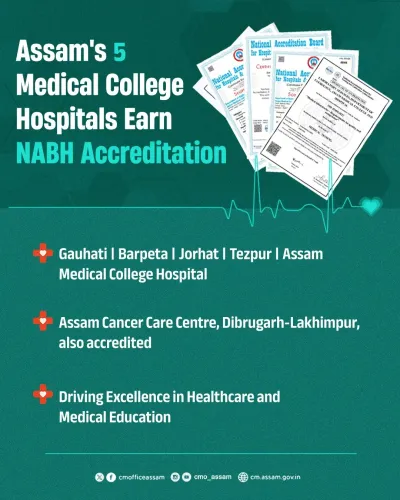
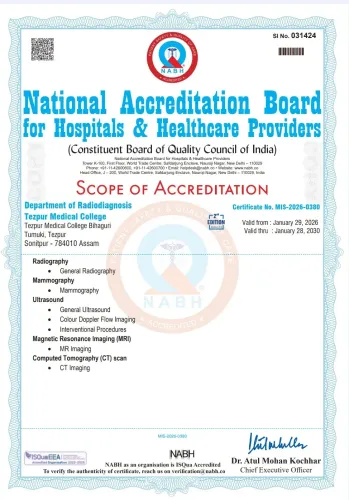
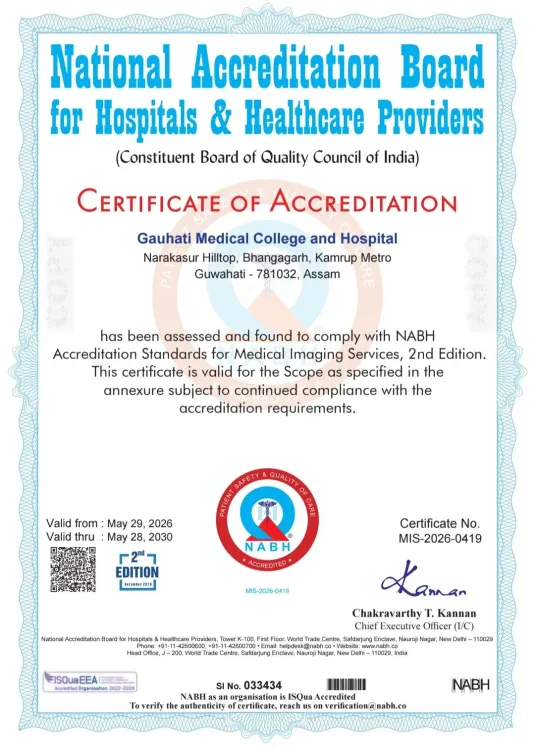
Five Assam government medical colleges — GMCH Guwahati, Tezpur Medical College, Assam Medical College Dibrugarh, FAAMC Barpeta, and JMCH Jorhat — have received NABH accreditation .
CM Himanta Biswa Sarma had issued a directive to all state medical colleges to secure NABH certification under the Quality Council of India.
NABH accreditation certifies hospitals against national benchmarks covering patient safety, infection control, and clinical governance.
The drive aligns with the Ayushman Bharat Pradhan Mantri Jan Arogya Yojana framework, which has encouraged accreditation for empanelled hospitals since 2018 .
The accreditation mandate is ongoing, with remaining Assam medical colleges and district civil hospitals potentially next in line.
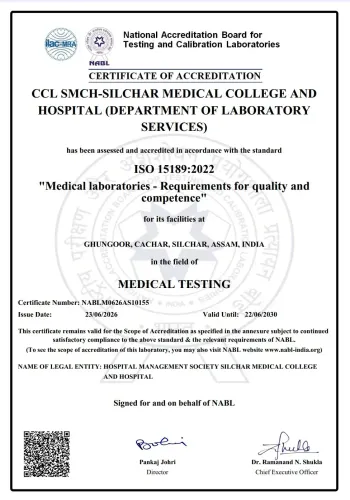
Assam Chief Minister Himanta Biswa Sarma announced on Wednesday, 24 June 2026 that five state-run medical colleges have secured accreditation from the National Accreditation Board for Hospitals and Healthcare Providers (NABH), marking a significant milestone in his administration's drive to standardise public healthcare quality across Assam.
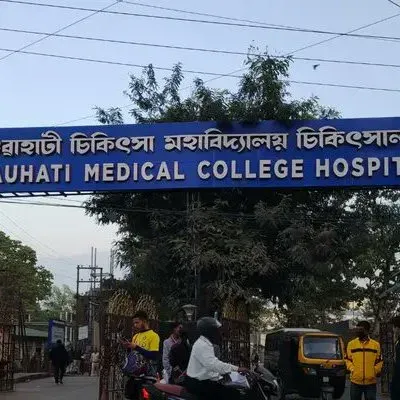
Posting on X, CM Sarma stated that he had directed all government medical colleges in the state to obtain NABH certification under the Quality Council of India. He confirmed that Gauhati Medical College and Hospital (GMCH), Tezpur Medical College, Assam Medical College Dibrugarh (AMC), Fakhruddin Ali Ahmed Medical College Barpeta (FAAMC), and Jorhat Medical College and Hospital (JMCH) have received the accreditation to date.
Context
NABH, operating under the Quality Council of India, is the apex body that certifies hospitals against rigorous clinical governance, patient safety, and infrastructure benchmarks. Accreditation signals that a facility meets nationally recognised quality norms — a credential long associated predominantly with private hospitals in India.
The Chief Minister's directive represents a deliberate policy choice to bring public teaching hospitals in Assam up to the same measurable standard, giving patients in government facilities a formal quality assurance mechanism.
Policy Backdrop
The push aligns with the spirit of the Ayushman Bharat Pradhan Mantri Jan Arogya Yojana, launched in 2018, which encouraged NABH accreditation for hospitals empanelled under the scheme as a condition for quality assurance and reimbursement eligibility.
Several Indian state governments have pursued similar accreditation mandates for district and teaching hospitals in recent years, reflecting a broader national effort to close the quality gap between public and private healthcare. Assam's drive stands out for explicitly covering all government medical colleges under a single directive from the Chief Minister's office.
Stakeholders and Impact
The immediate beneficiaries are patients at these five institutions — GMCH Guwahati, which serves as the state's premier tertiary referral centre, and colleges in Tezpur, Dibrugarh, Barpeta, and Jorhat that together cover a wide geographic spread from lower to upper Assam.
NABH accreditation typically requires hospitals to demonstrate compliance across domains including infection control, medication management, patient rights, and clinical outcomes tracking. For medical college administrations, the certification also reinforces training environments for students and resident doctors. For patients — many of them from economically vulnerable sections — it offers greater confidence in the care they receive at no or subsidised cost.
What's Next
The Chief Minister's post notes that the five colleges 'have received it till date,' implying the mandate remains active for remaining government medical colleges in the state. Attention will now turn to whether the accreditation drive is extended to Assam's district civil hospitals, which serve an even larger share of the rural population.
Sustained compliance — not just initial certification — will be the longer-term test, as NABH accreditation requires periodic reassessment. The administration's ability to maintain staffing, infrastructure, and process standards at all five institutions will determine whether this milestone translates into durable improvement in public healthcare delivery across Assam.
Point of View
A sector where state governments are routinely criticised for neglect. By anchoring the initiative to a central government-backed accreditation body, the Assam administration insulates the policy from partisan scrutiny and ties it to a national quality architecture. The geographic spread of the five accredited colleges — from Guwahati in the west to Dibrugarh in the east — suggests a deliberate effort to show statewide reach rather than concentration in the capital. The real test, however, lies in sustaining compliance through periodic reassessments rather than treating accreditation as a one-time milestone.
NationPress
23 Sept 2026
Frequently Asked Questions
What is NABH accreditation and why does it matter for government hospitals?
NABH, or the National Accreditation Board for Hospitals and Healthcare Providers, is a body under the Quality Council of India that certifies hospitals meeting national standards in patient safety, clinical governance, and infrastructure. For government hospitals, the certification signals to patients that care quality has been independently verified against the same benchmarks applied to leading private facilities.
Which Assam medical colleges have received NABH accreditation?
As of June 2026, five government medical colleges in Assam have received NABH accreditation: Gauhati Medical College and Hospital (GMCH), Tezpur Medical College, Assam Medical College Dibrugarh, Fakhruddin Ali Ahmed Medical College Barpeta, and Jorhat Medical College and Hospital.
Who directed Assam's medical colleges to get NABH accreditation?
Assam Chief Minister Himanta Biswa Sarma issued the directive, asking all government medical colleges in the state to secure NABH accreditation as part of his administration's effort to standardise healthcare quality across public hospitals.
Is NABH accreditation linked to Ayushman Bharat?
Yes. The Ayushman Bharat Pradhan Mantri Jan Arogya Yojana, launched in 2018, encouraged NABH accreditation for hospitals empanelled under the scheme, making it a quality benchmark for facilities seeking to participate in the national health insurance programme.
Will other Assam hospitals also get NABH accreditation?
CM Sarma's post indicates the mandate covers all government medical colleges, and the five accreditations announced are described as received 'till date,' suggesting the process is ongoing. Extension to district civil hospitals has not been officially announced but is being watched as a logical next step.