700 gm premature baby survives five-month NICU battle at Mumbai's KEM Hospital
Synopsis
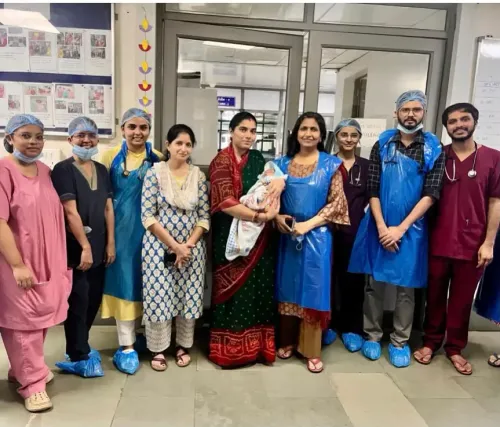
A 700-gram premature baby admitted to Mumbai's KEM Hospital — a BMC-run public facility — has been discharged after five months of intensive neonatal care, going home at 3.3 kg on full breastfeeds. The case, led by Dr Anitha Haribalakrishna, highlights a quietly growing capability in India's government NICU ecosystem.
Key Takeaways
A 700-gram premature baby boy was discharged from KEM Hospital, Mumbai on Sunday, 8 November 2026 after five months in the NICU.
The infant was sent home weighing 3.3 kg and on full breastfeeds.
Care was led by Dr Anitha Haribalakrishna , Head of Neonatology at KEM Hospital, a BMC -operated facility.
In March 2026 , a similar 700-gram premature baby born at 26 weeks was saved at a government hospital in Nagpur after 100 days of NICU care.
Babies under 1,000 grams at birth are classified as extremely low birth weight (ELBW) and face the highest neonatal mortality risks.
A 700-gram premature baby boy has been discharged in good health from KEM Hospital in Mumbai after five months of intensive neonatal care, marking a significant milestone for the city's public healthcare system. The infant, who arrived in a critically fragile condition, was sent home on Sunday weighing 3.3 kg and on full breastfeeds.
A Five-Month Battle in the NICU
The baby was admitted to the Neonatal Intensive Care Unit (NICU) of KEM Hospital — a government medical college and hospital operated by the Brihanmumbai Municipal Corporation (BMC) — immediately after birth, given his extremely low birth weight. Over the course of five months, the medical team managed a 'prolonged and challenging course requiring intensive care and respiratory support,' according to the hospital.
The care was led by Dr Anitha Haribalakrishna, Head of the Department of Neonatology at KEM Hospital. 'The baby battled several life-threatening complications, which were gradually overcome through continuous monitoring, multidisciplinary care and dedicated medical and nursing support,' she said in a statement.
What the Hospital Said
'After spending five months in the Neonatal Intensive Care Unit (NICU), he went home weighing 3.3 kg and on full breastfeeds,' the hospital said. KEM Hospital described the outcome as a reflection of the 'combined strength of its NICU facilities, clinical expertise, coordinated teamwork and sustained bedside care in treating some of the most vulnerable newborns.'
The hospital added that the successful discharge 'showcases the quality of specialised neonatal care available at KEM Hospital.'
Not an Isolated Achievement
This is not the first time a government hospital in Maharashtra has pulled off a comparable feat. In March 2026, paediatric doctors at a government medical college and hospital in Nagpur saved the life of another 700-gram infant born prematurely at just 26 weeks. That baby required 100 days of round-the-clock NICU monitoring and was discharged weighing 1.88 kg after being treated for severe respiratory distress and congenital heart complications.
Taken together, the two cases point to a growing — if underreported — capability within Maharashtra's public neonatal care infrastructure.
Why This Matters for Public Healthcare
Premature babies born below 1,000 grams — classified as extremely low birth weight (ELBW) infants — face some of the highest mortality risks in neonatal medicine. Survival rates in this category at government hospitals have historically lagged behind private tertiary care centres. The KEM Hospital case, handled entirely within the BMC-run public health system, is being cited as evidence that specialised neonatal outcomes are achievable in government settings with adequate staffing and equipment.
As neonatal care standards in public hospitals continue to improve, cases like this are likely to become a benchmark for what well-resourced government NICUs can deliver.
Point of View
Underexamined story about what India's public healthcare system can achieve when NICUs are properly resourced. Extremely low birth weight survival at government hospitals has historically been a gap metric, quietly overshadowed by private tertiary care benchmarks. Two such survivals in Maharashtra within the same year suggest this may no longer be an outlier. The question now is whether BMC and state health authorities will invest in systematically scaling these outcomes, or whether cases like this remain isolated moments of excellence in an otherwise under-funded system.
NationPress
8 Nov 2026
Frequently Asked Questions
What happened to the 700-gram premature baby at KEM Hospital Mumbai?
The baby boy, born weighing just 700 grams, was admitted to the NICU at KEM Hospital in Mumbai and received five months of intensive neonatal care. He was discharged on Sunday, 8 November 2026, weighing 3.3 kg and on full breastfeeds.
Which hospital treated the premature baby and who led the care?
KEM Hospital in Mumbai, run by the Brihanmumbai Municipal Corporation (BMC), treated the infant. The care was supervised by Dr Anitha Haribalakrishna, Head of the Department of Neonatology at the hospital.
What complications did the premature baby face during treatment?
According to the hospital, the baby battled several life-threatening complications that required continuous monitoring, respiratory support, and multidisciplinary medical and nursing care over five months.
Has any other government hospital in Maharashtra achieved a similar outcome?
Yes. In March 2026, a government hospital in Nagpur saved another 700-gram premature baby born at 26 weeks. That infant was discharged after 100 days in the NICU, weighing 1.88 kg, after treatment for severe respiratory distress and congenital heart complications.
Why is the survival of a 700-gram premature baby medically significant?
Babies born below 1,000 grams are classified as extremely low birth weight (ELBW) infants and face some of the highest mortality risks in neonatal medicine. Achieving survival and healthy discharge at a government hospital underscores the growing capability of public NICU infrastructure in India.