India's Unorganised Sector Adds Over 74.5 Lakh Jobs in 2025

Synopsis
In a promising development for India's economy, over 74.5 lakh new jobs were created in the unorganised sector during 2025, reflecting significant growth in various sectors and improved wage levels. Discover how digital integration and women-led businesses are shaping the future of employment in India.
Key Takeaways
Over 74.52 lakh new jobs created in 2025.
6.18% increase from prior year.
GVA grew by 10.87% .
Women-owned establishments rise to 27% .
Internet usage in establishments increased to 39.4% .
New Delhi, March 24 (NationPress) In the year 2025, India's unorganised sector saw the creation of over 74.52 lakh new jobs from January to December, marking a 6.18 percent increase compared to the period of October 2023 to September 2024, as reported by the Annual Survey of Unincorporated Sector Enterprises (ASUSE) released on Tuesday.
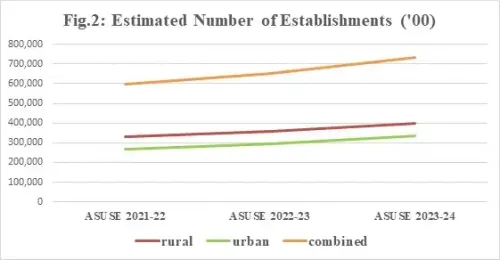
The total number of establishments surged to 7.92 crore during this timeframe, up from 7.34 crore in the previous ASUSE report for 2023-24, indicating a growth rate of approximately 7.97 percent. This data was provided by the Ministry of Statistics.
During this period, Gross Value Added (GVA) also experienced a remarkable growth of 10.87 percent (at current prices). This growth was particularly driven by a 16.77 percent increase in the trade sector, followed by 8.52 percent in manufacturing and 7.36 percent in other services.
The average earnings per worker rose by 3.88 percent in 2025 when compared to the previous ASUSE report, indicating an enhancement in wage levels.
Women-led proprietary businesses accounted for a significant 27 percent of total establishments, an increase from 26.2 percent in the previous year (ASUSE 2023-24).
Furthermore, the proportion of establishments utilizing the internet surged from 26.7 percent in ASUSE 2023–24 to 39.4 percent in ASUSE 2025, underscoring the sector's increasing digital integration.
The unincorporated non-agricultural sector is a vital component of the Indian economy, substantially contributing to both employment and Gross Domestic Product (GDP). This sector supports the livelihoods of millions and plays a crucial role in the production and distribution of goods and services nationwide. By enhancing the activities of the incorporated sector and bolstering domestic value chains, it significantly contributes to the overall socio-economic progress of the nation, according to the official statement.
The Annual Survey of Unincorporated Sector Enterprises (ASUSE) aims to assess the economic and operational characteristics of non-agricultural establishments involved in manufacturing, trade, and other service sectors (excluding construction).
This survey gathers essential economic data such as workforce numbers, GVA, wages, fixed assets, and outstanding loans, along with operational parameters like ownership type, operational nature, registration status, and the adoption of Information and Communication Technology (ICT), the statement further clarified.
Point of View
The significant job creation in India's unorganised sector highlights the resilience of its economy. This growth not only reflects an increase in employment opportunities but also emphasizes the importance of digital transformation and women's contributions in the workforce. It is crucial for policymakers to continue supporting this sector to further enhance economic stability.
NationPress
22 Sept 2026
Frequently Asked Questions
What is the total number of jobs created in the unorganised sector in 2025?
Over 74.5 lakh new jobs were created in India's unorganised sector during 2025.
How much did the Gross Value Added (GVA) grow in 2025?
The Gross Value Added (GVA) grew by 10.87 percent at current prices during 2025.
What percentage of establishments are owned by women?
Women-owned proprietary establishments constituted 27 percent in 2025.
How has the digital integration in the unorganised sector changed?
The share of establishments using the internet increased significantly from 26.7 percent to 39.4 percent in 2025.
What sectors contributed to job growth?
The trade sector led with 16.77 percent growth, followed by manufacturing at 8.52 percent.