Akhilesh backs Kanti Singh for Lucknow Graduate MLC seat
Synopsis
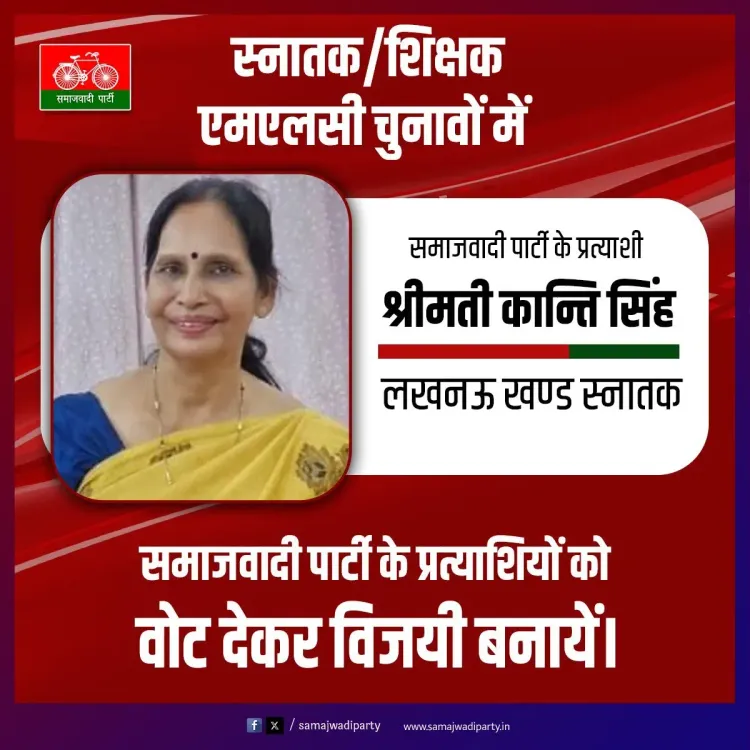
Samajwadi Party president Akhilesh Yadav has called on graduates and teachers in the Lucknow division to elect Smt. Kanti Singh to the UP Legislative Council's graduate MLC seat, framing her victory as a win for education and the educated.
Key Takeaways
Akhilesh Yadav personally endorsed Smt.
Kanti Singh as the Samajwadi Party candidate for the Lucknow Khand Snatak (graduate) MLC seat.
The appeal was posted on 21 October 2026 and signed 'Aapka Akhilesh', targeting the graduate electorate of the Lucknow division .
UP's graduate and teacher MLC constituencies are elected by small, specialised pools of registered graduates and teachers — not the general voter base.
Samajwadi Party contests these seats to strengthen its presence in the Uttar Pradesh Legislative Council and influence education-related debates.
Akhilesh framed the vote as defending the honour of 'teacher, learner, education, and the educated' — linking partisan support to a broader civic cause.
With the Uttar Pradesh Legislative Council's graduate and teacher MLC elections approaching, Samajwadi Party president Akhilesh Yadav has thrown his full weight behind the party's candidate for the Lucknow graduate constituency — urging voters to back Smt. Kanti Singh and, in doing so, defend the dignity of teachers, students, education, and the educated.
Posting on Wednesday, October 21, 2026, Akhilesh wrote in Hindi: 'श्रीमती कान्ति सिंह जी की जीत में हमारी जीत है।' — 'In Smt. Kanti Singh's victory lies our victory.' The appeal, signed with a characteristic 'Aapka Akhilesh' ('Your Akhilesh'), was directed at the specialised electorate of graduates registered in the Lucknow division.
Why the graduate and teacher seats matter in UP politics
The Uttar Pradesh Legislative Council — the state's upper house — includes constituencies elected exclusively by graduates and by registered teachers. These are not mass electorates; they are relatively small, educated voter pools whose preferences can shape debates on education policy, school governance, and higher-education funding inside the council chamber.
Samajwadi Party has historically contested these seats as part of a broader effort to consolidate its legislative council presence and amplify its voice on education-related legislation. A win here is not just a number — it is a platform inside the upper house to hold the ruling BJP government in Uttar Pradesh accountable on school teacher recruitment, university autonomy, and student welfare.
Kanti Singh and the Lucknow graduate constituency
Smt. Kanti Singh is the Samajwadi Party's candidate for the Lucknow Khand Snatak (Lucknow division graduate) MLC seat. Akhilesh's direct, personal endorsement — rare for a constituency of this specialised nature — signals how seriously the party is treating this election cycle. The message was clear and targeted: graduates and educators in the Lucknow division hold the ballot that can translate educational interests into legislative representation.
The appeal to 'raise the honour of teacher, learner, education, and the educated' frames the vote not merely as partisan support but as a civic act by an educated constituency choosing its own voice in the upper house. Whether that framing resonates with the graduate electorate will be answered when results are declared.
Point of View
Not just the Lok Sabha and Vidhan Sabha. These specialised constituencies — small, educated electorates — are increasingly valued as platforms for policy influence on education, a theme SP has used consistently to contrast itself with the ruling dispensation. Framing a council election appeal around the 'dignity of the educated' is also a soft outreach to a demographic that has historically been swing territory in UP's upper-house contests.
NationPress
21 Oct 2026
Frequently Asked Questions
Who is Kanti Singh and which seat is she contesting?
Smt. Kanti Singh is the Samajwadi Party candidate contesting the Lucknow Khand Snatak (Lucknow division graduate) MLC seat in the Uttar Pradesh Legislative Council elections.
What is a graduate MLC seat in Uttar Pradesh?
Graduate MLC seats in the UP Legislative Council are constituencies where only registered graduates of a specific division are eligible to vote, electing a member to the upper house of the state legislature.
Why is Akhilesh Yadav appealing for votes in an MLC election?
Akhilesh Yadav, as Samajwadi Party president, personally backed the party's Lucknow graduate MLC candidate to mobilise the educated voter base and strengthen SP's representation in the UP Legislative Council.
What does the Uttar Pradesh Legislative Council do?
The UP Legislative Council is the upper house of the state legislature; it reviews legislation, debates policy, and includes members elected from specialised constituencies such as graduates and teachers.
When did Akhilesh Yadav post his appeal for Kanti Singh?
Akhilesh Yadav posted his appeal on Wednesday, 21 October 2026 , calling on Lucknow division graduates to vote for Smt. Kanti Singh in the upcoming MLC election.