Akhilesh flags 4,000 EVMs burnt after Bengal polls, questions integrity
Synopsis
Samajwadi Party president Akhilesh Yadav alleged on 13 June 2026 that 4,000 EVMs used in the West Bengal assembly election were gutted in a fire, calling it a 'story of suspicion' and saying the public is wise enough to judge — reigniting a long-running opposition campaign against EVM credibility ahead of the 2027 UP polls.
Key Takeaways
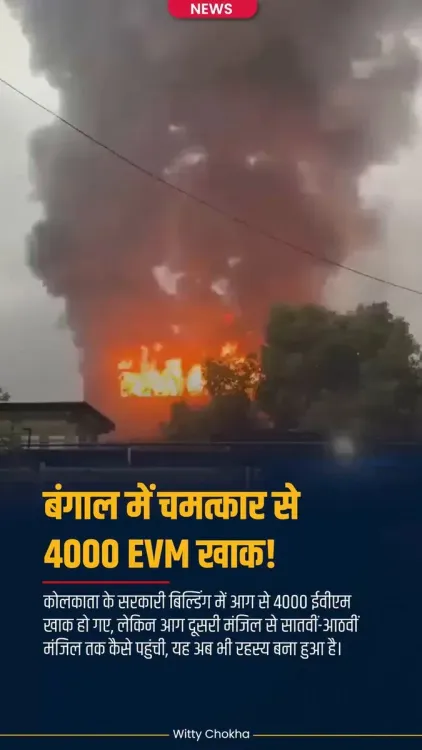
Akhilesh Yadav alleged on 13 June 2026 that 4,000 EVMs used in the West Bengal assembly election were destroyed in a fire.
He called the incident a 'story of suspicion' and said the public is wise enough to judge — without making a direct legal accusation.
The specific claim of 4,000 EVMs burning could not be independently verified by NationPress; the Election Commission of India had issued no public statement as of this report.
Opposition parties including the Samajwadi Party have questioned EVM integrity since the 2019 Lok Sabha elections , demanding VVPAT verification or paper ballots.
The Supreme Court upheld EVM use with VVPAT in multiple orders between 2019 and 2023 .
The controversy is likely to intensify ahead of the 2027 Uttar Pradesh assembly elections , with pressure mounting on the Election Commission for a formal audit response.
Samajwadi Party president Akhilesh Yadav on Saturday, 13 June 2026, alleged that 4,000 Electronic Voting Machines (EVMs) used in the West Bengal assembly election were destroyed in a fire, calling the incident a 'story of suspicion' and asserting that the public is wise enough to draw its own conclusions.
Context
Yadav posted in Hindi: 'प. बंगाल विधानसभा चुनाव में इस्तेमाल हुई 4000 EVM मशीन का आग में जल जाना, कह रहा है शक़ का फ़साना' — loosely translated as, 'The burning of 4,000 EVM machines used in the West Bengal assembly election tells a tale of suspicion.' He added: 'The rest of the public is wise.' The post was accompanied by a video. NationPress could not independently verify the specific claim of 4,000 EVMs being destroyed.
EVM storage and handling after elections falls under the jurisdiction of the Election Commission of India (ECI), which is constitutionally mandated to maintain custody of voting machines between polls. Any fire in a government warehouse holding EVMs would ordinarily require a formal ECI inquiry and public disclosure.
Policy Backdrop
Opposition parties, including the Samajwadi Party, have questioned EVM integrity repeatedly since the 2019 Lok Sabha elections, demanding either 100 percent VVPAT slip verification or a return to paper ballots. The Supreme Court of India upheld EVM use — with VVPAT paper trail — in multiple orders between 2019 and 2023, declining to order a ballot-paper revert.
Isolated EVM storage incidents, including fires in government warehouses, have been reported across several states since 2017. Each such incident has historically prompted demands from the losing side for transparency, while the Election Commission has maintained that EVMs are tamper-proof and that storage protocols are robust.
The 2021 West Bengal Legislative Assembly election — won decisively by the ruling Trinamool Congress — was followed by opposition allegations of post-poll irregularities, though those complaints centred on violence rather than EVM integrity at the time.
Stakeholders and Impact
Akhilesh Yadav's statement is directed at a broad opposition constituency that has long harboured scepticism about electronic voting. By framing the alleged fire as a 'tale of suspicion,' he is amplifying a narrative that connects EVM storage lapses to questions of electoral credibility — a line of argument that resonates with voters in states like Uttar Pradesh, where assembly elections are due in 2027.
The Election Commission of India has not, as of this report, issued a public statement specifically addressing the claim made in the post. Opposition parties across the spectrum — from the Samajwadi Party in the north to regional formations in the east — have a shared interest in EVM accountability, making this the kind of post that can quickly aggregate cross-party amplification on social media.
What's Next
Pressure is likely to mount on the Election Commission to clarify the status of EVM storage in West Bengal and to release any incident reports related to warehouse fires. Opposition parties may use the issue to revive petitions before the Supreme Court or file formal complaints with the ECI ahead of the next major electoral cycle.
With Uttar Pradesh heading to polls in 2027, Akhilesh Yadav has a clear political incentive to keep EVM credibility in public discourse. Whether the Election Commission responds with a detailed audit or maintains silence will shape how far this controversy travels beyond social media.
Point of View
Without making a directly falsifiable legal claim. By letting the alleged fire 'speak for itself' and invoking public wisdom, he sidesteps the burden of proof while keeping the narrative alive. The timing — well ahead of the 2027 Uttar Pradesh elections — signals that EVM credibility will be a recurring mobilisation theme for the Samajwadi Party. The Election Commission's response, or lack thereof, will determine whether this stays a social-media moment or escalates into a formal political and legal confrontation.
NationPress
27 Oct 2026
Frequently Asked Questions
Did 4,000 EVMs really burn after the West Bengal election?
Samajwadi Party president Akhilesh Yadav made this claim in a post on 13 June 2026, but NationPress could not independently verify the specific figure of 4,000 EVMs being destroyed. The Election Commission of India had not issued a public statement on the matter as of this report.
What did Akhilesh Yadav say about EVMs and West Bengal?
Akhilesh Yadav posted in Hindi that the burning of 4,000 EVMs used in the West Bengal assembly election 'tells a tale of suspicion,' adding that 'the public is wise' — implying voters should draw their own conclusions about electoral integrity.
Who is responsible for EVM storage after elections in India?
The Election Commission of India is constitutionally responsible for the custody, storage and security of EVMs between elections. Any incident involving stored EVMs in a government warehouse would ordinarily require a formal ECI inquiry.
Has the Supreme Court upheld the use of EVMs in India?
Yes. The Supreme Court of India upheld EVM use — coupled with VVPAT paper-trail verification — in multiple orders between 2019 and 2023, declining opposition demands to revert to paper ballots.
Why do opposition parties keep raising EVM concerns before elections?
Indian opposition parties have questioned EVM integrity since at least the 2019 Lok Sabha elections, often demanding 100 percent VVPAT verification. Analysts see such statements as part of a broader strategy to keep electoral accountability in public discourse, particularly ahead of major state polls.