Akhilesh flags PDA Rath's Raebareli stop as proof SP will form govt
Synopsis
Samajwadi Party president Akhilesh Yadav hails the PDA Rath's opening stop in Raebareli — where a welcome garland reportedly needed a crane — as evidence that the SP-led PDA social coalition is on course to form the next government in Uttar Pradesh.
Key Takeaways
Akhilesh Yadav posted on 24 September 2026 about the first stop of the PDA Rath yatra in Raebareli .
He emphasised the sentiment of 'boundless love and affection' from supporters, not merely the spectacle of a giant garland requiring a crane.
Akhilesh declared that Raebareli has 'ensured' the Samajwadi Party will form a PDA Sarkar in Uttar Pradesh.
PDA stands for Pichhda, Dalit, Alpsankhyak — the SP's three-community electoral coalition introduced during the 2022 UP elections .
The yatra is part of the SP's pre-election mobilisation cycle ahead of the 2027 Uttar Pradesh assembly elections .
Akhilesh's closing slogan — 'Jo peedit, wo PDA' (whoever is aggrieved, they are PDA) — frames the coalition as a movement of the wronged.
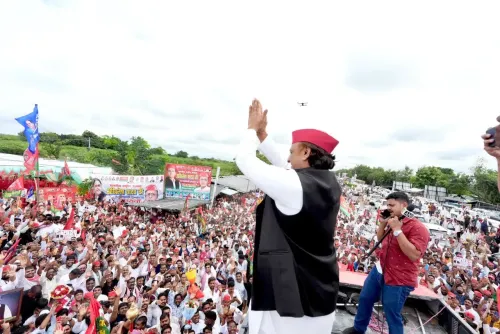
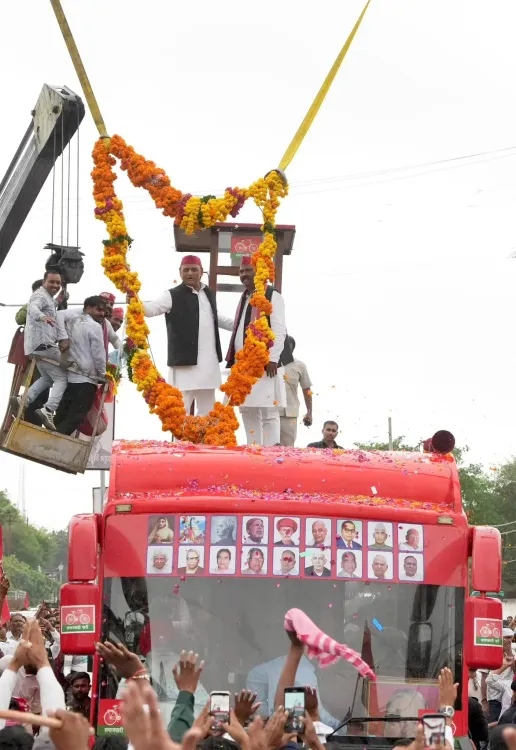
A garland so massive it needed a crane to be lifted — and Samajwadi Party president Akhilesh Yadav says that is not even the point. Writing on X on Thursday, 24 September 2026, Akhilesh described the first stop of the PDA Rath yatra in Raebareli as an outpouring of 'boundless love and affection' from his own people — and declared it proof that a 'PDA Sarkar' is now within reach.
In his post, Akhilesh wrote: 'बात इतने बड़े हार से स्वागत की नहीं है कि उसे क्रेन से उठाया जाए, बात अपनों से मिल रहे बेइंतहा प्यार-मोहब्बत की है' — ('It is not about a welcome with such a large garland that it needs a crane to lift; it is about the boundless love and affection received from our own people'). He thanked the people of Raebareli, party workers, office-bearers and leaders, and closed with a rallying line: 'Jo peedit, wo PDA' — whoever is aggrieved, they are PDA.
What the PDA formula means — and why Raebareli matters
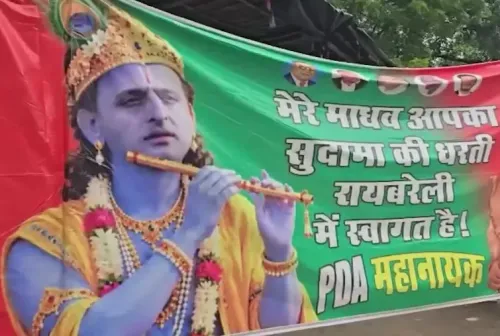
PDA stands for Pichhda (backward classes), Dalit, Alpsankhyak (minorities) — the three-community social coalition that the Samajwadi Party has positioned as its core electoral arithmetic in Uttar Pradesh. The framework was formally pushed during the 2022 UP assembly elections and has since become the ideological spine of the party's outreach strategy. A 'PDA Rath' — a campaign vehicle touring the state — is designed to physically carry that message into constituency after constituency before polling day.
Raebareli, a Lok Sabha constituency in central UP, carries heavy political symbolism. The choice to begin the Rath's first major public stop there signals an intent to contest ground that has historically been significant for multiple political formations. A crane-lifted garland at the welcome rally — whatever its exact dimensions — becomes a ready-made visual metaphor: the crowd so large, the enthusiasm so dense, that logistics had to catch up with sentiment.
The road to 2027 — and the arithmetic behind the yatra
The 2027 Uttar Pradesh assembly elections are the unstated subject of every sentence Akhilesh wrote. Rath yatras have been a recurring mobilisation tool in UP politics — part spectacle, part organisational census, part loyalty test for booth-level workers. The PDA Rath is all three simultaneously: it maps enthusiasm, energises cadre, and — crucially — generates images and moments that travel far beyond the rally ground on social media.
Akhilesh's confidence is deliberate. By saying 'Raebareli has ensured that we are going to form our PDA government,' he is not reporting a poll but setting a psychological floor for his party's workers: the momentum is declared, the destination is named, the only variable is effort. In UP's notoriously complex caste arithmetic, projecting inevitability is itself a campaign tool — it discourages fence-sitters from aligning with the incumbent and emboldens undecided PDA-constituency voters to commit.
With the Rath's first outing drawing the kind of reception that, by Akhilesh's own telling, required heavy machinery to manage, the Samajwadi Party is betting that the energy visible in Raebareli on 24 September 2026 is reproducible — stop after stop, district after district — all the way to election day.
Point of View
Emotionally charged ground movement well before election season officially opens. By declaring that a single rally stop has 'ensured' government formation, Akhilesh is deploying the classic momentum narrative — projecting confidence to consolidate wavering supporters and put the ruling establishment on notice. The slogan 'Jo peedit, wo PDA' is a shrewd broadening device: it makes the coalition elastic enough to absorb any voter who feels aggrieved, regardless of caste identity. Whether the Rath can sustain this energy across UP's 403 assembly constituencies — and whether the PDA arithmetic translates into booth-level conversions — will be the real test as 2027 approaches.
NationPress
24 Sept 2026
Frequently Asked Questions
What is the PDA Rath yatra?
The PDA Rath is a campaign vehicle journey organised by the Samajwadi Party to reach and mobilise voters from the Pichhda (backward classes), Dalit, and Alpsankhyak (minority) communities across Uttar Pradesh ahead of state elections.
What does PDA stand for in Samajwadi Party politics?
PDA stands for Pichhda, Dalit, Alpsankhyak — a three-community social coalition that the Samajwadi Party has promoted as its core electoral formula in Uttar Pradesh since the 2022 assembly elections.
Why did Akhilesh Yadav mention a garland being lifted by a crane?
Akhilesh used the image of a crane-lifted welcome garland to illustrate the scale of enthusiasm at the Raebareli rally, but stressed that the real significance was the outpouring of 'boundless love and affection' from supporters, not the spectacle itself.
What is the significance of Raebareli for UP politics?
Raebareli is a Lok Sabha constituency in central Uttar Pradesh with longstanding political importance for multiple parties, making it a symbolically significant launch pad for any major campaign outreach.
When are the next Uttar Pradesh assembly elections?
The next Uttar Pradesh assembly elections are scheduled for 2027, and the PDA Rath yatra is widely seen as part of the Samajwadi Party's early mobilisation effort ahead of that poll.