Amit Shah: NAFED turns profit, now serves 74 lakh farmers
Synopsis
Union Home Minister Amit Shah has said NAFED — once on the verge of closure in 2014 — is now earning a ₹500 crore profit and serving 74 lakh farmers under the Modi government, highlighting a decade of cooperative-sector revival.
Key Takeaways
Union Home Minister Amit Shah posted on 23 June 2026 claiming NAFED was near closure in 2014 but has since turned around under the Modi government.
NAFED is now reported to be generating a profit of ₹500 crore and serving 74 lakh farmers .
NAFED , founded in 1958 , is India's apex cooperative body for agricultural marketing and minimum support price procurement operations.
The Ministry of Cooperation , created in July 2021 with Shah as minister, has been the institutional driver of cooperative-sector reform.
NAFED's recovery is being positioned by the government as a model for the broader revival of India's cooperative movement.
Further procurement and marketing guidelines from the Ministry of Cooperation are expected in the next fiscal cycle.
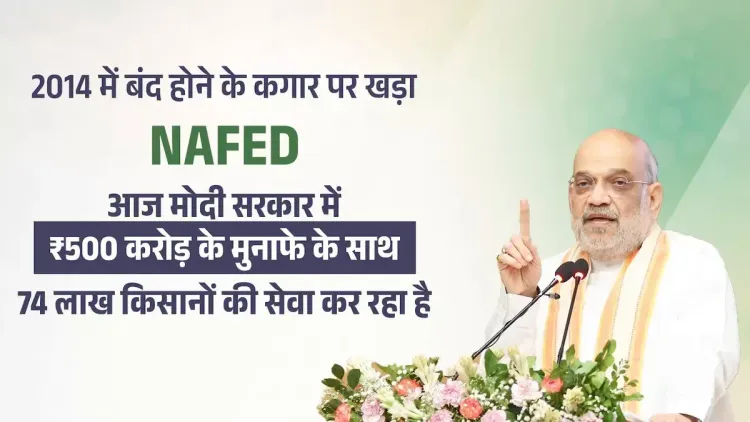
Union Home Minister Amit Shah on Tuesday, 23 June 2026 highlighted the turnaround of the National Agricultural Cooperative Marketing Federation of India (NAFED), stating that the apex cooperative body — which was on the verge of closure in 2014 — is today generating a profit of ₹500 crore and serving 74 lakh farmers under the Modi government.
Shah posted in Hindi on X: '2014 mein band hone ke kagaar par khada NAFED aaj Modi sarkar mein ₹500 crore ke munaafe ke saath 74 lakh kisaanon ki seva kar raha hai' — translating to: 'NAFED, which was on the verge of shutting down in 2014, is today serving 74 lakh farmers with a profit of ₹500 crore under the Modi government.'
Context
NAFED, established in 1958, is India's apex body for cooperative marketing and procurement of agricultural produce. By the early 2010s, the federation had accumulated significant financial stress and was widely reported to be in a precarious operational state. The claim that it was 'on the verge of closure in 2014' anchors Shah's narrative of institutional revival under the current dispensation.
Shah, who holds the portfolio of Minister of Cooperation in addition to his role as Home Minister, has been the central figure in the government's push to revitalise India's cooperative sector since the Ministry of Cooperation was created in July 2021 — the first dedicated central ministry for the sector.
Policy Backdrop
Since 2014, the central government has pursued a series of reforms aimed at improving the financial health and operational reach of agricultural cooperatives. These include procurement support, digitisation drives, and expanded market linkages for small and marginal farmers. The creation of the Ministry of Cooperation in 2021 marked a structural escalation of this approach, bringing cooperatives under direct and focused ministerial oversight for the first time.
NAFED plays a critical role in the government's price support operations, procuring commodities such as pulses, oilseeds, and onions directly from farmers at minimum support prices. Its financial recovery, as claimed by Shah, would represent a significant turnaround for an institution that is central to India's agricultural safety net.
Stakeholders and Impact
The 74 lakh farmers figure cited by Shah underscores the scale at which NAFED now operates, positioning it as a key vehicle for integrating small producers into organised agricultural supply chains. Cooperative farming societies and state-level agricultural marketing bodies that interface with NAFED would also stand to benefit from a financially stable apex body.
For the broader cooperative movement, a profitable and operationally robust NAFED signals that the institutional model can be commercially viable while fulfilling its social mandate — an argument the Ministry of Cooperation has consistently advanced as it pushes for reforms across thousands of primary agricultural credit societies and multi-state cooperatives.
What's Next
Parliamentary deliberations on the Cooperative Sector Development agenda are expected to continue in the coming sessions, with the Ministry of Cooperation likely to table new procurement and marketing guidelines in the next fiscal cycle. Shah's post signals that the government intends to showcase NAFED's recovery as a flagship example of cooperative-sector governance ahead of upcoming political and legislative milestones.
Whether NAFED's reported turnaround translates into sustained structural reform — or remains contingent on government procurement mandates — will be closely watched by agricultural economists and cooperative sector stakeholders alike.
Point of View
Shah has a direct stake in projecting cooperative institutions as success stories, and NAFED's scale of farmer outreach makes it an ideal vehicle for that message. The timing suggests the government is building a pre-legislative or pre-election record on cooperative sector reform. The broader arc points to a sustained BJP strategy of using cooperative institutions — historically associated with regional parties and state-level politics — as instruments of central policy consolidation.
NationPress
22 Sept 2026
Frequently Asked Questions
What is NAFED and why is it in the news?
NAFED, or the National Agricultural Cooperative Marketing Federation of India, is the country's apex cooperative body for agricultural procurement and marketing, founded in 1958. It is in the news after Union Home Minister Amit Shah claimed it has turned profitable with a ₹500 crore surplus and is now serving 74 lakh farmers under the Modi government.
Was NAFED really going to shut down in 2014?
Amit Shah has stated that NAFED was 'on the verge of closure' in 2014, referring to the severe financial stress the federation had accumulated by that period. The government has credited its policy interventions since 2014 with reversing this trajectory.
What is the Ministry of Cooperation and what does it do?
The Ministry of Cooperation is a central government ministry created in July 2021, with Amit Shah as its minister. It was established to provide focused policy attention to India's cooperative sector, covering agricultural marketing, credit societies, and multi-state cooperatives.
How many farmers does NAFED serve in 2026?
According to Amit Shah's post on 23 June 2026, NAFED is currently serving 74 lakh farmers across India.
What role does NAFED play in farmer support?
NAFED conducts minimum support price procurement operations for commodities such as pulses, oilseeds, and onions, directly purchasing produce from farmers to protect them from market price volatility. It also facilitates cooperative marketing linkages for small and marginal producers.