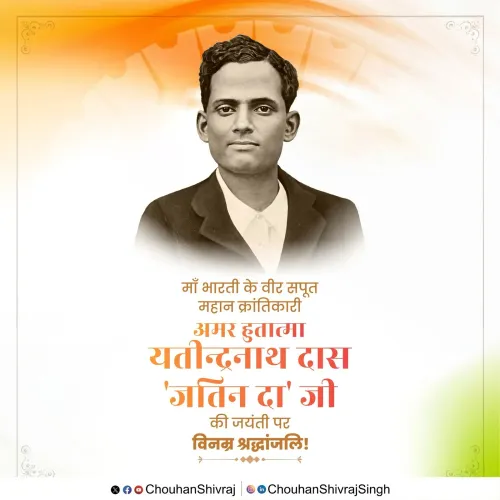
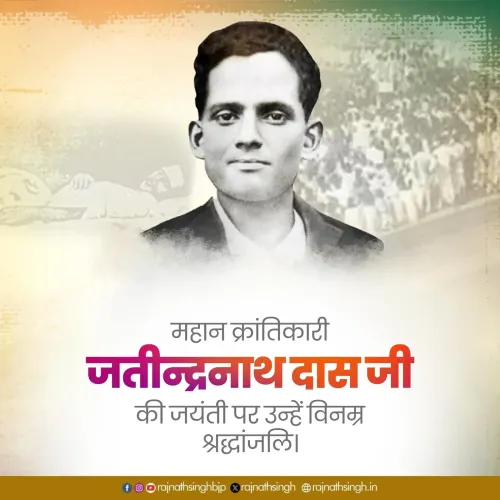
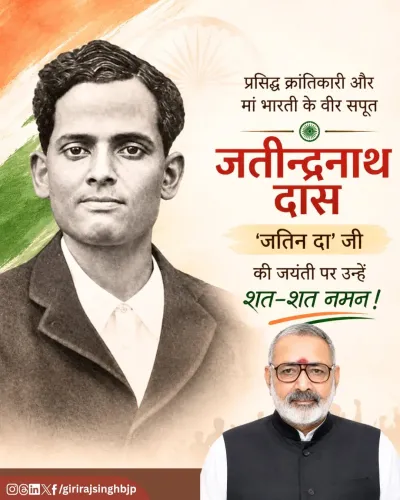
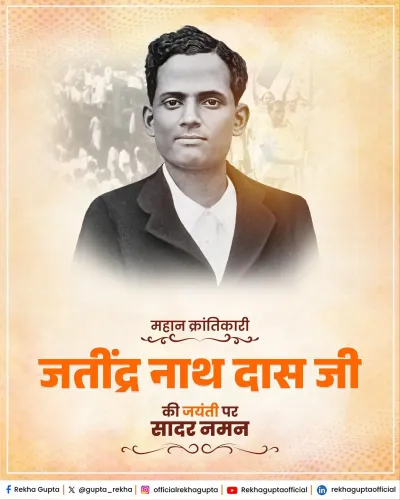
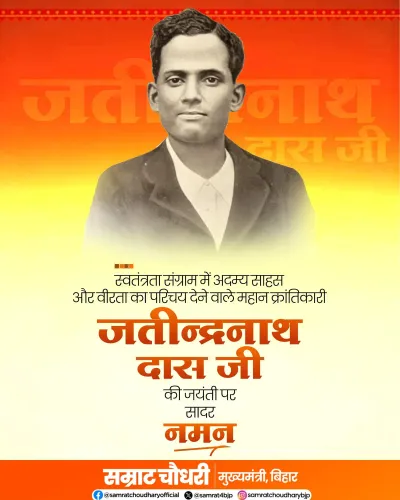
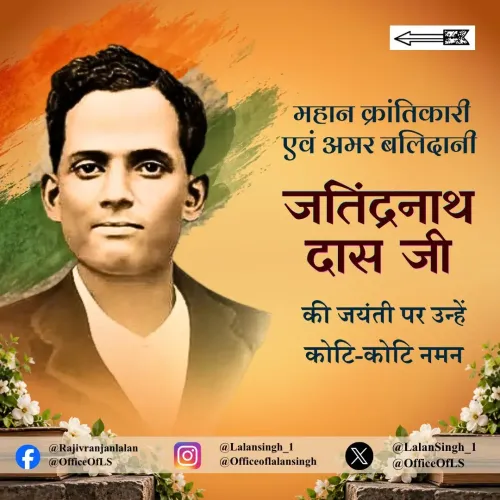
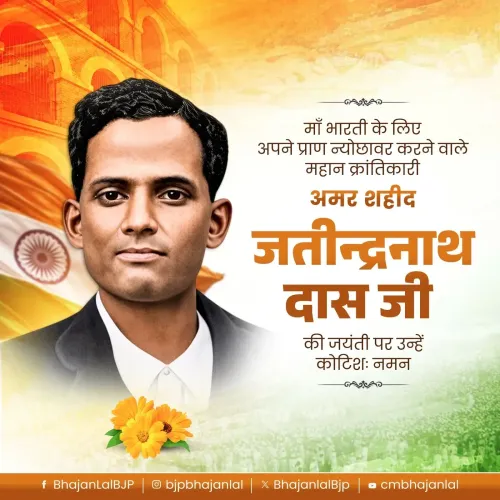
Amit Shah pays tribute to revolutionary Jatindranath Das on jayanti
Synopsis
Union Home Minister Amit Shah paid tribute on 27 October 2026 to revolutionary Jatindranath Das on his birth anniversary, honouring the leader who died after a 63-day hunger strike in Lahore Central Jail in 1929 protesting discrimination against Indian political prisoners.
Key Takeaways
Amit Shah posted a bilingual tribute in Hindi and Bengali on 27 October 2026 for revolutionary Jatindranath Das's birth anniversary.
Das died on 13 September 1929 in Lahore Central Jail after a 63-day hunger strike protesting discriminatory treatment of Indian political prisoners.
Das joined the independence movement as a student and was associated with the Anushilan Samiti and HSRA revolutionary circles.
Shah described Das's 'indomitable courage, sacrifice, and martyrdom' as a lasting inspiration for national service.
The tribute is part of BJP leadership's sustained pattern of honouring armed-resistance figures alongside the mainstream independence narrative.
A young student who walked into the independence movement and never walked out — Jatindranath Das gave his last breath not on a battlefield but on a prison floor, after 63 days of hunger strike that the British Empire could neither break nor ignore. On his birth anniversary on Tuesday, 27 October 2026, Union Home Minister Amit Shah paid solemn tribute to the revolutionary, calling his sacrifice an eternal source of inspiration for the nation.
Sixty-three days that shook Lahore Central Jail
Posting in both Hindi and Bengali — a deliberate linguistic choice that signals the all-India sweep of Das's legacy — Shah wrote: 'Maa Bharati ki swatantrata ke liye apna jeevan samarpit karne wale mahan krantikari Jatindranath Das ji ki jayanti par unhe naman.' ('On the birth anniversary of the great revolutionary Jatindranath Das, who devoted his life to the freedom of Mother India, I bow to him.')
The tribute recalls how Das, having plunged into the freedom struggle from his student years, organised youth and 'ignited the flame of revolution in their hearts.' When jailed, he refused to accept the discriminatory treatment meted out to Indian political prisoners by British authorities, launching a hunger strike that lasted 63 days. He died on 13 September 1929 in Lahore Central Jail — his body exhausted, his resolve intact.
Student organiser, HSRA comrade, martyr
Das was closely associated with the Anushilan Samiti and the revolutionary circles that also produced Bhagat Singh. His hunger strike was not a solo act of desperation — it was a coordinated protest by political prisoners demanding equal treatment, and Das became its most visible, and ultimately fatal, symbol. His death sent shockwaves through the subcontinent and turned him into an icon of non-violent resistance within an armed-resistance movement — a paradox that has only deepened his historical resonance.
Shah's tribute underscores that Das's 'indomitable courage, sacrifice, and martyrdom will forever inspire the people of this country toward national service.'
BJP's steady reclamation of revolutionary memory
Union ministers and BJP leaders have made it a consistent practice to mark the jayantis and death anniversaries of revolutionary figures — Das, Bhagat Singh, Chandrashekhar Azad — on social media. The pattern is deliberate: it places armed-resistance narratives at the centre of India's independence story, alongside and sometimes in contrast to the mainstream Congress-led nonviolent movement. Das's Bengali roots also make this tribute politically resonant in West Bengal, where the memory of revolutionary martyrs carries deep cultural weight.
Point of View
The Home Minister frames the BJP as the natural inheritor of the armed-resistance strand of India's freedom struggle. This is part of a broader, long-running project by BJP leadership to position the party's nationalist ideology within a lineage of revolutionary sacrifice that predates and runs parallel to the Congress-led movement.
NationPress
27 Oct 2026
Frequently Asked Questions
Who was Jatindranath Das?
Jatindranath Das was an Indian revolutionary freedom fighter associated with the Anushilan Samiti and HSRA circles. He died on 13 September 1929 in Lahore Central Jail after a 63-day hunger strike protesting the discriminatory treatment of Indian political prisoners by British authorities.
Why did Jatindranath Das go on hunger strike?
Das launched a hunger strike inside Lahore Central Jail to protest the racial discrimination and inhumane conditions imposed on Indian political prisoners by the British colonial administration. He maintained the fast for 63 days and died as a result.
When is Jatindranath Das's birth anniversary?
Jatindranath Das's birth anniversary, known as his jayanti, falls on 27 October. Union Home Minister Amit Shah paid tribute to him on this day in 2026.
Why did Amit Shah post the tribute in Bengali as well as Hindi?
Jatindranath Das had Bengali roots and is a celebrated figure in Bengal's revolutionary tradition. Amit Shah posted the tribute bilingually to acknowledge Das's regional significance and to reach Bengali-speaking audiences across India, particularly in West Bengal.
What was Jatindranath Das's connection to Bhagat Singh?
Jatindranath Das moved in the same revolutionary circles as Bhagat Singh, both being associated with the Hindustan Socialist Republican Association and its allied networks. Their shared imprisonment in Lahore connected their legacies closely.