Amit Shah Reviews Gujarat Law-Order, Flags Coastal Security
Synopsis
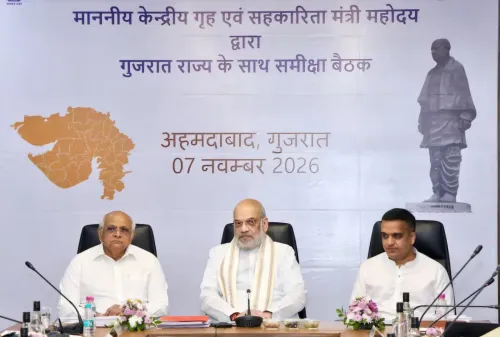
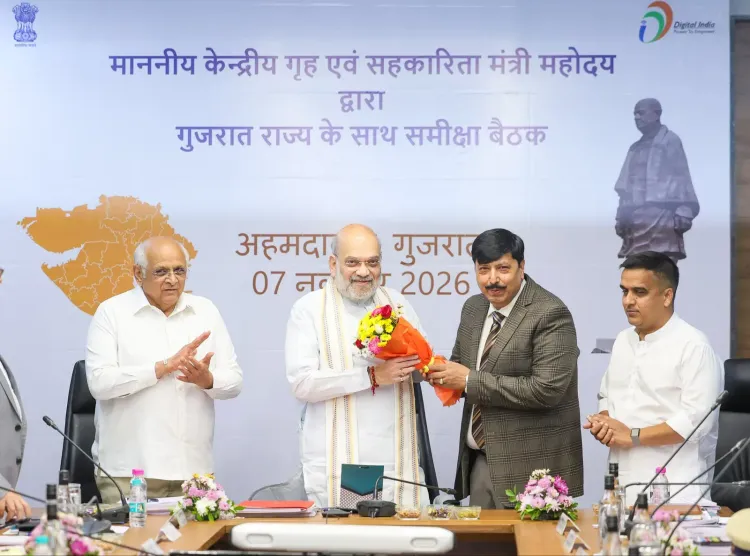
Union Home Minister Amit Shah chaired a law-and-order review in Ahmedabad with Gujarat CM Bhupendra Patel and Deputy CM Harsh Sanghavi, highlighting 92% charge-sheet filing within 60 days under the new criminal codes and the deportation of 2,412 illegal foreign nationals, while directing joint coastal surveillance and drug-network crackdowns.
Key Takeaways
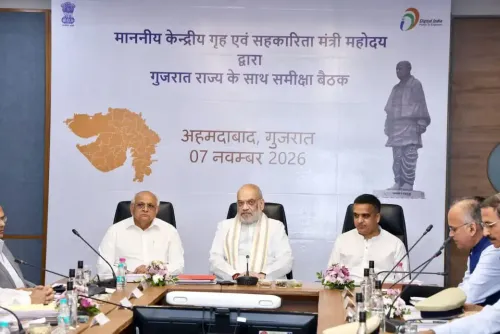
Amit Shah held a law-and-order review in Ahmedabad with Gujarat CM Bhupendra Patel and Deputy CM Harsh Sanghavi .
Gujarat filed 92% of charge sheets within 60 days of the new criminal codes taking effect from 1 July 2024 .
2,412 illegal foreign nationals have been deported since the new laws were implemented.
Shah directed central and state agencies to jointly strengthen coastal surveillance along Gujarat's western seaboard.
The 'Nasha Mukt Gujarat' anti-drug campaign was flagged for intensified, coordinated inter-agency action.
The meeting is part of the Centre's rolling, metric-driven state-by-state review of Bharatiya Nyaya Sanhita implementation.
Two thousand four hundred and twelve illegal foreign nationals deported, 92% of charge sheets filed within 60 days of new criminal laws taking effect — Union Home Minister Amit Shah arrived in Ahmedabad on Saturday to take stock of Gujarat's internal security and came away with numbers that the Centre wants every state to match.
What the Ahmedabad review room heard
The high-level meeting brought together Gujarat Chief Minister Bhupendra Patel and Deputy Chief Minister Harsh Sanghavi — who holds the home portfolio — alongside senior state and central officials. Shah reviewed the state's performance across law and order, coastal surveillance, and narcotics interdiction. His post on X, written in Hindi, called Gujarat's record under the new laws 'outstanding' (उत्कृष्ट प्रदर्शन).
The headline metrics: since the three new criminal codes — the Bharatiya Nyaya Sanhita, the Bharatiya Nagarik Suraksha Sanhita, and the Bharatiya Sakshya Adhiniyam — replaced the colonial-era IPC, CrPC, and Evidence Act from 1 July 2024, Gujarat has filed 92% of charge sheets within 60 days, one of the tightest compliance windows the new codes demand. Alongside that, 2,412 undocumented foreign nationals have been deported — a figure Shah cited as a marker of the state's enforcement tempo.
Why Gujarat's western coastline is always on the agenda
Gujarat shares a long maritime boundary with Pakistan and sits at the centre of the western seaboard's narcotics trafficking routes. That geography makes coastal surveillance a standing item in every Centre-state security conversation involving the state. Shah's directive from the meeting was pointed: central and state agencies must work together to 'strengthen coastal surveillance, strike drug networks, and realise the resolve of a drug-free Gujarat' (नशामुक्त गुजरात के संकल्प को साकार करें).
The 'Nasha Mukt Gujarat' (Drug-Free Gujarat) campaign has been a state-level initiative since at least 2018, but Saturday's review signals that the Centre wants the campaign to move from rhetoric to measurable interdiction results — with joint agency operations rather than parallel efforts.
The new criminal laws' first real performance test
The Bharatiya Nyaya Sanhita trio, passed by Parliament in 2023 and enforced nationwide from July 2024, introduced strict timelines for investigations and charge-sheet filings that were absent in the old IPC framework. Gujarat's 92% compliance rate — if sustained — positions the state as a benchmark the Home Ministry can point to as it monitors implementation across all 28 states and 8 union territories. The Centre has been conducting rolling state-by-state reviews, and Saturday's Ahmedabad session fits that pattern squarely.
The meeting also underlines a structural shift in how New Delhi manages internal security: rather than waiting for annual reports, the Home Ministry is running real-time, metric-driven reviews that put chief ministers and their home departments on notice. Gujarat, given its border geography and port exposure, is an early and prominent case study in whether that model delivers.
The next signal to watch: whether a joint Centre-state coastal exercise is announced in the coming weeks, and how other western-seaboard states measure up when their own reviews are held.
Point of View
With state-by-state compliance metrics creating a public performance ladder. Gujarat's coastal geography and proximity to Pakistan make it a high-stakes test case for the Centre's integrated security model. By publicly citing the 92% charge-sheet and deportation figures, Shah is simultaneously rewarding Gujarat's compliance and setting a benchmark that other states will be measured against. The dual emphasis on coastal surveillance and drug interdiction also signals that the Centre views narcotics trafficking through western sea routes as a national-security issue, not merely a law-enforcement one.
NationPress
8 Nov 2026
Frequently Asked Questions
Why did Amit Shah visit Ahmedabad for a security review?
Amit Shah visited Ahmedabad to chair a high-level review of Gujarat's law-and-order situation and internal security, including progress under the new criminal laws, coastal surveillance, and anti-drug operations, alongside Chief Minister Bhupendra Patel and Deputy Chief Minister Harsh Sanghavi.
What are the new criminal laws Shah mentioned?
The new criminal laws are the Bharatiya Nyaya Sanhita, Bharatiya Nagarik Suraksha Sanhita, and Bharatiya Sakshya Adhiniyam, which replaced the IPC, CrPC, and Evidence Act respectively and came into force on 1 July 2024.
What is Gujarat's charge-sheet compliance rate under the new criminal codes?
According to Amit Shah's post, Gujarat has filed 92% of charge sheets within 60 days of the new criminal laws taking effect, which the Home Minister described as outstanding performance.
How many illegal foreign nationals has Gujarat deported?
Shah stated that Gujarat has deported 2,412 undocumented foreign nationals since the new criminal laws were implemented.
What is the Nasha Mukt Gujarat campaign?
Nasha Mukt Gujarat, meaning 'Drug-Free Gujarat,' is a state-level anti-narcotics initiative running since at least 2018. Shah's Saturday review directed central and state agencies to work jointly to intensify drug-network crackdowns and achieve the campaign's goals.