Anurag Thakur Hails Two HP Scientists in Stanford Top 2% List
Synopsis
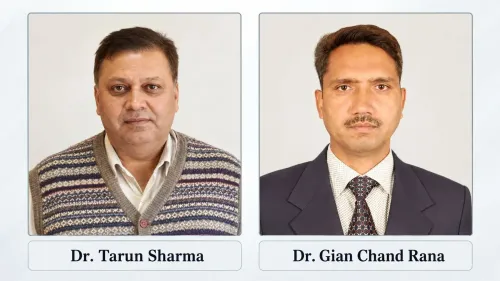
BJP MP Anurag Thakur celebrated two Himachal Pradesh scientists — Dr. Tarun Sharma of HP University and Dr. Gian Chand Rana of Govt Degree College Dhaneta — for featuring in the 2026 Stanford-Elsevier World's Top 2% Scientists ranking, with Rana hailing from Thakur's own constituency of Nadaun in Hamirpur.
Key Takeaways
Tarun Sharma of Himachal Pradesh University and Dr.
Gian Chand Rana of Government Degree College, Dhaneta have been named in the 2026 Stanford-Elsevier World's Top 2% Scientists ranking.
The ranking is based on Scopus citation data and measures scientific impact by field and career stage.
Sharma specialises in silicon photonics, nanophotonics and AI-driven photonics ; Dr.
Rana works in fluid dynamics and mechanical engineering .
Gian Chand Rana is from Nadaun , part of BJP MP Anurag Thakur's Hamirpur constituency in Himachal Pradesh.
Both recognitions highlight the geographic spread of India's growing research output beyond elite central institutions.
Two scientists from Himachal Pradesh have earned a place among the world's most-cited researchers — and BJP MP Anurag Thakur made sure the achievement did not pass without notice. On Saturday, 17 October 2026, Thakur took to X to congratulate Dr. Tarun Sharma of Himachal Pradesh University and Dr. Gian Chand Rana, Principal of Government Degree College, Dhaneta, on being named in the 2026 Stanford–Elsevier World's Top 2% Scientists ranking.
A global citation benchmark, and what it measures
The Stanford–Elsevier ranking is compiled annually using Scopus citation data, identifying the top 2% of scientists worldwide by both field-specific impact and career-stage performance. Selection is driven entirely by scientific output and citation counts — not nominations or peer votes — making it one of the more objective global yardsticks for research influence.
Dr. Sharma's work spans silicon photonics, nanophotonics and AI-driven photonics — areas sitting at the intersection of materials science and next-generation computing. Dr. Rana's research focuses on fluid dynamics and mechanical engineering, disciplines that underpin everything from aerospace design to industrial cooling systems. Both fields are active global research fronts, which makes citation-level recognition in them particularly meaningful.
Why Nadaun's name appeared in Thakur's post
Thakur was especially pointed about Dr. Rana's roots: 'It is a matter of immense pride that Dr. Gian Chand Rana hails from my constituency, Nadaun, in Hamirpur, Himachal Pradesh.' Nadaun is an assembly segment within the Hamirpur Lok Sabha constituency that Thakur has represented for several terms. Calling out the local connection is deliberate — it anchors a global ranking to a specific town, making the achievement legible and motivating for students in the Hamirpur belt.
Himachal Pradesh's scientists on a wider map
India's presence in global citation-based rankings has grown steadily over the past decade, but that growth has historically been concentrated in central elite institutions. Recognition of faculty from a state university in Shimla and a government degree college in Dhaneta signals something different: research output spreading into smaller, regional institutions that rarely make international lists. It is the kind of data point that state education planners watch when arguing for research infrastructure budgets in the annual cycle.
Thakur closed his post with a forward-looking note — 'May their work continue to advance knowledge, innovation and scientific progress' — framing the recognition not as a finish line but as momentum to build on.
For aspiring researchers in the hills of Himachal Pradesh, two names on a global list are now proof that world-class science does not require a passport to a metropolitan campus.
Point of View
Rather than from IITs or IISc, is the genuinely significant detail: it suggests India's research base is widening geographically. If state governments read these signals and direct research infrastructure spending toward smaller colleges, the trend could be self-reinforcing. For now, the ranking gives Himachal Pradesh a rare, citation-backed data point in the national science conversation.
NationPress
17 Oct 2026
Frequently Asked Questions
What is the Stanford-Elsevier World's Top 2% Scientists ranking?
It is an annual global list compiled using Scopus citation data that identifies the top 2% of scientists worldwide, ranked by field-specific citation impact across both single-year and career-long metrics.
Who are Dr. Tarun Sharma and Dr. Gian Chand Rana?
Dr. Tarun Sharma is a researcher at Himachal Pradesh University working in silicon photonics, nanophotonics and AI-driven photonics. Dr. Gian Chand Rana is the Principal of Government Degree College, Dhaneta, known for research in fluid dynamics and mechanical engineering.
Why did Anurag Thakur specifically mention Nadaun in his post?
Nadaun is an assembly constituency within Thakur's Hamirpur Lok Sabha seat. Dr. Gian Chand Rana hails from Nadaun, so Thakur highlighted the local connection to celebrate the achievement within his constituency.
Where is Himachal Pradesh University located?
Himachal Pradesh University is a state university based in Shimla, offering postgraduate and research programmes across sciences and humanities.
What does India's inclusion in the Stanford-Elsevier ranking say about Indian science?
India's representation in the ranking has grown over the past decade, and recognition of researchers from state institutions in smaller states signals that high-quality research output is spreading beyond elite central universities to regional colleges.