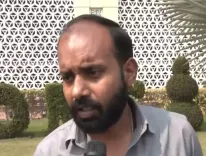
Anurag Thakur slams Rahul Gandhi over remarks on Indian economy abroad

Synopsis
BJP MP Anurag Thakur accused Rahul Gandhi of making a 'petty attempt' to demean India from foreign soil over remarks on the economy, calling Gandhi's words a path of 'fear, confusion and lies' with no truth — ahead of Parliament's Winter Session.
Key Takeaways
BJP MP Anurag Thakur posted a sharp attack on Rahul Gandhi on November 18, 2026 , over remarks Gandhi made about the Indian economy during an overseas visit.
Thakur accused Gandhi of making a 'petty attempt' to demean India from foreign soil and called his statement a reflection of 'ignorance and shallowness.' He charged Gandhi with pursuing a strategy of 'bhay, bhram aur jhooth' (fear, confusion and lies) to push India toward anarchy and distrust.
Thakur ended with a rhetorical question: 'Why do you have so much hatred for India's journey of progress?' The attack comes ahead of Parliament's Winter Session , where economic indicators are expected to be a key flashpoint between the ruling BJP and the Congress-led opposition.
Congress had not issued a formal response at the time of publication.
A sharp political volley landed on Wednesday, November 18, 2026, when BJP MP Anurag Thakur accused Congress leader Rahul Gandhi of once again attempting to diminish India's standing from foreign soil — this time over remarks Gandhi made about the Indian economy during an overseas visit.
Thakur pulled no punches in his post on X, writing: 'राहुल गांधी जी ने एक बार फिर विदेशी सरजमीं से भारत को नीचा दिखाने का ओछा प्रयास किया है' — ('Rahul Gandhi has once again made a petty attempt to demean India from foreign soil'). He said Gandhi's statement on the Indian economy exposed what he called his 'ignorance and shallowness.'
The charge: 'Fear, confusion and lies'
Thakur framed Gandhi's remarks not as legitimate opposition but as a deliberate strategy to push the country toward 'anarchy and distrust.' His exact words accused the Congress leader of walking a path of 'bhay, bhram aur jhooth' — fear, confusion and lies — and of harbouring inexplicable hostility toward India's development journey.
The post closed with a pointed rhetorical question directed at Gandhi: 'After all, why do you have so much hatred for India's journey of progress?' It is a framing Thakur and other senior BJP leaders have used repeatedly when Gandhi has spoken critically about the economy, unemployment, or inequality during foreign engagements.
A recurring BJP playbook on 'foreign soil' criticism
Anurag Thakur, who served as Union Minister for Information & Broadcasting and Youth Affairs & Sports before transitioning to the backbenches, has been one of the BJP's most vocal critics of Gandhi. He represents Hamirpur constituency in Himachal Pradesh and has long functioned as a frontline party spokesperson on political attacks.
The 'foreign soil' accusation is a well-worn instrument in Indian political discourse. Ruling-party MPs routinely invoke it when opposition leaders speak to international audiences about domestic economic or governance concerns — framing such commentary as a betrayal of national interest rather than democratic accountability. The charge carries particular sting in an era of heightened economic nationalism.
Winter session backdrop
The timing is notable. India's Parliament Winter Session is approaching, and economic indicators — growth numbers, employment data, inflation — are expected to dominate floor debates. Gandhi's overseas remarks, whatever their precise content, have handed the BJP an early opening salvo, and Thakur's post signals the party intends to use them aggressively heading into that session.
Congress has not yet issued a formal response to Thakur's broadside. When it does, the exchange is likely to spill from social media directly onto the floor of the Lok Sabha. The Indian economy's narrative — who owns it, who damages it, and who speaks for it abroad — will be the battlefield all winter.
Point of View
The ruling party reframes the story as one of national betrayal rather than policy disagreement — shifting the debate from data to patriotism. This move is particularly effective heading into a Winter Session where Congress is expected to press hard on unemployment and growth figures. By putting Gandhi on the defensive over his 'foreign soil' remarks before Parliament convenes, the BJP attempts to frame him as a hostile actor rather than a legitimate critic. Whether Congress can pivot back to the economic substance will define the early tone of the session.
NationPress
18 Nov 2026
Frequently Asked Questions
What did Anurag Thakur say about Rahul Gandhi?
BJP MP Anurag Thakur accused Rahul Gandhi of making a 'petty attempt' to demean India from foreign soil over remarks on the Indian economy, calling Gandhi's statement a reflection of 'ignorance and shallowness' and claiming it had no truth whatsoever.
What remarks did Rahul Gandhi make about the Indian economy?
The specific content of Rahul Gandhi's overseas remarks has not been detailed in the public domain at this time. Thakur's post refers to a statement Gandhi made about the Indian economy during a foreign visit, but does not quote it directly.
Why do BJP leaders criticise opposition speeches made abroad?
BJP leaders frequently invoke the 'foreign soil' argument to frame opposition criticism of India's economy or governance as harmful to national interest and image, turning a policy debate into a question of patriotism — a strategy that has been used across multiple election cycles.
Who is Anurag Thakur?
Anurag Thakur is a BJP Lok Sabha MP from Hamirpur, Himachal Pradesh. He previously served as Union Minister for Information and Broadcasting and for Youth Affairs and Sports, and is a prominent party spokesperson on political affairs.
Will this row come up in Parliament's Winter Session?
It is likely. Economic indicators and opposition critiques of government performance are expected to be central flashpoints in the Winter Session, and Thakur's public attack signals the BJP intends to use Gandhi's overseas remarks as an early talking point on the floor.