Is Punjab CM Failing on Water Crisis? Union Minister's Response to Raghav Chadha
Click to start listening
Synopsis
Tensions rise in Parliament as Union Minister Bhupender Yadav questions AAP's Raghav Chadha over Punjab's water crisis, suggesting it's a state issue. Chadha invokes Guru Nanak’s wisdom while warning of serious health risks from pollution, calling for urgent action and support for Punjab—once the nation's agricultural hero.
Key Takeaways
- Punjab's water crisis is a significant issue.
- Political accountability is questioned amid rising pollution levels.
- Chadha's warnings about uranium contamination highlight urgent health risks.
- Both leaders emphasize the need for collaborative solutions.
- The historical role of Punjab in agriculture adds to the gravity of the situation.
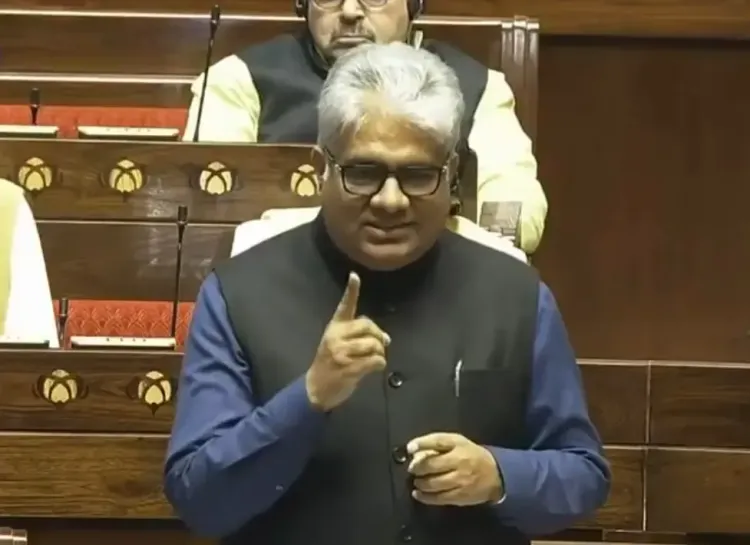
New Delhi, Dec 3 (NationPress) Union Environment and Forest Minister Bhupender Yadav took a swipe at AAP Rajya Sabha member Raghav Chadha on Wednesday regarding the pressing issue of Punjab's water crisis. Yadav highlighted that the concern raised by Chadha involves a situation managed by the state government of his own political party.
While the treasury benches erupted in applause, Yadav remarked, “Did Raghav Chadha speak the truth, or is he upset with the Chief Minister?”
The Union Minister emphasized that Punjab has not adequately tackled disease and pollution issues.
“Punjab has faltered in protecting subjects under the State List. We are aware of the dangers posed by land pollution; we have issued multiple notices. This remains a major challenge that the state government must address,” he stated.
Earlier, while contributing to a debate on a water pollution amendment, Raghav Chadha referenced the teachings of Guru Nanak Dev Ji.
“Air is the Guru, water the father, and earth the mother,” Chadha expressed.
He reminded the assembly that Punjab, known as the land of five rivers – Panj plus Aab – is facing a dire water crisis in both quality and quantity.
“Once, when the nation was in need, Punjab spearheaded the Green Revolution. When India required grain, Punjab provided it. However, this hero is now suffering. Farmers, while serving the nation, resorted to chemical fertilizers and excessive water usage, leading to toxic water and a depleted water table. This is not the farmers’ fault; it is the price of feeding India,” he remarked.
Chadha issued a grave warning, citing the Union government’s upcoming 2025 Groundwater Quality Report which identifies Punjab as the state most severely impacted by uranium contamination.
“Uranium is no ordinary metal; it is radioactive and poses serious health risks, including kidney damage and cancer. Recent post-monsoon tests reveal 62.5% exceed safe limits for uranium, with arsenic, lead, cadmium, and chromium also surpassing WHO standards in regions like Malwa, Bathinda, Mansa, and others,” he reported.
Chadha asserted that Punjab seeks justice, not charity, highlighting its role as the backbone of India’s food security for the past fifty years.
“Today, the nation must support Punjab,” he urged.
He concluded by proposing a Punjab Water Restoration Mission, aimed at implementing continuous digital monitoring of industrial discharges.
“Utilize ecological engineering to revitalize rivers. Ensure safe drinking water for everyone. Independent foreign audits must be implemented for accountability,” he stated.
Yadav’s remarks followed a debate on a “Statutory Resolution” he had introduced, which sought the adoption of the Water (Prevention and Control of Pollution) Amendment Act, 2024, aimed at decriminalizing minor offenses for Manipur.
With President’s Rule enforced in Manipur since February 13, 2025, the resolution would extend the Amendment Act to Manipur upon its passage.
Point of View
This discourse highlights the pressing issue of water pollution in Punjab and the political dynamics at play. While both leaders present valid points, the focus should remain on collaborative efforts for sustainable solutions that prioritize public health and environmental integrity.
NationPress
03/12/2025
Frequently Asked Questions
What is the main issue discussed between Bhupender Yadav and Raghav Chadha?
The main issue is the severe water crisis in Punjab, with Yadav questioning Chadha's concerns, which he argues are the responsibility of the state government led by AAP.
What alarming statistics did Raghav Chadha present?
Chadha highlighted that 62.5% of post-monsoon water samples in Punjab exceeded safe limits for uranium, along with other pollutants surpassing WHO thresholds.
What solution did Chadha propose?
Chadha proposed launching a Punjab Water Restoration Mission that would include digital monitoring of industrial discharge and ecological engineering to revitalize rivers.
How did Yadav respond to Chadha's concerns?
Yadav pointed out that the Punjab government has failed in managing pollution and health issues, suggesting that Chadha's criticisms might stem from dissatisfaction with his party's leadership.
What historical significance does Punjab hold in India's agriculture?
Punjab is known as the land of five rivers and was pivotal in launching the Green Revolution, positioning itself as a major contributor to India's food security over the decades.