Assam Budget 2026: ₹1,789 Cr Allocated for Agriculture
Synopsis
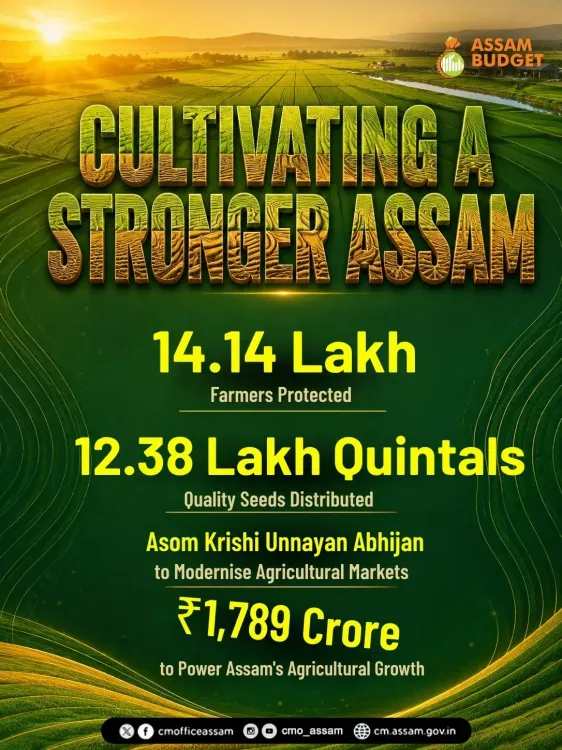
Assam's Chief Minister's Office has announced key agricultural highlights from Budget 2026, including a ₹1,789 crore allocation, protection of 14.14 lakh farmers over five years, distribution of 12.38 lakh quintals of quality seeds, and approval of the Asom Krishi Unnayan Abhijan to modernise agricultural markets.
Key Takeaways
₹1,789 crore has been allocated in Assam Budget 2026 to drive agricultural growth across the state.
14.14 lakh farmers have been protected through state-backed interventions over the last five years.
12.38 lakh quintals of quality seeds were distributed to farmers during the same period.
The Asom Krishi Unnayan Abhijan has been approved to modernise agricultural markets and supply chains in Assam .
The announcements build on earlier initiatives including the APART project and national PM-KISAN coverage.
Chief Minister Himanta Biswa Sarma was directly tagged in the post, signalling top-level political ownership of the agriculture agenda.
The Chief Minister's Office of Assam on Saturday, 11 July 2026, announced key agricultural highlights from Assam Budget 2026, underscoring the state government's sustained push to strengthen farmer welfare and modernise the rural economy. The post, shared under the hashtag #AssamBudget2026, outlined a cluster of achievements and fresh allocations aimed at transforming Assam's agriculture sector.
Context
The announcement details four headline deliverables from the budget. According to the post, 14.14 lakh farmers have been protected over the last five years through state-backed interventions. In the same period, 12.38 lakh quintals of quality seeds were distributed to cultivators across the state. A new scheme, the Asom Krishi Unnayan Abhijan, has been approved to modernise agricultural markets and supply chains. Capping the package, a budgetary allocation of ₹1,789 crore has been earmarked to power agricultural growth in the state.
The post tagged Chief Minister Himanta Biswa Sarma alongside cabinet colleagues, signalling that the announcements carry direct political ownership at the top of the state government. CM Sarma has led the Assam BJP government since 2021 with agriculture and infrastructure as stated priorities.
Policy Backdrop
Agriculture contributes significantly to Assam's economy, with paddy, tea, and horticulture forming the backbone of rural livelihoods. The state has progressively increased budgetary focus on the sector across successive budgets under the current administration, combining input subsidies, seed distribution, and infrastructure upgrades.
Earlier state-level efforts include the Assam Agribusiness and Rural Transformation Project (APART), launched in 2018 with World Bank assistance to strengthen agricultural value chains. At the national level, the PM-KISAN direct income support scheme, rolled out in 2019, has covered eligible farmers in Assam as well. The newly approved Asom Krishi Unnayan Abhijan is positioned as a state-specific intervention designed to reduce dependence on centrally sponsored programmes by building local market infrastructure.
This trajectory reflects a broader pattern across Northeast India, where state governments are increasingly deploying dedicated agricultural schemes to raise productivity and improve market linkages, aligning with national rural growth priorities.
Stakeholders and Impact
The primary beneficiaries are Assam's small and marginal farmers, who make up the bulk of the agricultural workforce in the state. Seed distribution at the scale cited — 12.38 lakh quintals over five years — is intended to improve crop yields by replacing low-quality planting material with certified varieties.
Rural agricultural markets stand to gain from the Asom Krishi Unnayan Abhijan, which targets supply chain modernisation. If implemented effectively, the scheme could reduce post-harvest losses and improve price realisation for farmers at the farm gate. The ₹1,789 crore allocation provides the fiscal headroom to pursue these objectives across the current budget cycle.
What's Next
Attention will now shift to the detailed operational guidelines and implementation timeline for the Asom Krishi Unnayan Abhijan. Observers will track how quickly the scheme moves from approval to on-ground rollout, particularly the pace of market infrastructure upgrades in rural districts.
Quarterly utilisation certificates for the ₹1,789 crore agriculture allocation will serve as a key indicator of actual spending progress. The degree to which these investments translate into measurable income gains for Assam's farming communities will define the legacy of Budget 2026 for the state's rural economy.
Point of View
789 crore allocation translates into measurable farm-income gains will be the real test of this budget's ambition.
NationPress
10 Oct 2026
Frequently Asked Questions
What is the Asom Krishi Unnayan Abhijan?
The Asom Krishi Unnayan Abhijan is a newly approved state government scheme in Assam designed to modernise agricultural markets and supply chains, reducing post-harvest losses and improving price realisation for farmers.
How much has Assam allocated for agriculture in Budget 2026?
Assam has allocated ₹1,789 crore for agriculture in Budget 2026 to support farmer welfare and drive growth across the sector.
How many farmers have been protected under Assam's schemes in the last five years?
According to the Chief Minister's Office of Assam, 14.14 lakh farmers have been protected through state-backed interventions over the last five years.
What is the significance of seed distribution in Assam's agriculture budget?
The distribution of 12.38 lakh quintals of quality seeds over five years is intended to replace low-quality planting material with certified varieties, improving crop yields for small and marginal farmers.
Who is the Chief Minister of Assam overseeing these agricultural initiatives?
Himanta Biswa Sarma has been the Chief Minister of Assam since 2021 and leads the state government's focus on agriculture, infrastructure, and rural development.