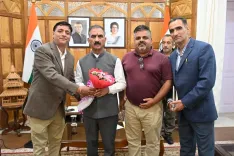
Joshi shares PM Modi's bouquet of India's global achievements
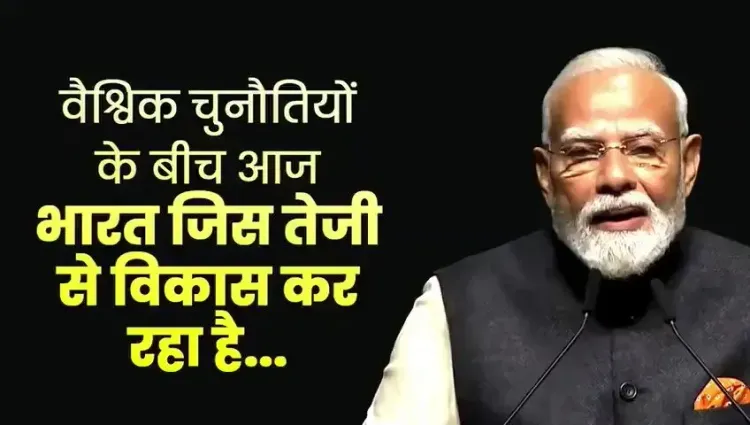
Synopsis
Union Consumer Affairs Minister Pralhad Joshi shared PM Modi's enumeration of India's global rankings on July 11, 2026 — spanning vaccines, dairy, mobile manufacturing, startups, and UPI — framing them as proof of an unprecedented development pace amid global challenges.
Key Takeaways
Minister Pralhad Joshi quoted PM Narendra Modi listing India's global rankings on July 11, 2026 .
India is described as the world's fastest-growing major economy and largest vaccine producer .
India ranks as the second-largest mobile manufacturer , largest milk producer , and second-largest fish producer .
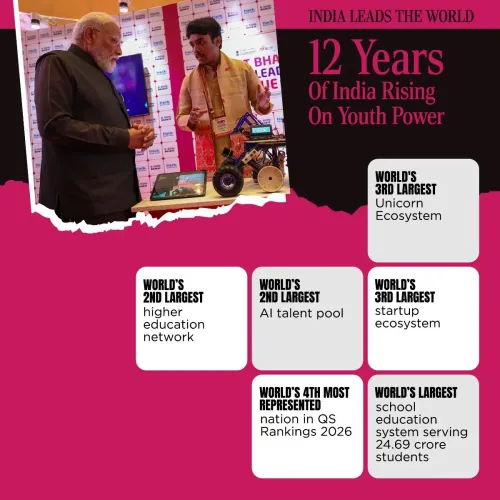
India has become the world's third-largest startup ecosystem and third-largest automobile market .
UPI processes billions of digital transactions monthly, cited as a new global development model.
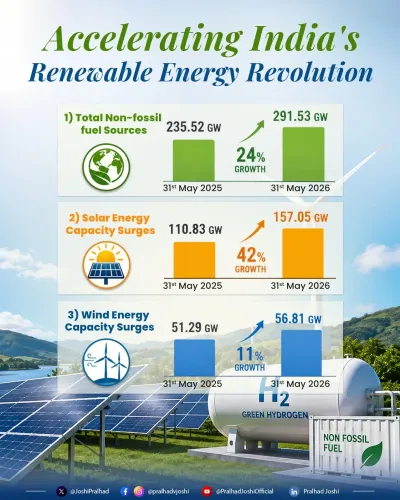
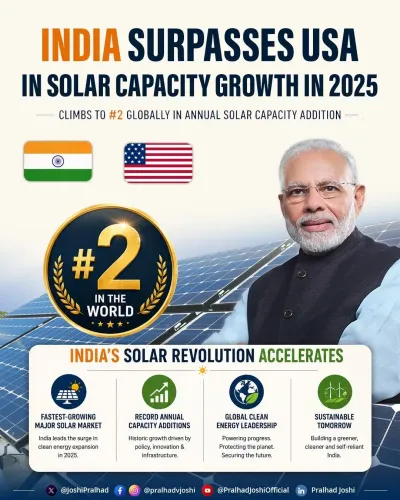
PM Modi indicated India is on track to become the world's third-largest renewable energy producer .
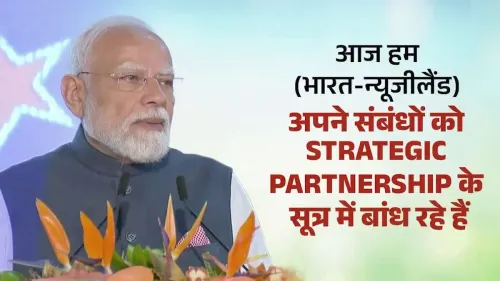
Union Consumer Affairs Minister Pralhad Joshi on Saturday, July 11, 2026, shared a sweeping account of India's economic and technological milestones, quoting Prime Minister Narendra Modi to present what he called 'a bouquet of the nation's achievements and India's capabilities' amid an evolving global landscape.
Context
The post reproduces remarks attributed to PM Modi, describing India as the world's fastest-growing major economy and cataloguing its standing across sectors ranging from vaccines and dairy to mobile manufacturing and digital payments. Modi is quoted as saying, 'Today, billions of digital transactions are happening in India every month through UPI,' and pointing to India's rise in drone technology and the space economy as markers of a new development model being offered to the world.
The enumerated rankings — largest vaccine producer, second-largest mobile manufacturer, largest milk producer, second-largest fish producer, third-largest automobile market, and third-largest startup ecosystem — reflect a consolidated pitch for India's diversified economic footprint on the global stage.
Policy Backdrop
The achievements cited are rooted in a decade-long policy architecture. The Make in India campaign, launched in 2014, positioned India as a global manufacturing destination, while the Digital India programme of 2015 expanded digital infrastructure that underpins today's UPI volumes. Production Linked Incentive (PLI) schemes, rolled out from 2020, directly accelerated mobile-phone manufacturing and pharmaceutical output, including vaccine capacity.
The Startup India initiative, also launched in 2016, helped cultivate an ecosystem that has grown into one of the three largest in the world. The Atmanirbhar Bharat package of 2020 reinforced self-reliance across these sectors, reducing import dependence at a time of global supply-chain disruption.
On renewable energy, PM Modi is quoted as saying India 'is soon going to become the world's third largest renewable energy producer' — a forward-looking target consistent with the government's stated clean-energy ambitions, though specific timelines remain subject to ongoing capacity additions.
Stakeholders and Impact
The breadth of sectors mentioned signals that the government's messaging is directed at multiple constituencies simultaneously: dairy farmers and fisheries workers in rural India, mobile manufacturers and startup founders in urban and peri-urban centres, and renewable energy developers and digital payment users across the economy. India's UPI platform, operated by the National Payments Corporation of India (NPCI) since 2016, now processes billions of transactions monthly, making it one of the most cited examples of India's digital public infrastructure model.
Internationally, the composite ranking narrative reinforces India's positioning as a diversified alternative in global supply chains — a pitch that carries weight amid ongoing geopolitical realignments affecting trade and investment flows.
What's Next
Analysts and industry observers will watch upcoming Union Budget allocations for extensions of PLI schemes and renewable energy targets as concrete tests of whether the ambitions outlined in PM Modi's remarks translate into sustained fiscal commitment. NPCI quarterly reports on UPI transaction volumes will offer a near-term data point on the digital payments trajectory. Parliamentary discussions on updated space policy and drone regulations are also anticipated as the government seeks to formalise the enabling frameworks for two of the sectors highlighted in the post. India's ability to sustain its growth leadership will depend on policy continuity, infrastructure investment, and its capacity to absorb global economic headwinds.
Point of View
A deliberate signalling exercise that consolidates diverse sectoral wins into a single unified narrative ahead of what is likely a politically significant occasion. The 'bouquet' framing is notable: by bundling agriculture, manufacturing, digital infrastructure, and clean energy together, the BJP seeks to demonstrate that its growth story is broad-based rather than confined to urban or elite sectors. This approach connects to a longer arc of competitive nationalism in Indian economic policy — using international rankings as domestic political currency. The renewable energy forward-look is the one aspirational note in an otherwise declarative list, suggesting the government is aware that clean energy leadership remains a work in progress even as it claims momentum.
NationPress
11 Jul 2026
Frequently Asked Questions
What global rankings did PM Modi highlight for India in July 2026?
PM Modi, as quoted by Minister Pralhad Joshi, cited India as the world's fastest-growing major economy, largest vaccine producer, largest milk producer, second-largest mobile manufacturer, second-largest fish producer, third-largest automobile market, and third-largest startup ecosystem.
What is UPI and why is it significant for India?
UPI, or Unified Payments Interface, is a real-time digital payment system launched by the National Payments Corporation of India in 2016. It processes billions of transactions monthly and is cited by the government as a homegrown model of digital public infrastructure being studied globally.
Is India the third-largest renewable energy producer?
PM Modi stated India 'is soon going to become' the world's third-largest renewable energy producer, indicating this is a near-term target rather than a current confirmed ranking.
What government schemes contributed to India's mobile manufacturing rise?
Production Linked Incentive schemes rolled out from 2020, alongside the Make in India campaign launched in 2014, are the primary policy drivers behind India's emergence as the world's second-largest mobile manufacturer.
Why did Minister Pralhad Joshi share this post?
Joshi shared the post to amplify PM Modi's account of India's economic and technological achievements, a common practice among senior ministers to extend the reach of the Prime Minister's public addresses across social media platforms.