Joshi: India Now World's 2nd Largest Solar Growth Market
Synopsis
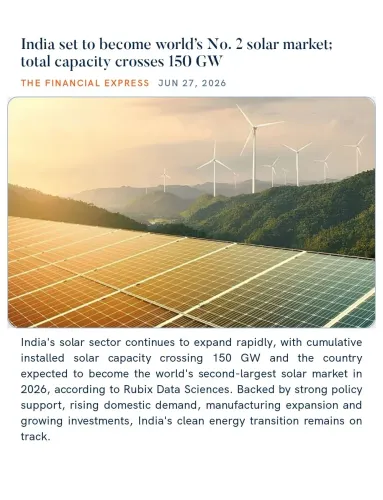
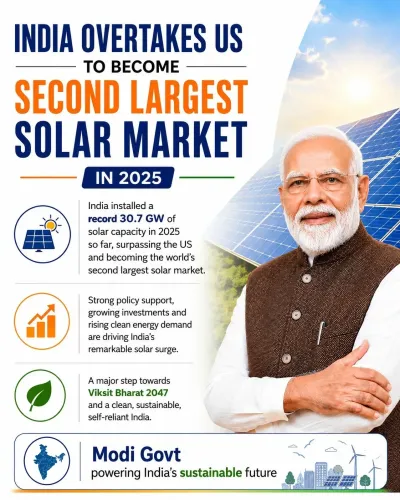
Union Minister Pralhad Joshi announced that India surpassed the USA in 2025 annual solar capacity additions to become the world's second-largest solar growth market, crediting Prime Minister Narendra Modi's clean energy push and citing policy support, innovation and infrastructure as the drivers of record renewable capacity expansion.
Key Takeaways
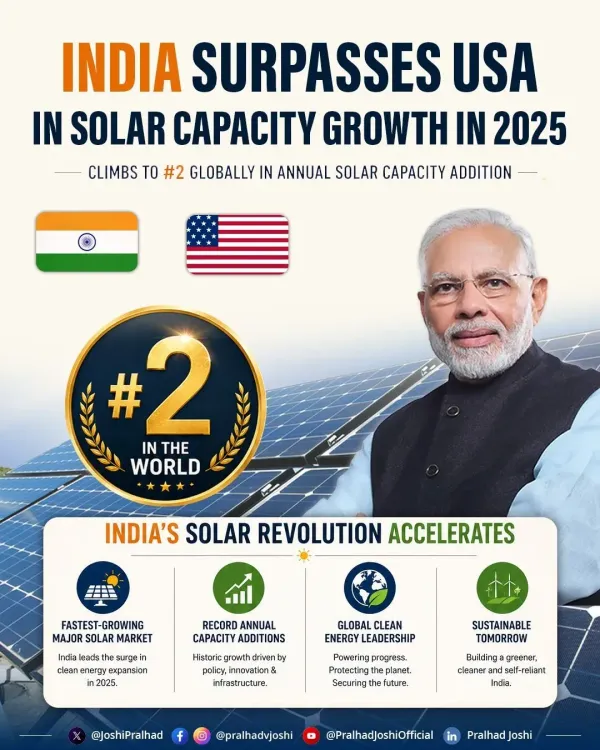
Union Minister Pralhad Joshi said India surpassed the USA in annual solar capacity additions in 2025.
The post positions India as the world's second-largest solar growth market and fastest-growing major solar market.
Joshi credited Prime Minister Narendra Modi's leadership, citing policy support, innovation and infrastructure.
India targets 450 GW of renewable energy by 2030, set in 2019, with solar as the dominant component.
India co-founded the International Solar Alliance with France in 2015 to mobilise USD 1 trillion in solar investments.
The announcement carried the hashtag #IndiaRanks2InSolar, signalling a coordinated government messaging push.
Union Consumer Affairs and New and Renewable Energy Minister Pralhad Joshi on Wednesday, 3 June 2026, declared that India has overtaken the United States in annual solar capacity additions in 2025 to become the world's second-largest solar growth market. In a post on X, the minister attributed the surge to policy support, innovation and infrastructure built under Prime Minister Narendra Modi.
'India's solar growth story is setting global benchmarks,' Joshi wrote, adding that the country is now the 'fastest-growing major solar market' and is 'driving record capacity additions through strong policy support, innovation and world-class infrastructure.' He framed the milestone as evidence that the #CleanEnergy transition is 'accelerating, strengthening energy security, advancing sustainable development and reinforcing India's position as a global leader in #RenewableEnergy.'
Context
The minister's announcement positions India alongside China at the top of the global solar league table, a status the government has been pursuing for over a decade. Joshi, a senior BJP leader from Karnataka, holds the renewable energy portfolio in addition to consumer affairs and food and public distribution, giving him direct oversight of the Ministry of New and Renewable Energy (MNRE).
The post is accompanied by the hashtag #IndiaRanks2InSolar, signalling a coordinated government messaging push around the milestone. It does not specify the gigawatt figure for 2025 additions, which the MNRE is expected to release in its official year-end statistics.
Policy backdrop
India's solar push traces back to the Jawaharlal Nehru National Solar Mission, launched in 2010 under the National Action Plan on Climate Change with an initial target of 20 GW of solar power by 2022. That target was repeatedly revised upward, and in 2019 the government set an overarching renewable energy goal of 450 GW by 2030, with solar as the largest component.
To anchor global cooperation, India co-founded the International Solar Alliance with France in 2015, a treaty-based grouping that aims to mobilise USD 1 trillion in solar investments across member countries. Domestic momentum has been reinforced by a production-linked incentive scheme for solar module manufacturing, viability gap funding for utility-scale projects, and rooftop and agricultural programmes such as PM-KUSUM and the rooftop solar mission.
Stakeholders and impact
The acceleration cited by Joshi has direct implications for solar developers, state-owned power distribution companies and household rooftop adopters. Faster capacity addition typically lowers tariffs discovered in MNRE and state auctions, but also stresses transmission infrastructure and discom balance sheets that must integrate variable renewable supply.
For domestic manufacturers, the framing of India as the 'fastest-growing major solar market' is intended to attract investment in cell, wafer and module production, an area where the country has historically depended on Chinese imports. The government has been progressively tightening rules on approved module and cell lists to push localisation.
Geopolitically, surpassing the USA in annual additions, as claimed in the post, would mark a symbolic shift in the clean-energy hierarchy at a time when industrial policy on solar manufacturing is intensifying in both Washington and New Delhi.
What's next
Attention will turn to the MNRE's official 2025-26 capacity addition data, which is expected to formalise the numbers behind Joshi's claim. Any upward revision of the 2030 renewable target, or new sector-specific announcements in the next Union Budget and at upcoming COP climate negotiations, will indicate how the government plans to convert this growth momentum into long-term decarbonisation outcomes.
Point of View
If borne out by MNRE's final 2025-26 statistics, would mark a useful talking point ahead of COP negotiations and the next Union Budget cycle. The harder test lies in translating capacity additions into grid integration, manufacturing depth and reduced import dependence on Chinese modules. Expect further announcements as the government builds the case for a revised post-2030 renewable target.
NationPress
18 Oct 2026
Frequently Asked Questions
Has India overtaken the USA in solar capacity additions?
According to Union Minister Pralhad Joshi's post, India surpassed the USA in annual solar capacity additions in 2025 to become the world's second-largest solar growth market. Official MNRE year-end data will formalise the figures.
Who is Pralhad Joshi?
Pralhad Joshi is the Union Minister of Consumer Affairs, Food and Public Distribution and the Minister of New and Renewable Energy. He is a senior BJP leader from Karnataka and oversees India's solar policy implementation.
What is India's renewable energy target for 2030?
India has set a target of 450 GW of renewable energy capacity by 2030, announced in 2019, with solar power as the largest contributing component alongside wind and other sources.
What is the International Solar Alliance?
The International Solar Alliance is a treaty-based grouping co-founded by India and France in 2015 to promote solar deployment among member countries and mobilise USD 1 trillion in solar investments globally.
What schemes drive solar growth in India?
Key drivers include the National Solar Mission launched in 2010, the production-linked incentive scheme for module manufacturing, viability gap funding for utility-scale projects, the rooftop solar mission and PM-KUSUM for agricultural solarisation.