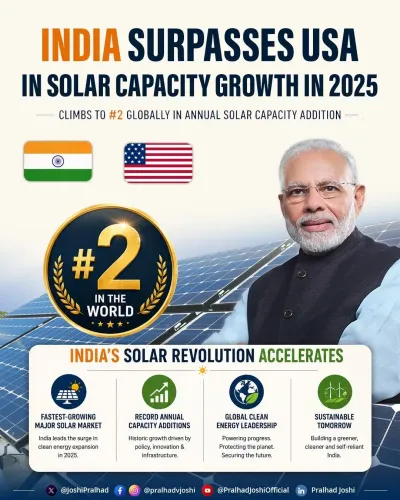
Joshi Highlights India Overtaking US as 2nd-Largest Solar Market
Synopsis
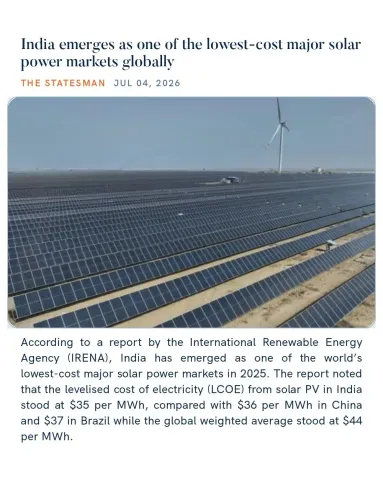
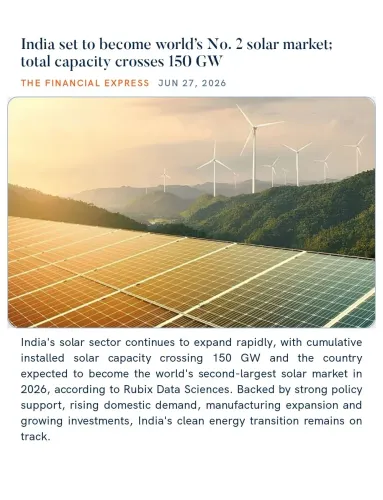
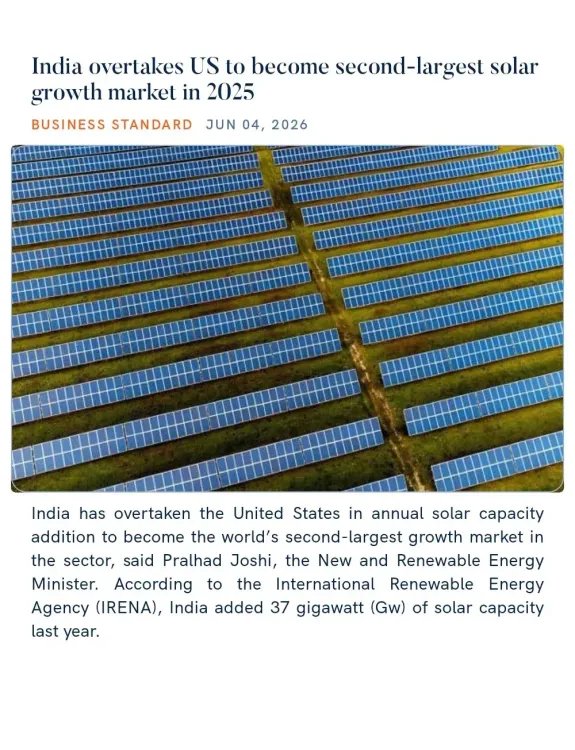
Union Minister Pralhad Joshi flagged a report stating India has overtaken the United States to become the world's second-largest solar growth market in 2025, underscoring momentum toward the 500 GW non-fossil capacity target by 2030 and continued policy push on manufacturing, tenders and rooftop solar.
Key Takeaways
Union Minister Pralhad Joshi shared a report on 4 June 2026 stating India has overtaken the US as the second-largest solar growth market in 2025.
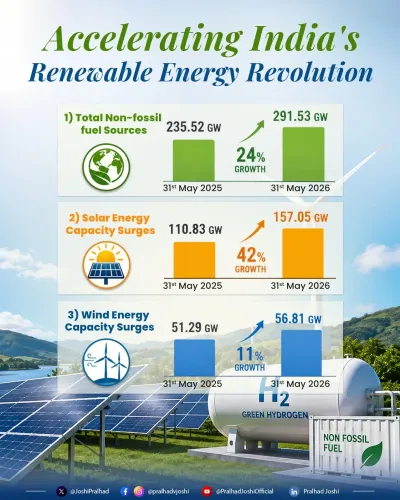
India targets 500 GW non-fossil capacity by 2030, a commitment made at COP26 in Glasgow.
The National Solar Mission, launched in 2010, anchors the country's deployment push.
PLI for solar modules and basic customs duty on imports underpin manufacturing localisation.
The International Solar Alliance, co-launched with France in 2015, drives global solar investment mobilisation.
Next SECI tender rounds and budget-cycle decisions on duties and PLI will shape the trajectory.
Union Consumer Affairs Minister and Minister of New and Renewable Energy Pralhad Joshi on 4 June 2026 flagged a milestone for India's clean-energy push, sharing a report that says India has overtaken the United States to become the world's second-largest solar growth market in 2025. The post, circulated via the NaMo App, comes as the Centre accelerates capacity additions toward its 500 GW non-fossil-fuel target by 2030.
Context
The minister's post amplifies a single line: 'India overtakes US to become second-largest solar growth market in 2025'. The framing positions India behind only China in incremental solar deployment, a ranking that has shifted in recent years as annual installations in the country have scaled sharply.
Pralhad Joshi, a senior BJP leader from Karnataka, holds the renewable energy portfolio alongside consumer affairs, food and public distribution. He has used the platform repeatedly to spotlight rooftop solar adoption, utility-scale tenders and module manufacturing progress.
Policy backdrop
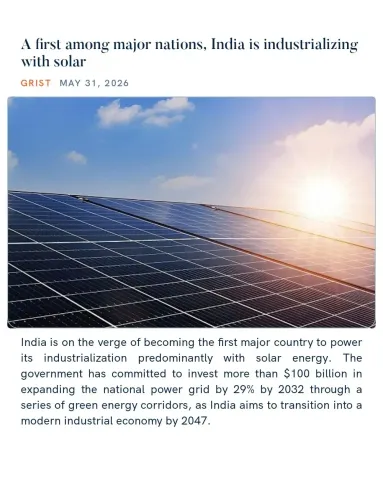
India's solar trajectory traces back to the Jawaharlal Nehru National Solar Mission, launched in 2010 and subsequently revised upward to push both grid-connected and distributed solar. At COP26 in Glasgow in 2021, the country committed to 500 GW of non-fossil capacity by 2030 as part of its broader net-zero 2070 pledge.
Parallel instruments have shaped the supply side. The Production Linked Incentive scheme for high-efficiency solar modules, basic customs duty on imported cells and modules, and payment security mechanisms for developers have together attempted to localise manufacturing while keeping deployment on track. On the diplomatic front, the International Solar Alliance, co-launched by India and France in 2015, remains New Delhi's principal vehicle for mobilising solar investment among sunshine-belt nations.
The United States, by comparison, has driven its own solar surge through the Inflation Reduction Act and state-level renewable portfolio standards, with tax credits anchoring utility-scale and residential build-outs.
Stakeholders and impact
The ranking, if it holds through full-year tallies, carries direct implications for solar developers, equipment suppliers and state distribution companies. Independent power producers bidding into Solar Energy Corporation of India tenders stand to gain from sustained pipeline visibility, while discoms face the parallel task of integrating variable generation and managing power purchase agreements.
For investors, India's positioning strengthens the case for long-duration renewable infrastructure exposure, particularly in states with high irradiance such as Rajasthan, Gujarat and Karnataka. Module manufacturers operating under the PLI umbrella also benefit from a deeper domestic demand base as import dependence on Chinese supply chains remains a policy concern.
The broader pattern is one of policy continuity. Solar deployment in India has accelerated across successive governments, supported by central financial assistance for rooftop programmes such as PM Surya Ghar: Muft Bijli Yojana and continued viability-gap funding for utility-scale projects.
What's next
Attention now turns to the next round of SECI tender outcomes, any revision to solar module import duties, and PLI allocations in the forthcoming budget cycle. The pace of transmission build-out and storage tendering will determine whether the headline ranking translates into reliable round-the-clock clean power.
For the Centre, the post serves a dual purpose: signalling progress on a flagship climate commitment and reinforcing investor confidence ahead of further capacity auctions. The test will be whether 2026 additions sustain the trajectory that produced the 2025 ranking.
Point of View
But the headline ranking sits alongside persistent challenges around module import dependence, discom finances and grid integration. Reading the milestone purely as competitive positioning against the United States obscures the structural test ahead, namely sustaining annual additions at scale through 2030. The broader arc remains one of policy continuity rather than a sudden break.
NationPress
21 Oct 2026
Frequently Asked Questions
What did Pralhad Joshi say about India's solar ranking?
He shared a report stating India has overtaken the United States to become the world's second-largest solar growth market in 2025. The post was circulated through the NaMo App on 4 June 2026.
What is India's renewable energy target for 2030?
India has committed to 500 GW of non-fossil-fuel installed capacity by 2030. The target was announced by Prime Minister Narendra Modi at the COP26 climate summit in Glasgow in 2021.
Which ministry handles solar energy policy in India?
The Ministry of New and Renewable Energy, currently led by Pralhad Joshi, handles solar and other renewable energy policy. It oversees flagship programmes including PM Surya Ghar: Muft Bijli Yojana and the PLI scheme for solar modules.
What is the International Solar Alliance?
The International Solar Alliance is a treaty-based intergovernmental organisation co-launched by India and France in 2015. It mobilises investment and policy cooperation among solar-rich countries to expand deployment.
Who is the largest solar market in the world?
China remains the largest solar market globally, both in installed capacity and annual additions. India and the United States have alternated in the next tier of major solar growth markets.