Pralhad Joshi: India's Solar Power Up 38% to 164.59 GW
Synopsis
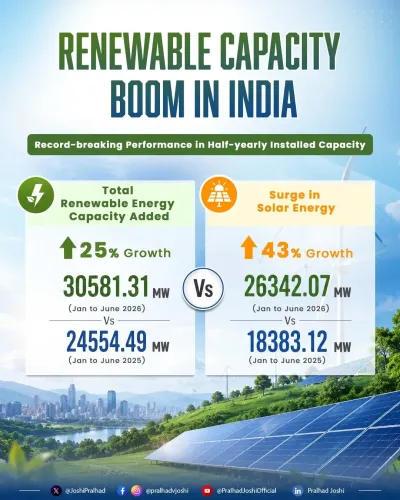
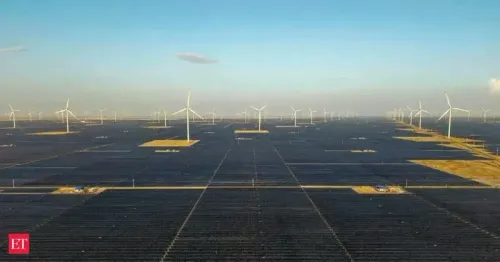
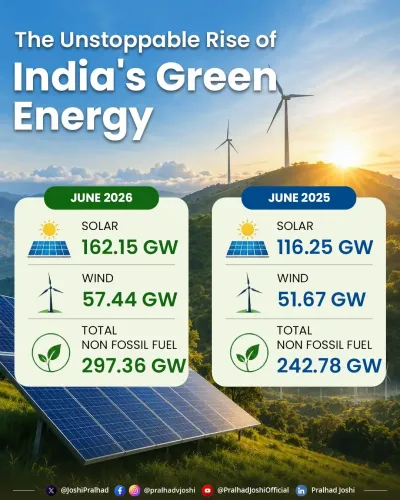
India's solar power capacity has jumped 38.29% in one year to 164.59 GW and total non-fossil fuel capacity has crossed 300.50 GW, Union Minister Pralhad Joshi announced on 10 August 2026, marking a significant milestone on the road to the country's 500 GW target by 2030.
Key Takeaways
India's solar power capacity grew 38.29% year-on-year to reach 164.59 GW .
Wind power capacity rose 11.51% to 58.14 GW .
Total non-fossil fuel installed capacity now stands at 300.50 GW , crossing the 300 GW threshold.
India's 500 GW non-fossil fuel target by 2030 was committed at COP26 in 2021; roughly 200 GW remains to be added in four years.
The announcement was made by Union Minister Pralhad Joshi , who holds the New and Renewable Energy portfolio.
India's clean energy story just hit a striking milestone. Union Minister for New and Renewable Energy Pralhad Joshi announced on Monday, 10 August 2026 that the country's solar power capacity has surged 38.29% in a single year to reach 164.59 GW — a figure that signals the pace of India's green transition is accelerating well beyond earlier projections.
Wind power has kept pace, growing 11.51% to 58.14 GW, pushing India's total non-fossil fuel installed capacity to 300.50 GW. That number matters: it means India has already crossed the 300 GW threshold on a journey toward its 500 GW non-fossil fuel target by 2030, a commitment made at COP26 in Glasgow in 2021.
From Paris to 300 GW — the decade-long build
The arithmetic of India's renewable ambition started with a pledge at the 2015 Paris Climate Conference — 175 GW of renewable energy by 2022. Six years later at COP26, Prime Minister Narendra Modi raised the bar dramatically: 500 GW of non-fossil capacity by the end of this decade. Crossing 300 GW puts India past the halfway mark with four years still on the clock.
The Ministry of New and Renewable Energy, which Joshi heads alongside the Consumer Affairs portfolio, has driven this expansion through competitive auctions, central and state policy incentives, and sustained private investment. Solar, once a niche technology in India, is now the engine of the entire programme — its 164.59 GW dwarfs every other non-fossil source in the mix.
What the 38% solar jump actually means
A 38.29% year-on-year rise in solar capacity is not incremental — it is transformational. To add that share of capacity in twelve months requires a pipeline of projects clearing land, grid, and financing hurdles simultaneously. It also implies that auction rounds announced in prior years are now delivering at scale, a sign that the policy machinery is functioning as designed.
Wind's 11.51% growth, while more modest in percentage terms, reflects the longer lead times and more complex siting requirements of onshore wind projects. The sector is watching closely for any push into offshore wind, which the ministry has flagged as a future frontier.
India's energy security calculus is shifting. Every gigawatt of domestic renewable capacity reduces dependence on imported fossil fuels, insulating the economy from global commodity price shocks. With 300.50 GW of clean capacity now online, that buffer is becoming meaningful at a macro level.
The remaining distance to 500 GW by 2030 is still steep — roughly 200 GW in four years. Whether the pace holds will depend on grid infrastructure keeping up with generation, and on distribution companies absorbing the added supply without financial strain. Those are the pressure points to watch.
Point of View
Not just a statistical blip. The harder test now is the grid: adding generation at this pace without matching transmission and distribution investment risks stranding capacity, which is the quiet risk neither the ministry's announcements nor opposition critiques tend to address. If the 500 GW target is to land on time, the next policy frontier is less about capacity auctions and more about who pays for the wires.
NationPress
25 Sept 2026
Frequently Asked Questions
What is India's current solar power capacity in 2026?
According to Union Minister Pralhad Joshi's announcement on 10 August 2026, India's solar power capacity has reached 164.59 GW , a rise of 38.29% in one year.
What is India's total non-fossil fuel energy capacity?
India's total non-fossil fuel installed capacity now stands at 300.50 GW , combining solar, wind, and other clean energy sources.
What is India's renewable energy target by 2030?
India committed at COP26 in 2021 to achieving 500 GW of non-fossil fuel capacity by 2030 , up from an earlier pledge of 175 GW by 2022 made at the 2015 Paris Climate Conference.
How much has India's wind power capacity grown?
India's wind power capacity grew by 11.51% to reach 58.14 GW , according to the figures shared by Minister Pralhad Joshi.
Who is Pralhad Joshi and what ministry does he head?
Pralhad Joshi is a senior BJP leader from Karnataka and Union Minister holding the portfolios of New and Renewable Energy, and Consumer Affairs, Food and Public Distribution.