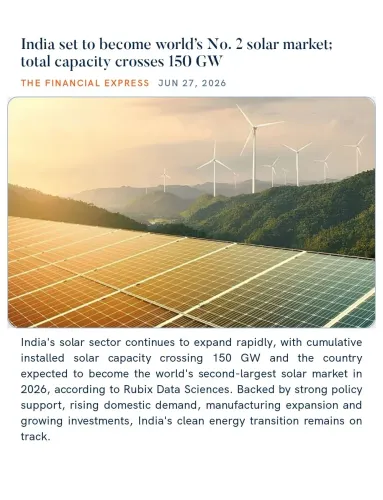
Joshi: India adds record 15.3 GW solar in Q1 2026

Synopsis
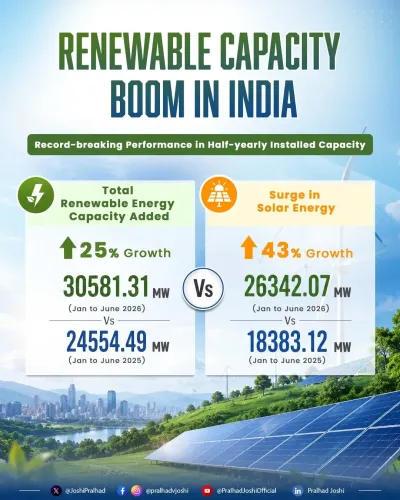
India recorded its highest-ever quarterly solar installations at 15.3 GW in Q1 2026, up 143 per cent from 6.3 GW in Q1 2025, Union Minister Pralhad Joshi announced on 30 May 2026, citing the milestone as evidence of the country's progress toward its 500 GW non-fossil fuel target by 2030.
Key Takeaways
15.3 GW of solar capacity was added in Q1 2026 — India's highest-ever single-quarter solar installation figure.
The addition represents a 143 per cent year-on-year increase from 6.3 GW added in Q1 2025 .
Union Minister Pralhad Joshi attributed the record to policy direction under Prime Minister Narendra Modi .
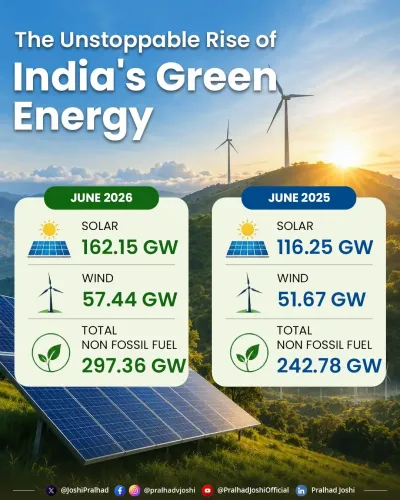
The milestone is framed as progress toward India's COP26 pledge of 500 GW non-fossil fuel capacity by 2030 .
The achievement aligns with the Viksit Bharat vision of a developed, self-reliant India by 2047 .
India is the world's third-largest energy consumer and has made reducing fossil fuel import dependence a strategic priority.
Union Minister of New and Renewable Energy Pralhad Joshi on Saturday, 30 May 2026, announced that India added a record 15.3 GW of solar capacity in the first quarter of 2026, marking a 143 per cent year-on-year jump from 6.3 GW installed in Q1 2025 — the highest quarterly solar installation figure the country has ever recorded.
Context
Joshi, posting on X, said the milestone reflects 'India's unwavering commitment to sustainable development, energy security and a greener future' and credited the achievement to the leadership of Prime Minister Narendra Modi. The minister framed the record as a step toward making India a global renewable energy leader and realising the Viksit Bharat vision — the government's long-term blueprint for a developed India by 2047.
The figures cited by the minister — 6.3 GW in Q1 2025 rising to 15.3 GW in Q1 2026 — are drawn from Ministry of New and Renewable Energy data and have not yet been independently cross-checked against official published statistics for the period.
Policy Backdrop
India's solar push has deep policy roots. The Jawaharlal Nehru National Solar Mission, launched in 2010, first set the institutional framework for large-scale solar deployment and domestic manufacturing. Since then, successive auction rounds and falling module prices have driven sharp capacity additions each year.
At COP26 in 2021, India committed to reaching 500 GW of non-fossil fuel power capacity by 2030 and achieving net-zero emissions by 2070. Quarterly records of this scale are central to demonstrating that the country is on track to meet those internationally announced targets under the Paris Agreement.
India is the world's third-largest energy consumer, and surging electricity demand driven by industrialisation and urbanisation has made reducing fossil fuel import dependence a pressing strategic priority alongside the climate agenda.
Stakeholders and Impact
Solar developers and power utilities stand to benefit most directly from the sustained policy and auction pipeline that has underpinned this growth. Large quarterly additions signal a healthy project pipeline, competitive tariffs, and improving grid integration capacity.
For ordinary consumers, accelerated renewable capacity additions ease pressure on coal-fired generation and can moderate long-run electricity costs. The government has also linked renewable expansion to job creation in manufacturing, installation, and operations across states.
Internationally, the record positions India alongside China and the United States as one of the dominant markets for annual solar additions, reinforcing its standing in multilateral climate negotiations ahead of upcoming COP summits.
What's Next
Attention will now turn to whether the Q2 2026 figures sustain this pace, and to any revised capacity targets or fresh tender announcements from the Ministry of New and Renewable Energy. Analysts and industry bodies will also watch for grid infrastructure investments needed to absorb rising variable renewable generation without compromising supply reliability.
If the quarterly trajectory holds, India's cumulative installed solar base could cross significant milestones well ahead of the 2030 deadline, strengthening the government's case at future climate forums that emerging economies can pursue both rapid growth and deep decarbonisation simultaneously.
Point of View
The government signals that renewable energy is not merely an environmental policy but a core pillar of its 2047 development agenda. The scale of quarterly additions, if sustained, would materially accelerate India's path to its 500 GW non-fossil fuel commitment and strengthen its negotiating posture at future COP summits. The framing also serves a domestic political purpose: demonstrating tangible, measurable delivery on a flagship promise to voters in energy-deficit states.
NationPress
19 Sept 2026
Frequently Asked Questions
How much solar capacity did India add in Q1 2026?
According to Union Minister Pralhad Joshi, India added 15.3 GW of solar capacity in the first quarter of 2026, the highest quarterly figure ever recorded by the country.
What was India's solar capacity addition in Q1 2025?
India added 6.3 GW of solar capacity in Q1 2025, making the Q1 2026 figure of 15.3 GW a 143 per cent year-on-year increase.
What is India's renewable energy target by 2030?
At COP26 in 2021 , India committed to achieving 500 GW of non-fossil fuel power capacity by 2030 and net-zero emissions by 2070.
What is Viksit Bharat and how does it relate to solar energy?
Viksit Bharat is the Indian government's vision for a fully developed, self-reliant India by 2047 . Renewable energy expansion, including record solar additions, is positioned as a central enabler of that long-term economic and sustainability goal.
Who is Pralhad Joshi and what ministry does he head?
Pralhad Joshi is a senior BJP leader from Karnataka who serves as Union Minister of New and Renewable Energy as well as Minister of Consumer Affairs, Food and Public Distribution in the Modi government .