White House Announces 'Task Force Iron Gate' Against Iran
Synopsis
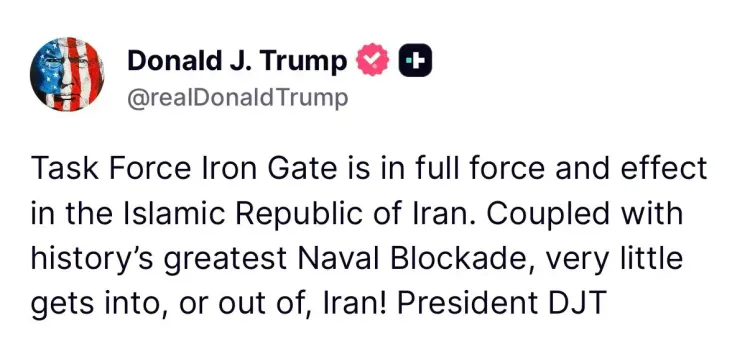
The White House declared 'Task Force Iron Gate' is 'in full force and effect' in Iran on 9 November 2026, signalling a new US enforcement mechanism against Tehran amid decades of sanctions pressure — with details of scope yet to be released.
Key Takeaways
The White House announced on 9 November 2026 that 'Task Force Iron Gate' is 'in full force and effect' in Iran .
No specific mandate, targeted sectors, or participating agencies have been officially detailed in the post.
The announcement fits a long pattern of US named enforcement mechanisms against Tehran dating back to the 1980s .
Follow-up statements from the State Department and Treasury Department are expected to clarify scope and designations.
India 's energy and infrastructure interests — including the Chabahar port corridor — may be affected depending on the task force's reach.
A terse, pointed declaration from the White House landed in the early hours of Monday, 9 November 2026 — just four words short of an ultimatum: 'Task Force Iron Gate is in full force and effect in the Islamic Republic of Iran.' No elaboration. No diplomatic softening. That is the message Washington chose to send Tehran overnight, and in its brevity lies the pressure.
What 'Iron Gate' signals in the US-Iran playbook
The United States has a long and layered history of deploying named enforcement mechanisms against Iran — from executive-order-driven sanctions packages going back to the 1980s to multi-agency task forces targeting oil exports, arms proliferation, and financial flows. A named operation or task force typically signals a coordinated, cross-agency effort — often involving the Treasury Department, the State Department, and in some configurations the Department of Defense — rather than a single policy announcement. 'Iron Gate' as a name evokes closure, a sealed perimeter: the language of enforcement, not negotiation.
The White House has not, as of this post, elaborated on the specific mandate of Task Force Iron Gate — whether it targets nuclear enrichment activity, proxy financing, missile development, or some combination. That deliberate ambiguity is itself a signal: it keeps Tehran guessing about scope while projecting confidence about resolve.
The backdrop: decades of pressure, periodic escalation
US-Iran relations have been defined since 1979 by alternating cycles of sanctions, diplomatic back-channels, and enforcement crackdowns. The pattern is consistent: Washington announces a mechanism, Tehran responds with defiance or counter-escalation, and the international community watches for where the pressure cracks or holds. Each named task force or executive action adds another layer to what is now one of the world's most complex bilateral sanctions architectures.
Watchers of the relationship will now be looking to follow-up statements from the State Department and Treasury for specifics — what entities are designated, what financial channels are targeted, and whether allied governments in Europe or the Gulf have been briefed to co-enforce. The White House post alone does not answer those questions, but it sets the clock running.
Why India is watching closely
India has historically navigated US-Iran tensions with care — balancing its own energy import interests, the Chabahar port infrastructure corridor, and its strategic relationship with Washington. Any new, named US enforcement mechanism against Tehran lands directly in that triangular tension. Indian companies and policymakers will need clarity on scope before they can calibrate their own compliance posture. That clarity is precisely what the White House has not yet provided — and that gap will drive the next 24 to 48 hours of diplomatic traffic.
Point of View
No detail, maximum resolve — is a classic pressure-signalling move: it maximises ambiguity for Tehran while locking in a public commitment Washington must now follow through on. Historically, named US task forces against Iran precede rounds of secondary sanctions that catch third-country firms in the net, making this directly relevant to any government with Iranian economic ties. For India, which has carefully preserved its Chabahar corridor stake through multiple US-Iran cycles, the absence of detail is precisely the problem — compliance decisions cannot be made in a vacuum. The next 48 hours of State Department and Treasury messaging will reveal whether 'Iron Gate' is a narrow enforcement tool or the opening move in a broader escalation campaign.
NationPress
9 Nov 2026
Frequently Asked Questions
What is Task Force Iron Gate?
'Task Force Iron Gate' is a US government mechanism declared by the White House on 9 November 2026 as being 'in full force and effect' in Iran. Official details about its mandate, scope, and participating agencies have not yet been released.
What does the Task Force Iron Gate announcement mean for India?
India has significant economic and strategic interests in Iran, including the Chabahar port infrastructure corridor. Any new US enforcement mechanism against Iran can trigger secondary sanctions that affect Indian companies trading with or investing in Tehran, requiring careful compliance review.
Is Task Force Iron Gate a military operation?
The White House has not specified whether the task force is military, financial, intelligence-based, or a combination. The term 'task force' in US Iran policy has historically referred to multi-agency enforcement and sanctions coordination efforts.
How has the US historically used task forces against Iran?
The United States has employed multiple executive orders, congressional sanctions acts, and enforcement task forces against Iran since the 1980s, targeting oil exports, financial transactions, arms procurement, and proxy-financing networks.
What happens next after the White House Iron Gate announcement?
Policy watchers expect follow-up statements from the US State Department and Treasury Department detailing which Iranian entities are designated, what financial channels are targeted, and whether allied governments have been asked to co-enforce the new mechanism.