US economic offensive against Iran unlikely to succeed under IRGC hardliners: Report
Synopsis
The US has quietly swapped targeted economic pressure for total economic isolation of Iran — but the upgrade may not matter. With IRGC hardliners firmly in control and history showing that sweeping sanctions rarely break ideologically entrenched regimes, Washington’s new playbook faces a structural ceiling. Meanwhile, reports that the US has burned through 80% of its THAAD interceptors expose a kinetic exhaustion that makes the pivot to economic tools less a choice than a necessity.
Key Takeaways
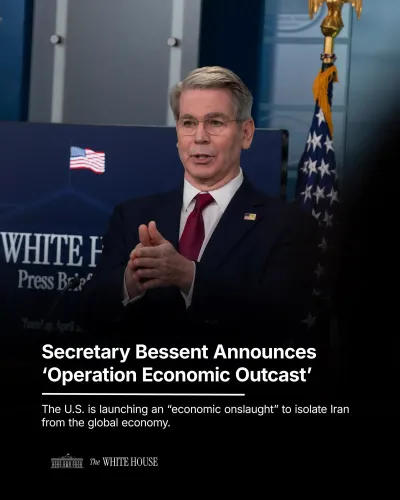
The US has replaced 'Operation Economic Fury' with 'Operation Economic Outcast' , escalating to full-spectrum economic isolation of Iran .
IRGC hardliners now control Iran’s regime, making economic coercion historically less likely to succeed.
The US military has reportedly depleted roughly 80 per cent of its THAAD interceptor inventory and about half of its Patriot missile supplies.
Long-range missile stockpiles are also under significant pressure after months of sustained operations.
Analysts warn the US’s kinetic exhaustion raises questions about its readiness to counter threats in other global theatres .
The United States has shifted its operational strategy against Iran, combining a muscular military posture with a more institutionalised economic offensive — a move that analysts say is unlikely to achieve its intended results given the consolidation of power by Islamic Revolutionary Guard Corps (IRGC) hardliners in Tehran, according to a new analysis published in India Narrative.
From 'Economic Fury' to 'Economic Outcast'
The earlier US strategy, dubbed 'Operation Economic Fury', applied targeted and limited economic pressure on Iran within the broader Middle East conflict framework. The revised approach, now referred to as 'Operation Economic Outcast', escalates this to a full-spectrum economic offensive — complete isolation of Iran and the severing of all direct and indirect economic support channels. The structural shift is notable, but analysts argue the practical impact may be far less significant than Washington hopes.
History, the report cautions, offers little comfort for the new strategy. According to the analysis, “massive sanctions and economic coercive measures have failed against regimes with hardline ideologies and institutional and structural resilience.” Iran under IRGC control, it argues, fits that profile precisely.
Why the US Is Pivoting Away from Kinetic Options
The pivot toward economic coercion is not purely strategic — it is also a function of necessity. Conventional military power, the report notes, is gradually failing to push Iran to the margins. This has prompted the US security establishment to recalibrate, layering non-military tools alongside sustained military pressure.
The shift offers two potential advantages, according to the analysis. First, it slows the depletion of critical ammunition stocks. Second, it reopens a diplomatic window while maintaining sustained pressure on Tehran.
US Kinetic Reserves Under Serious Strain
The urgency of this pivot is underscored by a troubling picture of American military readiness. According to reports cited in the analysis, the US military has expended roughly 80 per cent of its THAAD interceptor inventory and approximately half of its Patriot missile supplies. Long-range missile stockpiles are also reportedly under significant pressure, with months of sustained operations said to have heavily depleted reserves.
This erosion of kinetic capacity raises what the report describes as serious questions about Washington’s ‘global readiness’ and its “ability to counter threats in other theatres.” The implication is stark: the US may be stretching its military resources thin at a moment when strategic demands are multiplying.
Why Economic Coercion May Still Fall Short
The central problem with the economic offensive, analysts argue, is structural. Regimes with deeply entrenched ideological foundations and institutional resilience — such as the IRGC-dominated government in Iran — have historically absorbed even the most severe sanctions without capitulating. The IRGC’s parallel economic networks, which operate largely outside the formal Iranian economy, provide a degree of insulation that conventional sanctions struggle to penetrate.
This is not the first time the international community has attempted to pressure Tehran through economic isolation. Successive rounds of sanctions over the past two decades have constrained Iran’s economy but have not fundamentally altered its strategic behaviour or political trajectory.
What Comes Next
Whether the combined pressure of 'Operation Economic Outcast' and sustained military engagement produces a different outcome remains to be seen. Analysts are watching closely for signs of fracture within Iran’s ruling establishment — though, as the report notes, the consolidation of IRGC influence makes such an outcome less likely in the near term. The broader question of US strategic overextension, particularly in the context of simultaneous commitments across multiple theatres, is expected to dominate security discussions in the months ahead.
Point of View
The reported depletion of 80% of US THAAD interceptors is a strategic alarm bell that extends well beyond Iran — it signals that Washington’s capacity for simultaneous kinetic commitments is more constrained than its posture suggests.
NationPress
16 Oct 2026
Frequently Asked Questions
What is 'Operation Economic Outcast' targeting Iran?
'Operation Economic Outcast' is the US’s updated economic strategy against Iran, involving full-spectrum economic isolation — cutting off all direct and indirect economic support to Tehran. It replaces the earlier, more limited 'Operation Economic Fury', which applied targeted economic pressure within the Middle East conflict framework.
Why is the US economic offensive against Iran unlikely to succeed?
Analysts argue that IRGC hardliners now controlling Iran have the institutional and ideological resilience to withstand even comprehensive sanctions. History shows that massive economic coercive measures have repeatedly failed against regimes with entrenched structures and parallel economic networks outside the formal economy.
How depleted are US military stockpiles amid the Iran conflict?
According to reports cited in the analysis, the US military has used roughly 80 per cent of its THAAD interceptor inventory and approximately half of its Patriot missile supplies. Long-range missile stockpiles are also said to be heavily strained after months of sustained operations.
Why is the US shifting from military to economic pressure on Iran?
The shift is driven by both strategy and necessity. Conventional military action has not succeeded in pushing Iran to the margins, while kinetic reserves are being depleted at an alarming rate. Economic coercion slows ammunition exhaustion and reopens a diplomatic window while maintaining sustained pressure on Tehran.
What are the broader implications of US kinetic exhaustion?
The depletion of critical missile inventories raises serious questions about US global military readiness and its ability to respond to threats in other theatres simultaneously. Analysts warn this overextension could constrain Washington’s strategic options beyond the Middle East.