US sanctions Iraq bank, Hong Kong firm in Iran crackdown Operation Economic Outcast
Synopsis
The Trump administration's Operation Economic Outcast reached into Iraq, Hong Kong, Dubai, and Cuba in a single day — designating an oil trustee, front companies, offshore banks, and a Cuban state bank linked to Iran. With secondary sanctions now on the table for foreign banks, Washington is signalling that no financial corridor is off-limits.
Key Takeaways
The US Treasury and State Department sanctioned entities across Iraq , Hong Kong , Dubai , and Cuba on 16 October 2026 under Operation Economic Outcast .
Sayyed Ruhollah Razavi , a Dubai-based Iranian oil trustee linked to the National Iranian Oil Company , was among those designated.
Cuba's BICSA was blacklisted for allegedly providing services to Iran's sanctioned Karafarin Bank since at least 2022 .
Funds allegedly moved through Hong Kong to the UAE and Türkiye , converted to gold and cash, and smuggled via Mahan Air to Iran.
FinCEN issued a parallel alert asking banks to flag potential Iranian abuse of religious charity networks, including khums tithes.
Treasury warned that foreign banks engaging in transactions with designated parties risk secondary sanctions .
The United States on 16 October 2026 imposed a sweeping new round of sanctions targeting an Iraqi bank, two Iranian offshore banks, a Dubai-based Iranian oil intermediary, a Hong Kong front company, and a Cuban state-owned bank, as the Trump administration escalated its financial pressure campaign against Tehran under what it calls Operation Economic Outcast. The designations mark one of the broadest single-day enforcement actions under the operation since its launch in August.
Key Designations and Networks Targeted
Sayyed Ruhollah Razavi, described by the US Treasury as 'one of the top oil trustees on whom the Iranian regime relies to sell oil and repatriate the revenue,' was among those blacklisted. Based in Dubai, Razavi reportedly oversaw the shipment of 'millions of barrels of oil overseas each month' on behalf of the National Iranian Oil Company (NIOC) before earlier US export restrictions took hold.
Hong Kong-based Elitesphere Trading Co., Limited was designated for allegedly moving funds on behalf of an affiliate of Iran's Shahr Bank through a network of brokers and front companies. Sadegh Bavi, described as an Iranian-Dominican national listed in Dubai and identified as an IRGC-Qods Force facilitator, was also sanctioned.
On the banking side, the Treasury blacklisted Iraq-based International Development Bank for Investment and Finance, which it said provides 'US dollar access for Iran,' along with two Iranian offshore institutions — Jazireh International Bank Company and Chabahar International Bank Overseas Company.
Cuba Pulled Into Iran Sanctions Net
Secretary of State Marco Rubio separately sanctioned Cuba's state-owned Banco Internacional de Comercio S.A. (BICSA), alleging it had provided financial services to Iran's sanctioned Karafarin Bank since at least 2022. Rubio framed the move in stark terms, stating: 'For too long, Communist Cuba has been allowed to operate as an outpost for malign actors and terror groups — including the Islamic Republic of Iran, the world's number one state sponsor of terrorism — to target the United States.'
He added: 'Let me be clear: the Trump Administration will not tolerate a rogue state hosting hostile foreign military, intelligence and terror operations less than a hundred miles from the American homeland.'
How the Money Moves: Gold, Cash, and Charter Flights
The Treasury detailed the alleged mechanics of the sanctions-evasion network, stating that funds were moved 'through Hong Kong to the UAE and Türkiye where they are converted to gold and cash and then smuggled on Mahan Air flights to Iran and its terrorist proxies around the world.' The networks are said to have moved 'hundreds of millions of dollars through shell companies and foreign-exchange specialists across the Middle East and Asia.'
Religious Charity Networks Under Scrutiny
In a parallel action, the Treasury's Financial Crimes Enforcement Network (FinCEN) issued an alert directing banks to report potential Iranian abuse of religious charity structures, including the diversion of religious tithes known as khums. Treasury Secretary Scott Bessent said: 'Treasury will not allow the Iranian regime to continue its long history of abusing religious institutions to line the pockets of its elites and fund terrorism.'
Operation Economic Outcast: Background and Scope
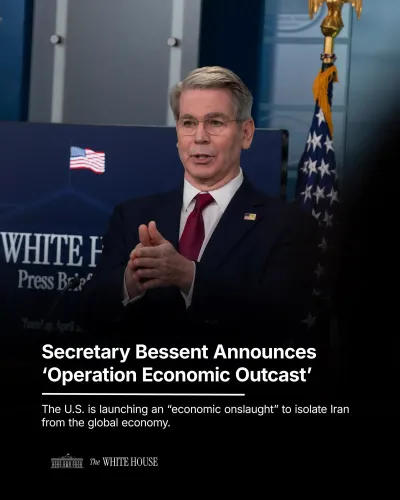
Operation Economic Outcast was formally announced by Bessent on 24 August. Earlier enforcement rounds targeted shadow fleet and procurement networks spanning the UAE, Hong Kong, China, and other jurisdictions. The Treasury warned that 'engaging in certain transactions involving the persons designated today may risk the imposition of secondary sanctions on participating foreign financial institutions' — a signal directed as much at third-country banks as at designated entities. Notably, the widening geographic footprint, from the Gulf to East Asia to the Caribbean, suggests Washington is systematically closing off Iran's remaining dollar-access corridors.
Point of View
Hong Kong, Dubai, Cuba — is the real headline, not any single designation. Washington is methodically mapping and severing every dollar-access corridor Iran has improvised since earlier sanctions rounds. The inclusion of Cuba is a pointed political signal from Rubio, folding Caribbean geopolitics into the Iran pressure campaign. The secondary sanctions warning is the sharpest instrument here: it puts third-country banks on notice that facilitating Iran is now a binary choice between Tehran and the US financial system. For banks in the Gulf and Asia with ambiguous Iran exposure, the compliance calculus just got significantly harder.
NationPress
16 Oct 2026
Frequently Asked Questions
What is Operation Economic Outcast?
Operation Economic Outcast is a US Treasury-led financial pressure campaign against Iran, formally announced by Treasury Secretary Scott Bessent on 24 August. It targets shadow banking, oil sales, and procurement networks that help Iran access the global financial system despite existing sanctions.
Which entities were sanctioned in the 16 October round?
The designations included Iraq's International Development Bank for Investment and Finance, Hong Kong-based Elitesphere Trading Co., Dubai-based oil intermediary Sayyed Ruhollah Razavi, Iranian offshore banks Jazireh International Bank and Chabahar International Bank Overseas Company, and Cuba's Banco Internacional de Comercio S.A. (BICSA). IRGC-Qods Force facilitator Sadegh Bavi was also blacklisted.
Why was Cuba's BICSA sanctioned alongside Iranian entities?
Secretary of State Marco Rubio sanctioned BICSA because it allegedly provided financial services to Iran's already-sanctioned Karafarin Bank since at least 2022. Rubio framed Cuba as an 'outpost for malign actors,' linking the Caribbean nation's banking system to Iran's broader sanctions-evasion network.
What are secondary sanctions and who is at risk?
Secondary sanctions are penalties the US can impose on foreign banks or companies — not just designated entities — that conduct transactions with sanctioned parties. In this context, any foreign financial institution dealing with the newly blacklisted entities risks losing access to the US dollar system.
How does Iran allegedly move money through these networks?
According to the US Treasury, funds are routed through Hong Kong to the UAE and Türkiye, where they are converted into gold and cash, and then reportedly smuggled into Iran and to its proxies via Mahan Air charter flights. Shell companies and foreign-exchange brokers are used to obscure the trail.