Smriti Irani fires back at Rahul Gandhi's 'vote chori' charge

Synopsis
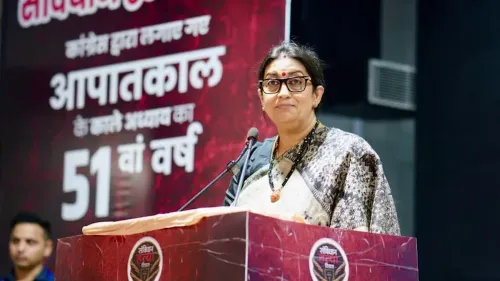
BJP leader Smriti Irani challenged Rahul Gandhi's 'vote chori' allegation on October 16, 2026, arguing that Kerala's own Congress leaders acknowledged the Election Commission's Special Summary Revision brought transparency — exposing a contradiction in the opposition's electoral fraud narrative.
Key Takeaways
BJP leader Smriti Irani publicly challenged Rahul Gandhi's 'vote chori' (vote theft) allegations on October 16, 2026 .
Irani cited statements from Kerala Congress leaders who reportedly acknowledged the Election Commission's Special Summary Revision (SIR) brought transparency to electoral rolls.
SIR is the Election Commission's periodic process to remove duplicates, deceased voters, and ineligible entries from voter lists ahead of polls.
Irani framed the Congress position as contradictory: accepting electoral outcomes when favourable, and alleging manipulation when not. 'Vote chori' has been a recurring Congress allegation covering both voter roll deletions and claimed EVM irregularities in recent election cycles.
The Election Commission had not formally responded to the latest round of allegations at the time of Irani's post.
A sharp political salvo landed on Friday, October 16, 2026, when BJP leader Smriti Irani turned Rahul Gandhi's 'vote chori' allegation on its head — pointing out that Kerala's own Congress leaders had acknowledged the transparency delivered by the Election Commission's Special Summary Revision (SIR) of electoral rolls, even as the Congress national leadership continues to cry foul.
The contradiction at the heart of Congress's complaint
Irani's post cuts straight to the political nerve: 'Jeete toh janta ka aashirvaad, haare toh Vote Chori?' ('Win and it is the people's blessing; lose and it is vote theft?') The line captures a tension that has shadowed Indian electoral discourse for years — the tendency to embrace institutional processes when convenient and question them when results disappoint.
At the centre of her argument is the Special Summary Revision, the Election Commission of India's periodic exercise to clean electoral rolls — removing duplicates, deceased voters, and ineligible entries ahead of state and national polls. Irani's charge is specific: if Kerala Congress leaders themselves credited SIR with bringing transparency to the voter list, on what factual basis does the party's central leadership sustain allegations of 'vote chori'?
Why SIR is a live political flashpoint
Voter roll management has become one of the most contested arenas in Indian politics. Opposition parties, including the Congress, have periodically alleged that legitimate voters — particularly from minority and marginalised communities — are deleted from rolls in disproportionate numbers. The ruling establishment's counter has consistently pointed to the same SIR process as an institutionally transparent, court-supervised mechanism.
The expanded use of VVPAT-equipped EVMs since the mid-2010s added another layer to this debate, with 'vote chori' as shorthand covering both alleged roll manipulation and claimed EVM tampering. Irani's framing zeros in on the roll-revision strand — and grounds it in statements attributed to local Congress functionaries in Kerala, the very state where the allegation is being pressed.
Irani versus Gandhi: the pattern behind the punch
This is not the first time Irani has taken on Rahul Gandhi directly and publicly. The two have been adversaries since the 2014 Amethi contest, a rivalry that sharpened further after the 2019 election when Irani unseated Gandhi from his family stronghold. Her interventions carry a specific political weight — she is not a distant critic but someone who has contested Gandhi on his own ground and won.
By citing Kerala Congress voices specifically, Irani also attempts to drive a wedge between the party's central messaging and its state-level political realities — a tactic that forces the Congress to either defend its own leaders' statements or distance itself from them.
The Election Commission has not formally responded to the latest round of allegations. With assembly poll cycles continuing across India's states, the question Irani is asking — whether 'vote chori' is a documented grievance or a flexible political instrument — is unlikely to fade quietly.
Point of View
Particularly ahead of election cycles where voter roll management becomes a charged issue. For the Congress, the challenge is real: sustaining a pan-India 'vote chori' allegation becomes harder when party functionaries in affected states are on record praising the very process being questioned. Irani's history as Gandhi's direct electoral adversary gives the attack an edge that a routine party spokesperson could not deliver.
NationPress
16 Oct 2026
Frequently Asked Questions
What is 'vote chori' and who has alleged it?
'Vote chori' literally means 'vote theft' in Hindi. Congress leader Rahul Gandhi and other opposition figures have used the term to allege irregularities in India's electoral process, including claims of voter deletions from rolls and questions about EVM reliability.
What is the Special Summary Revision (SIR) of electoral rolls?
The Special Summary Revision is the Election Commission of India's periodic exercise to update voter lists — removing duplicates, deceased registrants, and ineligible entries — conducted ahead of state and national elections to ensure roll accuracy.
Why is Smriti Irani's attack on Rahul Gandhi seen as politically significant?
Irani unseated Rahul Gandhi from his family bastion of Amethi in the 2019 general election, making her one of the BJP's most credible voices in direct attacks on Gandhi. Her interventions carry weight beyond routine party criticism.
What did Kerala Congress leaders reportedly say about SIR?
According to Irani's post and the broader political context, Kerala Congress leaders reportedly acknowledged that the Election Commission's Special Summary Revision process brought greater transparency to the state's electoral rolls — a position Irani argues contradicts the party's central 'vote chori' narrative.
How has the Election Commission responded to 'vote chori' allegations?
The Election Commission has consistently defended the Special Summary Revision process as transparent, court-supervised, and open to all political parties for feedback. As of Irani's October 16, 2026 post, there was no fresh formal response from the Commission to the latest allegations.