White House Announces US Strike on Iran 'Tonight'
Synopsis
The White House quoted President Donald Trump on June 11, 2026, announcing the United States would strike Iran 'very hard tonight,' asserting that Iran's navy, air force, radar, and most offensive capabilities had already been eliminated. The statement signals an active or imminent US military operation against Iran.
Key Takeaways
Trump , quoted by the White House on June 11, 2026 , announced a US military strike on Iran 'tonight.' The statement claims Iran's navy, air force, radar, anti-aircraft systems, and most offensive capability are 'GONE,' implying prior strikes had already degraded Iranian forces.
The announcement follows a long pattern of US maximum-pressure policy toward Iran , including the 2018 JCPOA withdrawal and the 2020 killing of General Qasem Soleimani .
Global energy markets and India's crude oil imports face direct exposure given Iran's proximity to the Strait of Hormuz .
No independent verification of the claimed destruction of Iranian military assets was available at the time of publication.
Responses from the UN Security Council , US Congress , and regional powers are expected to follow rapidly.
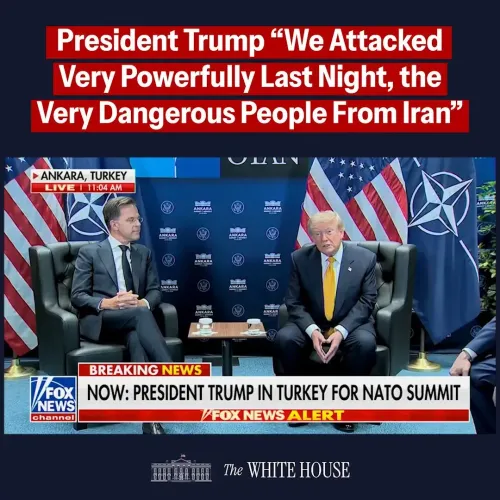
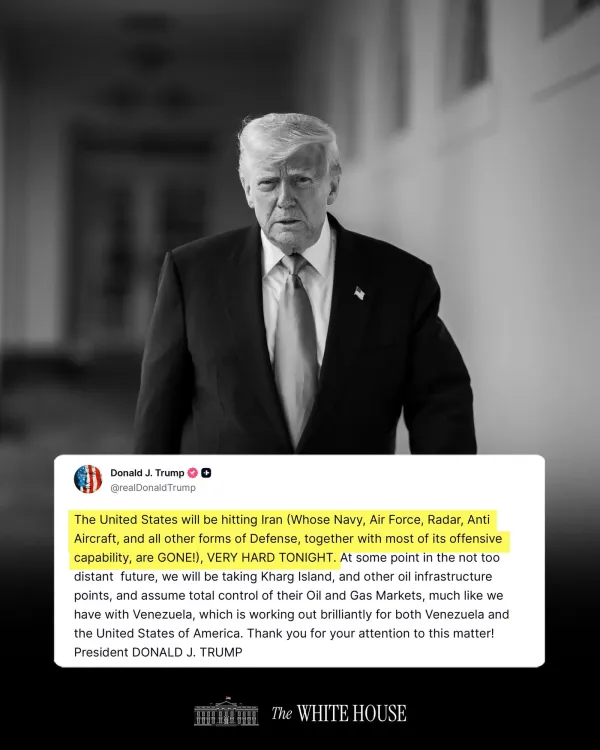
The White House, the official communications account of the Executive Office of the President of the United States, posted a statement on Thursday, June 11, 2026, quoting President Donald J. Trump announcing that the United States would strike Iran 'very hard tonight,' claiming that Iran's navy, air force, radar, anti-aircraft systems, and most of its offensive capability had already been destroyed.
Context
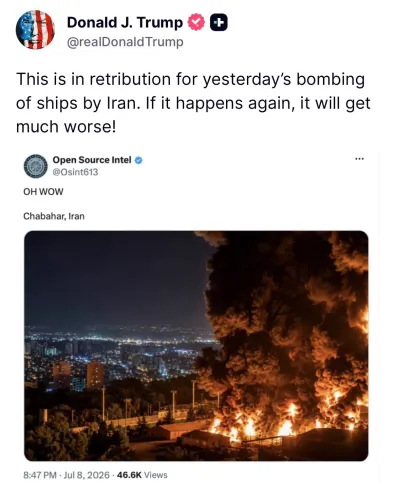
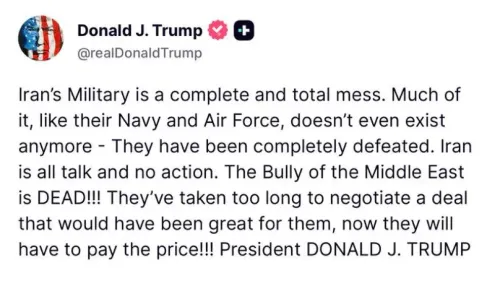
The statement, attributed directly to President Trump, reads: 'The United States will be hitting Iran (Whose Navy, Air Force, Radar, Anti Aircraft, and all other forms of Defense, together with most of its offensive capability, are GONE!), VERY HARD TONIGHT...' The post was published at 18:09 IST on June 11, 2026, and accompanied by one image. The language signals an active or imminent military operation, not a hypothetical threat.
The statement's parenthetical claim — that Iran's defensive and offensive military infrastructure has already been neutralised — implies prior strikes had already degraded Iranian capabilities before this announcement. No independent verification of those claims was available at the time of publication.
Policy Backdrop
US-Iran tensions have been a defining axis of American foreign policy for decades. President Trump, during his first term (2017–2021), withdrew the United States from the Joint Comprehensive Plan of Action (JCPOA) — the 2015 multilateral nuclear agreement — in May 2018, and reimposed sweeping economic sanctions on Tehran.
In January 2020, a US drone strike near Baghdad airport killed Iranian Major General Qasem Soleimani, commander of the Islamic Revolutionary Guard Corps' Quds Force. Iran retaliated with ballistic missile strikes on US bases in Iraq, raising fears of a broader regional war before tensions temporarily subsided. The current announcement, if followed by operational action, would represent a significant escalation beyond that episode.
Iran's nuclear programme and its network of regional proxies — spanning Iraq, Syria, Lebanon, Yemen, and Gaza — have remained the core flashpoints driving US military posture and sanctions policy toward Tehran.
Stakeholders and Impact
US armed forces and the Iranian military are the most immediate parties. Regional allies and adversaries alike — including Israel, Saudi Arabia, Iraq, and Turkey — face direct spillover risk from any large-scale exchange. Global energy markets are acutely sensitive to conflict in the Persian Gulf, through which a significant share of the world's crude oil transits via the Strait of Hormuz.
For India, the stakes are substantial: India is a major importer of West Asian crude and hosts a large diaspora in the Gulf region. Any sustained military conflict could affect oil prices, remittance flows, and the safety of Indian nationals in the area.
What's Next
Observers will closely watch for statements from the US Department of Defense confirming any operational follow-through, as well as emergency sessions of the UN Security Council. Reactions from European signatories to the JCPOA — including France, Germany, and the United Kingdom — and from Russia and China, both permanent members of the Security Council, will shape the international diplomatic response.
Congressional briefings on the legal and operational basis for any strike, and any Iranian counter-response, will define the next phase. The post's rhetoric of total Iranian military degradation, if borne out, would mark an unprecedented shift in the regional balance of power — with consequences extending well beyond West Asia.
Point of View
Time, and claimed prior damage, bypassing the usual diplomatic ambiguity. This fits a broader Trump-era pattern of using public declarations as instruments of pressure, but the specificity here — claiming Iran's defences are already 'GONE' — suggests either a major prior covert or overt operation or an attempt to psychologically pre-empt Iranian retaliation. For India and other non-aligned nations, the announcement forces an immediate recalibration of energy security and diaspora safety calculations. If operationally followed through, this would be the most significant direct US military action against a state actor since the 2003 Iraq invasion.
NationPress
20 Sept 2026
Frequently Asked Questions
Did the US attack Iran on June 11 2026?
The White House quoted President Trump on June 11, 2026, announcing that the United States would strike Iran 'very hard tonight.' Independent confirmation of any strike was not available at the time of this report.
What did Trump say about Iran's military?
President Trump's statement, as posted by the White House, claimed that Iran's navy, air force, radar, anti-aircraft systems, and most of its offensive capability had already been destroyed before this announcement.
How does this affect India?
India is a major importer of West Asian crude oil and has a large diaspora in the Gulf. Any sustained US-Iran military conflict risks higher oil prices, disrupted remittances, and potential danger to Indian nationals in the region.
What is the history of US-Iran military tensions?
Key flashpoints include the US withdrawal from the JCPOA nuclear deal in 2018, the killing of Iranian General Qasem Soleimani in a US drone strike in January 2020, and decades of sanctions and proxy conflicts across the Middle East.
What happens next after Trump's Iran strike announcement?
Observers are watching for US Department of Defense confirmation of any operation, emergency UN Security Council sessions, Congressional briefings on legal authority, and any Iranian counter-response.