White House: Trump committed to fighting state-led tyranny
Synopsis
The White House declared on 5 November 2026 that President Trump remains committed to fighting state-led tyranny, reiterating that America will never become a communist country — the latest in a long-running rhetorical theme targeting authoritarian governance at home and abroad.
Key Takeaways
The White House posted on 5 November 2026 that President Trump will 'always be committed to the fight against state-led tyranny.' The post declares: 'America will never, ever be a communist country.' The statement echoes Trump 's February 2019 State of the Union pledge that the U.S. would never become a socialist country.
The language targets China , Cuba , and Venezuela in its broader geopolitical context.
Analysts will watch for follow-up executive actions or legislative proposals reinforcing market-oriented or anti-foreign-influence policies.
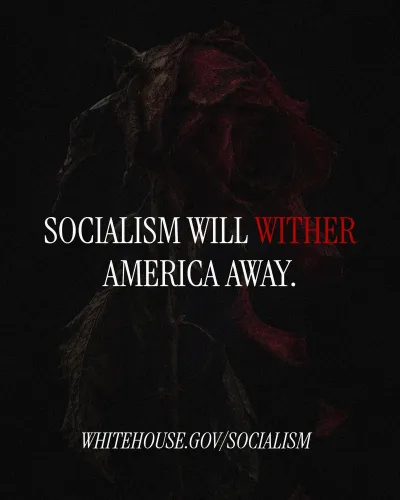
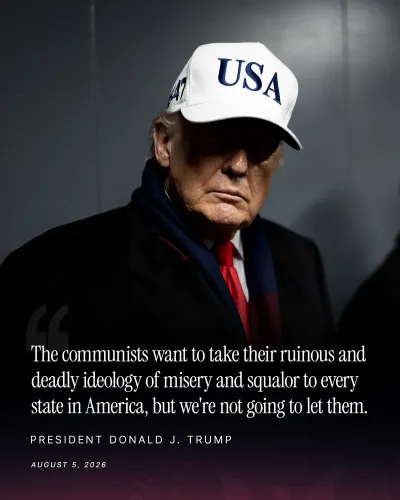
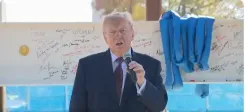
A declaration as old as the republic, restated with fresh urgency — the White House posted on X on 5 November 2026 that President Donald Trump 'will always be committed to the fight against state-led tyranny,' closing with an unambiguous pledge: 'America will never, ever be a communist country.'
A rhetorical line with deep roots in U.S. politics
The statement is the latest beat in one of the most consistent rhetorical throughlines in modern American governance. As far back as his February 2019 State of the Union address, Trump told Congress that the United States would 'never be a socialist country' — a line that drew a standing ovation and immediately entered the political lexicon. The 2026 post sharpens that framing, moving from 'socialist' to 'communist' and foregrounding the concept of 'state-led tyranny,' signalling a broader ideological target.
The geopolitical backdrop: China, Cuba, Venezuela
The language maps onto a long-running U.S. foreign-policy posture toward states Washington classifies as authoritarian communist governments — principally China, Cuba, and Venezuela. Invoking 'state-led tyranny' in a single breath with communism is a deliberate rhetorical coupling that links domestic-policy debates to international rivalry. It frames market-oriented governance not merely as economic preference but as a civilisational commitment. The phrasing has historically been deployed to push back against calls for expanded state intervention at home while simultaneously hardening diplomatic posture abroad.
What it signals, and what to watch
Statements from the official White House account carry weight beyond political rhetoric — they telegraph the administration's framing priorities, often preceding executive actions or legislative drives. Analysts tracking U.S. domestic policy will watch whether this post is followed by concrete executive orders or congressional proposals aimed at countering foreign influence operations or reinforcing free-market frameworks. The sharp, flag-emoji-punctuated brevity of the post also signals it is as much a mobilising message to Trump's political base as it is a governance statement.
In a political environment where the boundary between campaign energy and executive communication has blurred, the White House's choice to frame the presidency around the word 'always' — a word of permanence, not policy cycles — tells you exactly what register this message is meant to occupy.
Point of View
Absolute, and emotionally charged for a core constituency. By upgrading the 2019 'socialist' framing to 'communist' and pairing it with 'state-led tyranny,' the administration sharpens its contrast with geopolitical rivals such as China and Cuba while reinforcing a free-market, anti-interventionist domestic-policy identity. For Indian observers, the message is relevant: it telegraphs how the Trump administration will likely frame its foreign-policy alignments and trade negotiations, particularly with countries Washington categorises as adversarial. Whether rhetorical or prescriptive, statements from the official White House account consistently precede, or at minimum contextualise, executive action.
NationPress
5 Nov 2026
Frequently Asked Questions
What did the White House post about communism on November 5, 2026?
The White House posted that President Trump will always be committed to fighting state-led tyranny and that America will never, ever be a communist country.
Has Trump made similar anti-communism or anti-socialism statements before?
Yes. In his February 2019 State of the Union address, President Trump declared that America would never be a socialist country, a statement that became a signature political line.
Which countries does the US consider communist adversaries?
The United States has consistently identified China, Cuba, and Venezuela as the primary states it opposes on ideological and governance grounds related to communism and authoritarianism.
What could follow this White House statement on tyranny?
Analysts will watch for executive orders or legislative proposals targeting foreign influence operations or reinforcing free-market domestic policies, as such rhetorical statements from the White House often precede concrete policy moves.
Why does the White House use social media for such political declarations?
Official White House social media accounts serve as direct communication channels for the Executive Office, allowing the administration to frame its policy priorities and mobilise public support without intermediaries.