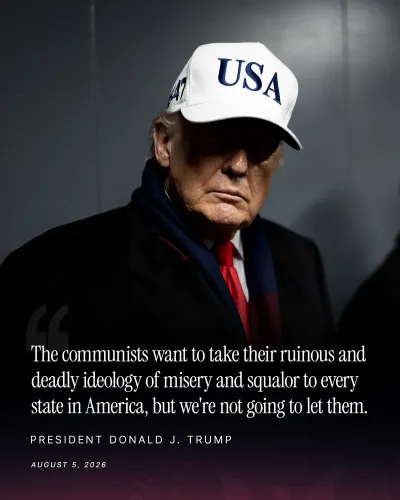
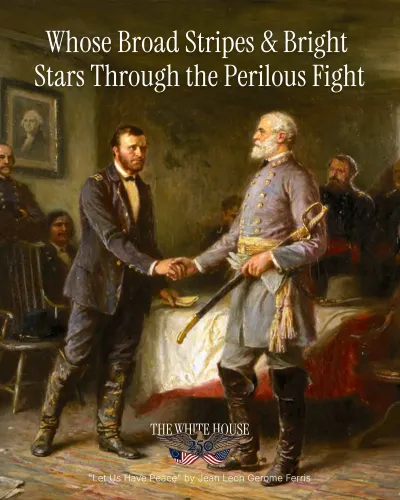
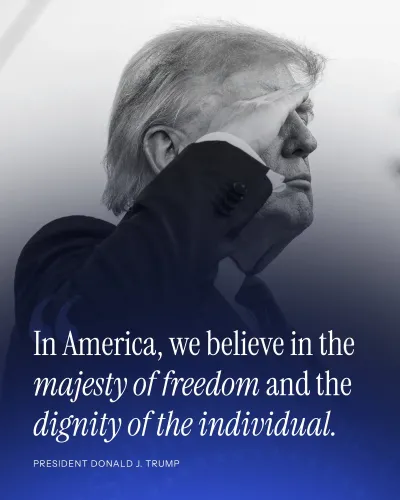
White House Declares Communism Antithetical to American Founding Values

Synopsis
The White House declared communism the 'exact opposite' of life, liberty, and the pursuit of happiness — invoking the Declaration of Independence to draw a sharp ideological line, echoing a Cold War-era framing that US administrations have deployed since the Truman Doctrine of 1947.
Key Takeaways
The White House posted that communism is 'the exact opposite of life, liberty, and the pursuit of happiness.' The three phrases are drawn directly from the Declaration of Independence of 1776 , the philosophical foundation of the United States.
The statement echoes the Truman Doctrine of 1947 , which formally framed US policy as opposition to communist expansion.
No specific country or event is named — the post is a broad ideological declaration from the Executive Office of the President.
US administrations across party lines have periodically returned to this founding-creed language when addressing ideological rivals.
In a pointed ideological declaration, the White House drew a sharp line between communism and the foundational principles of the United States, invoking the country's most sacred founding creed — life, liberty, and the pursuit of happiness — to frame the contrast.
The official White House post stated plainly: 'Communism is the exact opposite of life, liberty, and the pursuit of happiness — the very principles America was founded on.' The statement requires no diplomatic translation; it is a direct ideological assertion from the executive office of the world's most powerful democracy.
A Creed From 1776, Weaponised in 2026
The three phrases the White House invoked are not rhetorical flourishes — they are the precise language of the Declaration of Independence, drafted in 1776 and adopted by the Continental Congress as the philosophical bedrock of the American republic. Thomas Jefferson's formulation — that all men are endowed with the unalienable rights of life, liberty, and the pursuit of happiness — has anchored American political identity for 250 years.
Placing communism as the 'exact opposite' of that creed is a deliberate rhetorical move. It does not merely criticise a system of government; it positions communism as fundamentally incompatible with what it means to be American.
Cold War Echoes, Modern Stakes
This is not the first time the White House has reached for this framing. The lineage runs back to the Truman Doctrine of 1947, when President Harry Truman stood before Congress and explicitly cast US foreign policy as a bulwark against communist expansion — a framework that defined American strategy for four decades. Administrations across party lines have periodically returned to this language when making the case against ideological or geopolitical rivals.
What makes such a statement notable is its brevity and bluntness. It carries no policy prescription, names no country, and targets no specific event. It is a pure values statement from the official communications channel of the Executive Office of the President — and in the current global environment, the audience is as much international as domestic.
Why It Lands Differently Now
Ideological contrasts between American democracy and communist governance have sharpened in recent years as great-power competition with China and tensions involving Cuba, Venezuela, and other states have kept the question of competing political systems firmly in public discourse. A crisp White House post stripping the debate to its founding-document essentials signals that the executive branch wants that contrast heard — loudly and clearly.
The American founding fathers chose 'the pursuit of happiness' — not the guarantee of it. That distinction, the White House implicitly argues, is everything.
Point of View
The executive office makes the claim maximally durable and maximally shareable. In a 2026 geopolitical environment defined by US-China strategic competition and ongoing pressure on states like Cuba and Venezuela, such baseline ideological messaging serves as a foundation layer for future, more concrete policy pronouncements. It is worth watching whether this post precedes a foreign-policy announcement or a domestic political push — stripped of specifics, it can serve either purpose.
NationPress
4 Nov 2026
Frequently Asked Questions
What did the White House say about communism?
The White House stated that 'communism is the exact opposite of life, liberty, and the pursuit of happiness — the very principles America was founded on,' invoking the language of the Declaration of Independence.
What are 'life, liberty, and the pursuit of happiness'?
These are the three unalienable rights enumerated in the US Declaration of Independence, adopted in 1776, and are considered the philosophical cornerstone of American democracy.
Why does the US oppose communism?
US opposition to communism is rooted in both ideological and geopolitical grounds, formally articulated since the Truman Doctrine of 1947, which positioned the United States as a defender of free peoples against communist expansion.
Is this White House communism statement directed at a specific country?
The White House post names no specific country. It is a broad ideological declaration contrasting communism with American founding values, though it comes amid ongoing US strategic competition with China and tensions with Cuba and Venezuela.
How does this White House post fit into US political history?
US administrations since Harry Truman have periodically framed American foreign and domestic policy as a defence of founding ideals against communism. The 2026 White House post continues that tradition in concise, social-media-era form.