White House Declares Iran's Military 'Completely Defeated'
Synopsis
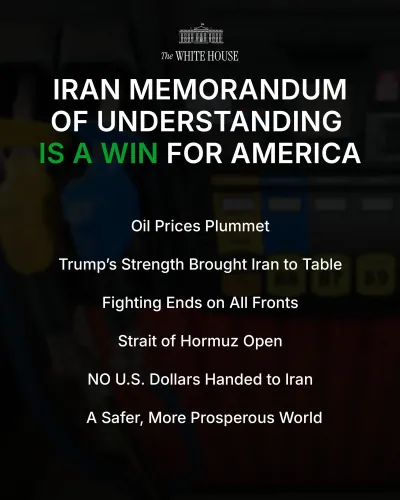
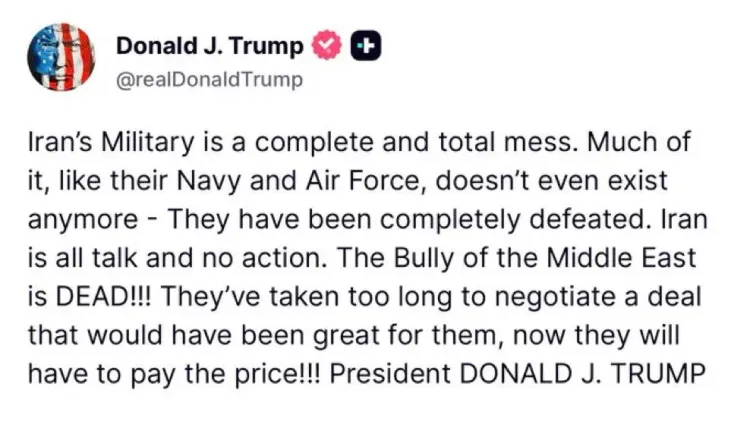
The White House on June 10, 2026 declared Iran's military 'completely defeated,' claiming its Navy and Air Force no longer exist. The post, referencing stalled negotiations, called Iran 'the Bully of the Middle East' — marking a sharp escalation in US rhetoric toward Tehran with major implications for regional stability and diplomacy.
Key Takeaways
The White House posted on June 10, 2026 declaring Iran's military 'completely defeated.' The post specifically claims Iran's Navy and Air Force 'don't even exist anymore.' The White House referred to Iran as 'the Bully of the Middle East' and declared it 'DEAD.' The post alludes to stalled negotiations, saying Iran has 'taken too long to negotiate a deal.' The US withdrew from the JCPOA in 2018 and has since maintained a maximum-pressure sanctions posture toward Tehran .
India and Gulf states face potential downstream effects on energy supply, trade routes, and regional security.
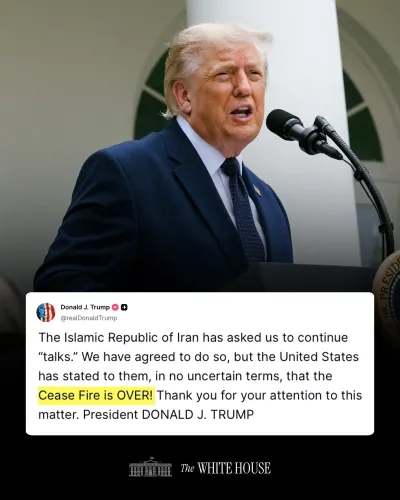
The White House, the official communications account of the Executive Office of the President of the United States, on Wednesday, June 10, 2026, posted a sweeping declaration on X asserting that Iran's military has been 'completely defeated' and that the country is 'all talk and no action.'
What the Post Says
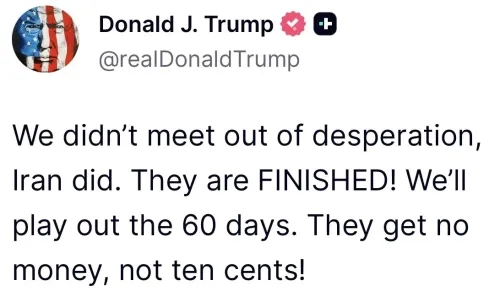
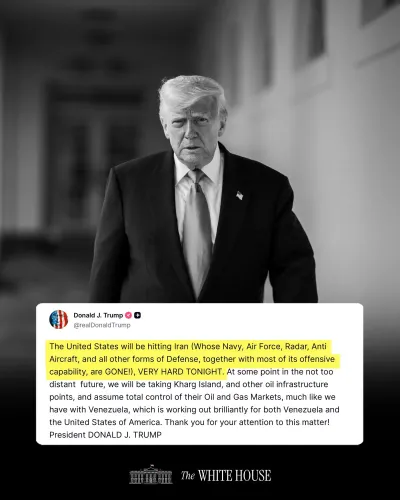
The post states that Iran's military is a 'complete and total mess,' with specific branches — including the Navy and Air Force — described as no longer existing. The language is pointed and declaratory: 'The Bully of the Middle East is DEAD!!!' The post also alludes to ongoing or stalled negotiations, noting that Iran has 'taken too long to negotiate a deal,' though the specific nature of those talks is not elaborated upon in the post itself.
The post includes a link whose destination content is not independently verifiable at this time. The White House did not, in the post text, provide evidentiary details to support the military-defeat claims.
Context
Iran has long maintained a military posture built around asymmetric capabilities — ballistic missiles, regional proxy networks, and naval presence in the Persian Gulf — rather than conventional force projection. Washington and Tehran have been in a state of sustained strategic rivalry for decades, with that tension punctuated by cycles of diplomacy and escalation.
The 2015 Joint Comprehensive Plan of Action (JCPOA) represented the most significant diplomatic breakthrough, placing limits on Iran's nuclear enrichment in exchange for sanctions relief. The United States withdrew from the JCPOA in 2018 and reimposed sweeping economic sanctions, initiating what became known as the 'maximum pressure' campaign. That framework of economic isolation and sharp rhetoric toward Tehran has defined much of Washington's posture in the years since.
Policy Backdrop
The phrase 'Bully of the Middle East' echoes prior maximum-pressure messaging used by US administrations to justify diplomatic and economic isolation of Iran. Framing Iran as a regional aggressor has historically been used to consolidate Gulf state alignment with Washington and to build international support for sanctions enforcement.
The reference to a 'deal' in the post suggests that some form of negotiation — likely relating to nuclear limits, sanctions relief, or a broader security arrangement — has been underway. The characterisation that Iran has 'taken too long' implies frustration with the pace or terms of those talks. Independent assessments of Iran's current military and nuclear status, as well as the status of any active negotiations, have not been confirmed through verifiable open sources at the time of publication.
Stakeholders and Impact
Gulf states, including Saudi Arabia, the United Arab Emirates, and Israel, have long viewed Iranian military reach as a primary security concern. A formal declaration of Iran's military defeat — if substantiated — would represent a seismic shift in the regional balance of power. India, which has significant energy, trade, and diaspora ties with both Iran and the broader Middle East, would face immediate implications for oil supply chains, shipping routes through the Strait of Hormuz, and the welfare of its large expatriate community in the Gulf.
The Iranian government has not, as of this report, issued a public response to the White House post.
What's Next
Attention will now turn to whether the White House follows this declaration with formal policy announcements — including any new sanctions architecture, a revised nuclear framework, or a bilateral or multilateral agreement. Statements from the International Atomic Energy Agency (IAEA) and remaining signatories of the JCPOA will be closely watched for any corroboration or contradiction of the claims made. The trajectory of US-Iran relations in the coming weeks will be a key indicator of whether this post marks a rhetorical escalation or a genuine turning point in Middle East diplomacy.
Point of View
Going well beyond the rhetorical bounds of the prior maximum-pressure campaign. By declaring Iran's Navy and Air Force as effectively non-existent, the statement — if backed by formal policy action — would signal a fundamental restructuring of the US posture in the Middle East. The reference to a stalled 'deal' suggests this declaration may be designed as coercive leverage in an ongoing negotiation rather than a purely factual military assessment. For India, which has carefully balanced ties with both Washington and Tehran, the sharpening of this binary will complicate its energy security calculus and its traditional policy of strategic autonomy.
NationPress
13 Sept 2026
Frequently Asked Questions
What did the White House say about Iran's military on June 10 2026?
The White House declared on June 10, 2026 that Iran's military is a 'complete and total mess' and has been 'completely defeated,' specifically claiming that Iran's Navy and Air Force no longer exist.
Is the US negotiating a deal with Iran in 2026?
The White House post alludes to ongoing negotiations, stating Iran has 'taken too long to negotiate a deal,' but did not specify the nature or current status of those talks. Independent confirmation of active negotiations is not available at the time of publication.
What is the JCPOA and why does it matter?
The JCPOA, or Joint Comprehensive Plan of Action, was a 2015 agreement between Iran and six world powers — including the US — that limited Iran's nuclear enrichment in exchange for sanctions relief. The United States withdrew from the agreement in 2018 and reimposed broad economic sanctions on Iran.
How does the US-Iran conflict affect India?
India has significant stakes in US-Iran tensions due to its dependence on Gulf energy supplies, trade routes through the Strait of Hormuz, and a large Indian diaspora in the Gulf region. Any major shift in the regional balance of power directly impacts Indian foreign policy and energy security.
What has Iran's military capability historically looked like?
Iran has traditionally relied on asymmetric military capabilities — including ballistic missiles and regional proxy networks — rather than conventional force projection. Independent assessments of any significant degradation of those capabilities have not been publicly confirmed as of this report.