Joshi Highlights India as Low-Cost Solar Power Market
Synopsis
Union Minister Pralhad Joshi on 4 July 2026 amplified a report confirming India's emergence as one of the world's lowest-cost major solar markets, underscoring the impact of a decade of policy-driven auction frameworks and the country's 500 GW clean energy target for 2030.
Key Takeaways
Union Minister Pralhad Joshi shared a report on 4 July 2026 identifying India as one of the lowest-cost major solar power markets globally.
India's solar cost competitiveness stems from competitive auction frameworks initiated under the Jawaharlal Nehru National Solar Mission launched in 2010 .
India has committed to 500 GW of non-fossil fuel capacity by 2030 , a pledge made at the COP26 Glasgow summit in 2021 .
The International Solar Alliance , co-founded by India and France in 2015 , reinforces India's multilateral leadership in solar deployment.
Domestic manufacturing support through production-linked incentives complements auction-driven tariff reductions, strengthening India's global solar position.
Upcoming state renewable purchase obligation revisions and the next Union Budget will be key indicators of whether the cost-reduction momentum is sustained.
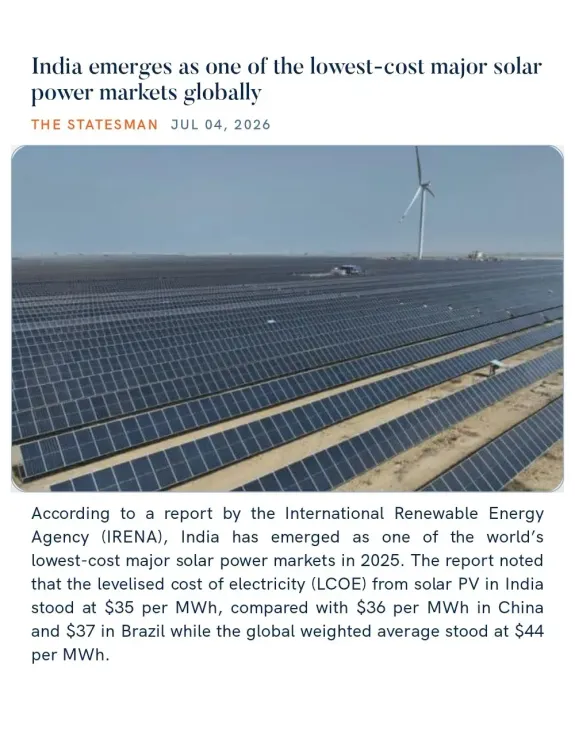
Union Minister of New and Renewable Energy Pralhad Joshi on Saturday, 4 July 2026, shared a report highlighting that India has emerged as one of the lowest-cost major solar power markets in the world, amplifying the finding through the NaMo App.
Context
The minister shared the report underscoring India's position as a globally competitive solar market on cost metrics. The development is significant given India's scale of solar deployment and the trajectory of tariff discovery through competitive auctions over the past decade.
Joshi holds charge of the Ministry of New and Renewable Energy alongside the Ministry of Consumer Affairs, Food and Public Distribution, making him the principal cabinet voice on India's clean energy transition.
Policy Backdrop
India's cost competitiveness in solar power is rooted in a sustained policy architecture. The Jawaharlal Nehru National Solar Mission, launched in 2010, set an initial target of 20 GW that was progressively scaled upward, driving successive rounds of competitive solar auctions that pushed tariffs lower with each cycle.
At the COP26 summit in Glasgow in 2021, India committed to achieving 500 GW of non-fossil fuel electricity capacity by 2030. Large-scale auction frameworks, combined with production-linked incentive schemes to build domestic manufacturing, have formed the twin pillars of this strategy.
India is also a co-founder of the International Solar Alliance, the India-France led treaty organisation established in 2015 to accelerate solar deployment among member nations — a multilateral platform that reinforces India's role as a global solar leader.
Stakeholders and Impact
The cost reduction trajectory benefits a wide set of stakeholders. Solar developers and renewable energy investors gain greater project viability and return certainty, while power consumers — industrial, commercial, and household — stand to benefit from more affordable electricity over time.
India's low-cost positioning also strengthens its attractiveness as a destination for global clean energy capital, particularly as developed economies seek to diversify supply chains away from a single dominant manufacturer base.
Domestic manufacturers supported under production-linked incentive schemes are positioned to capture a larger share of the value chain as the market scales, reinforcing both energy security and industrial growth objectives.
What's Next
Attention will now turn to the pace of fresh solar auction announcements and any revision to state-level renewable purchase obligations, which determine how much clean power distribution companies are mandated to procure. These obligations are a key demand-side lever for sustaining the cost-reduction momentum.
With the next Union Budget on the horizon, the solar sector will watch for continued fiscal support — including customs duty structures on equipment and incentives for domestic cell and module manufacturing — that can consolidate India's low-cost advantage on the global stage.
Point of View
The minister's endorsement keeps policy attention and potential fiscal support in focus at a critical juncture for domestic manufacturing ambitions.
NationPress
3 Oct 2026
Frequently Asked Questions
Why is India considered one of the lowest-cost solar markets in the world?
India's low solar costs are the result of competitive large-scale auctions that have driven tariff reductions over successive years, supported by the Jawaharlal Nehru National Solar Mission since 2010 and production-linked incentives for domestic manufacturing.
What is India's solar energy target for 2030?
India has committed to achieving 500 GW of non-fossil fuel electricity capacity by 2030, a pledge made at the COP26 climate summit in Glasgow in 2021.
What is the International Solar Alliance and what is India's role?
The International Solar Alliance is a treaty organisation co-founded by India and France in 2015 to accelerate solar deployment among member countries, with India playing a central leadership role.
What did Pralhad Joshi say about solar power in India?
On 4 July 2026, Minister Pralhad Joshi shared a report stating that India has emerged as one of the lowest-cost major solar power markets globally, highlighting the country's progress in clean energy.
How do solar auctions in India help reduce electricity costs?
Competitive solar auctions create price discovery pressure among developers, consistently pushing quoted tariffs lower with each successive bidding round, making solar-generated electricity progressively cheaper for consumers and distribution companies.