Joshi Highlights India's Solar Industrialisation Lead
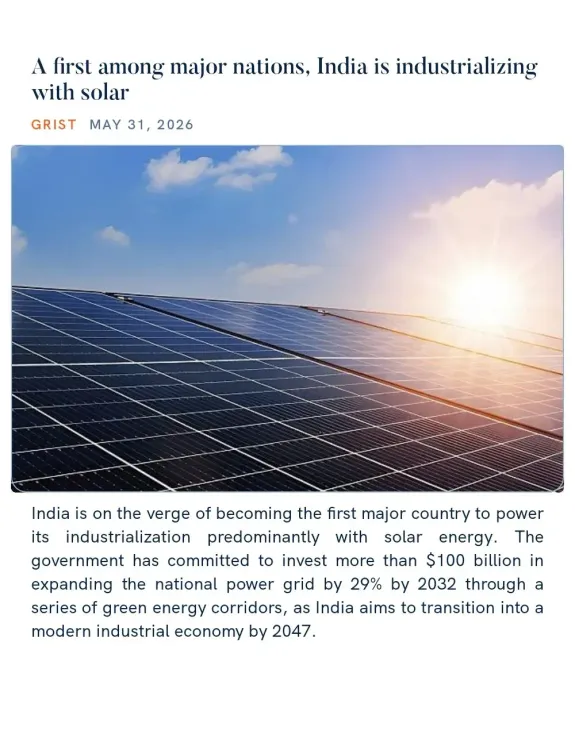
Synopsis
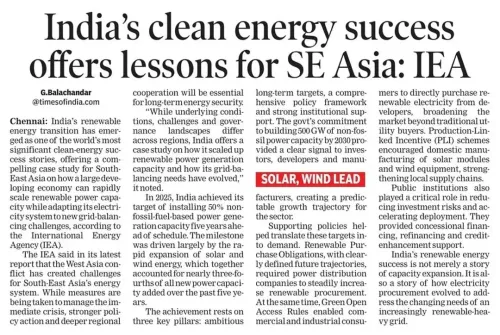
Union Minister Pralhad Joshi amplified a report on 1 June 2026 arguing India is the first major nation to industrialise alongside solar expansion. The claim draws on India's rise to third-largest solar producer and its 500 GW non-fossil target by 2030, backed by the PLI manufacturing scheme and the International Solar Alliance.
Key Takeaways
Pralhad Joshi shared an article on 1 June 2026 calling India the first major nation to industrialise with solar energy simultaneously.
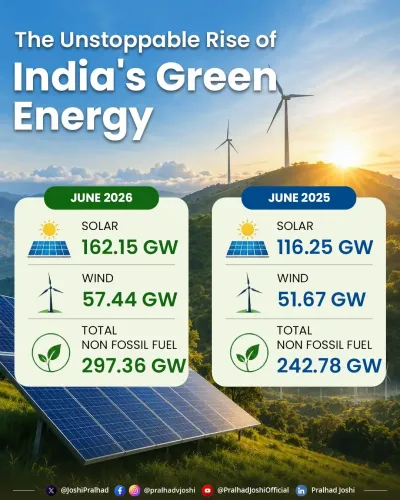
India is the third-largest solar power producer globally, scaling from under 1 GW in 2010 to tens of gigawatts today.
The country has committed to 500 GW of non-fossil fuel capacity by 2030 and net-zero by 2070 , pledged at COP26 .
The Production Linked Incentive (PLI) scheme for solar PV modules, launched in 2020 , aims to build domestic manufacturing and cut import dependence.
India co-founded the International Solar Alliance with France in 2015 , reinforcing its role as a global solar diplomacy leader.
Progress on PLI manufacturing rounds and future Union Budget targets will be key indicators of whether India sustains its solar-industrial dual track.
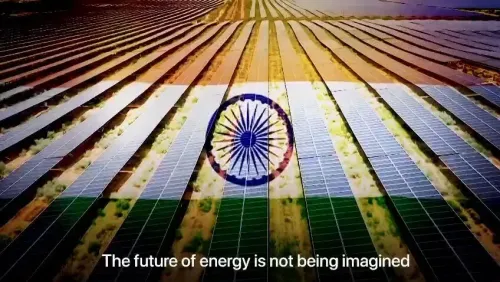
Union Minister of New and Renewable Energy Pralhad Joshi on Sunday, 1 June 2026 shared an article arguing that India has become the first major nation to pursue simultaneous industrialisation and large-scale solar energy deployment, amplifying the piece through the NaMo App.
Context
The article shared by Joshi frames India's solar expansion not merely as an energy transition but as an industrial strategy — a distinction that sets the country apart from other large economies that scaled solar after their primary industrialisation phases. By sharing the piece via the NaMo App, Joshi signalled alignment between the central government's energy narrative and the broader development story the ruling party has promoted.
India is currently the third-largest solar power producer globally, having scaled installed capacity from under 1 GW in 2010 to tens of gigawatts through successive central and state-level programmes. The country has committed to reaching 500 GW of non-fossil fuel capacity by 2030 and achieving net-zero emissions by 2070, targets formalised at COP26 in 2021.
Policy Backdrop
The foundation of India's solar push dates to the Jawaharlal Nehru National Solar Mission, launched in 2010, which set early targets for both grid-connected and off-grid solar applications. A decade later, the government introduced the Production Linked Incentive (PLI) scheme for high-efficiency solar photovoltaic modules in 2020, designed explicitly to build domestic manufacturing capacity and reduce dependence on imported panels.
India is also a founding member of the International Solar Alliance (ISA), the treaty-based multilateral body co-launched by India and France in 2015 to accelerate solar deployment among member countries. The ISA has positioned India as a global convener on solar diplomacy, reinforcing the domestic industrial narrative with an outward-facing dimension.
As Minister holding the New and Renewable Energy portfolio, Joshi oversees the implementation of PLI rounds, capacity auction timelines, and coordination with state distribution companies — making his amplification of the 'industrialisation-with-solar' framing a signal of the ministry's current messaging priorities.
Stakeholders and Impact
Domestic solar manufacturers stand to benefit most directly from the industrialisation framing, as it strengthens the policy rationale for continued PLI support and import tariffs on foreign panels. The argument that solar growth is additive to — rather than a replacement for — industrial output addresses a concern raised by energy-intensive industries about the pace of transition.
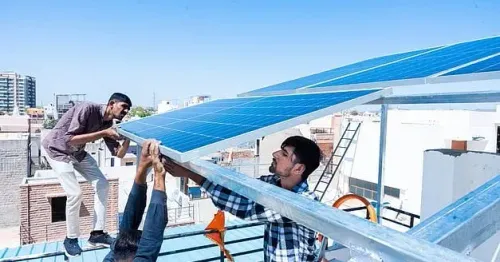
Electricity consumers, particularly in states with high renewable procurement mandates, are the downstream beneficiaries of expanded solar capacity, which has helped moderate wholesale power costs in several markets. For rural and semi-urban households still on unreliable grids, off-grid and rooftop solar programmes linked to the broader mission remain a practical touchpoint.
What's Next
Analysts and industry stakeholders will watch the progress of successive PLI solar manufacturing rounds and any revised capacity or tender targets announced in forthcoming Union Budgets or Ministry of New and Renewable Energy reviews. Whether India can sustain the dual track of rapid deployment and domestic manufacturing scale-up — without the supply-chain bottlenecks that have periodically delayed auctions — will determine how durable the 'first among major nations' claim remains.
With 2030 now under four years away, the gap between installed capacity and the 500 GW target will increasingly define the political and policy conversation around India's energy transition.
Point of View
Linking energy transition to economic nationalism at a time when the government faces scrutiny over manufacturing job creation. By foregrounding solar as an industrial story rather than an environmental one, the ministry aligns renewable energy with the 'Make in India' arc, making it politically easier to defend import tariffs and PLI outlays. The NaMo App distribution channel ensures the message reaches a party-aligned audience primed to receive it as a development achievement. With the 2030 deadline approaching, such framing also pre-empts criticism if capacity targets fall short by recasting the metric of success from gigawatts alone to industrial capacity built.
NationPress
14 Oct 2026
Frequently Asked Questions
Why did Pralhad Joshi share the solar article on NaMo App?
Joshi shared the article through the NaMo App on 1 June 2026 to amplify the argument that India is the first major nation to industrialise alongside large-scale solar deployment, aligning the message with the ruling party's development narrative.
Is India really the first major nation to industrialise with solar energy?
The claim, drawn from the article Joshi shared, rests on the argument that India is scaling solar capacity while still in an active industrialisation phase — unlike Western economies that deployed solar after their primary industrial growth. This framing is contested and depends on how 'industrialisation' is defined.
What is India's solar energy target for 2030?
India has committed to achieving 500 GW of non-fossil fuel electricity capacity by 2030, a target formalised in its updated Nationally Determined Contributions submitted at COP26 in 2021.
What is the PLI scheme for solar panels in India?
The Production Linked Incentive scheme for high-efficiency solar photovoltaic modules was announced in 2020 to incentivise domestic manufacturing of solar panels and reduce India's dependence on imported, primarily Chinese, components.
What is the International Solar Alliance and India's role in it?
The International Solar Alliance is a treaty-based multilateral organisation co-launched by India and France in 2015 to accelerate solar energy deployment among member countries. India serves as a founding host nation and has used the ISA to project solar diplomacy globally.