Rijiju: Cabinet Clears NIPU-2026 for Urea Self-Sufficiency
Synopsis
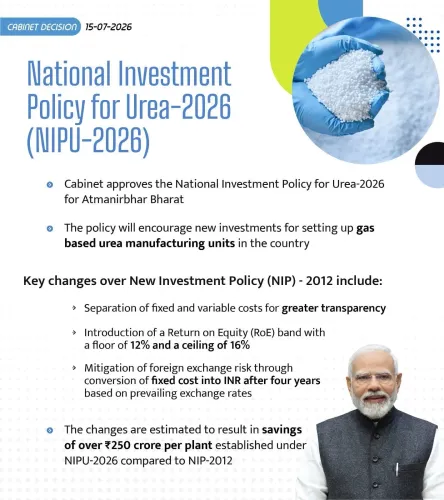
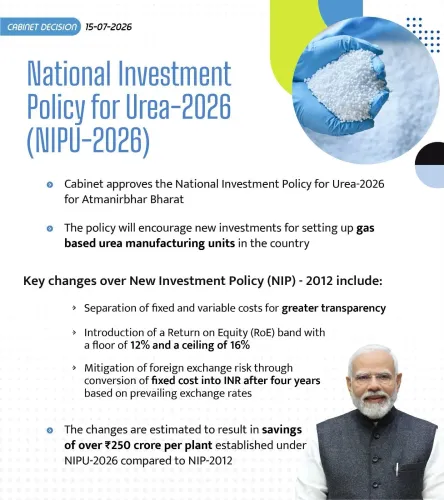
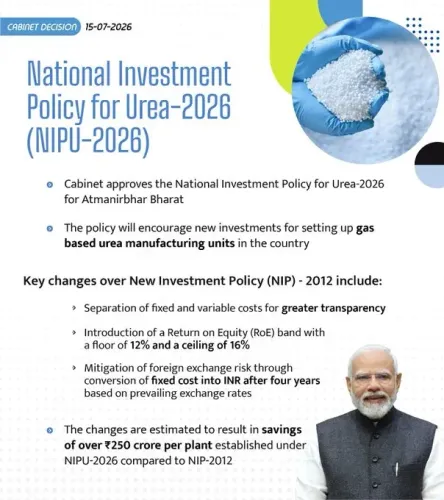
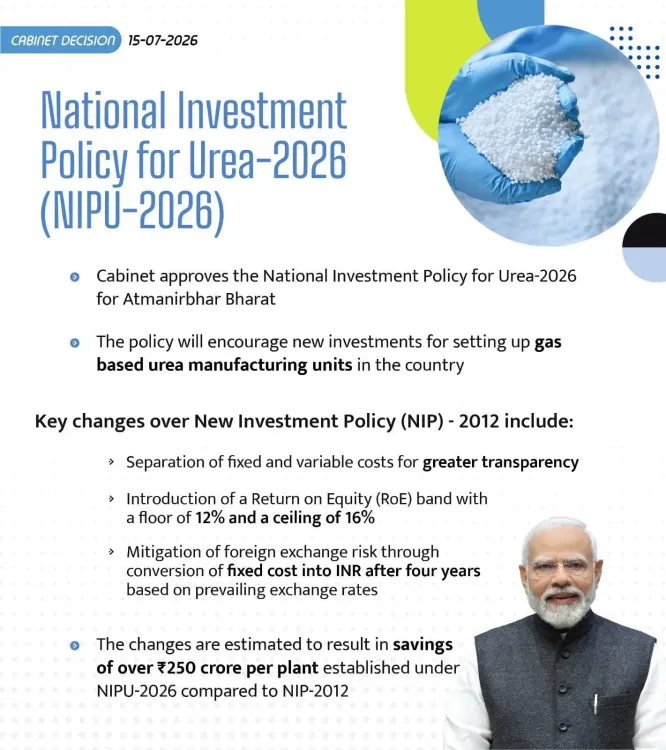
The Union Cabinet on July 16, 2026, approved the National Investment Policy for Urea-2026 (NIPU-2026), a framework to promote gas-based urea manufacturing in India. Announced by Minister Kiren Rijiju, the policy continues the Atmanirbhar Bharat push to reduce India's roughly 20 percent urea import dependence.
Key Takeaways
The Union Cabinet approved the National Investment Policy for Urea-2026 (NIPU-2026) on July 16, 2026 .
The policy was proposed by the Department of Fertilizers and is anchored in the Atmanirbhar Bharat self-reliance programme.
India currently meets only about 80 percent of its urea demand domestically, importing the rest from countries including China and Oman .
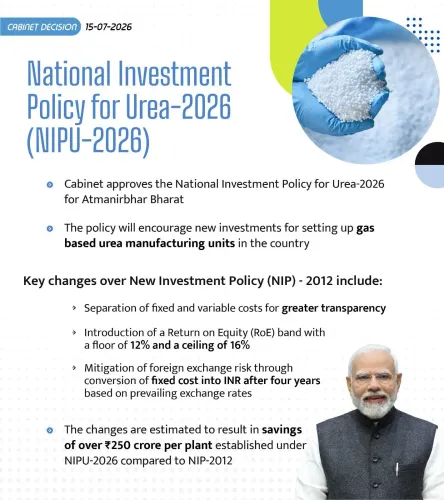
NIPU-2026 specifically targets new investments in gas-based urea manufacturing units to align with expanding pipeline infrastructure.
The policy follows earlier interventions including the New Investment Policy for Urea (2012) and the New Urea Policy 2015 .
Key next steps include gazette notification of guidelines, incentive structures, and parliamentary scrutiny of implementation.
Union Parliamentary Affairs Minister Kiren Rijiju on Thursday, July 16, 2026, announced that the Union Cabinet has approved the National Investment Policy for Urea-2026 (NIPU-2026), a new framework aimed at attracting fresh investment into gas-based urea manufacturing and reducing India's dependence on imported fertilizers.
Context
Posting on X, Rijiju stated that the policy — cleared under the leadership of Prime Minister Narendra Modi — is designed to 'encourage new investments in gas-based urea manufacturing units across the country' and to 'advance India's goal of self-sufficiency.' The announcement was tagged under #CabinetDecisions, signalling it as part of the broader post-cabinet communication drive.
The Department of Fertilizers, which operates under the Ministry of Chemicals and Fertilisers, had moved the proposal for NIPU-2026. The policy is framed within the Atmanirbhar Bharat self-reliance programme that Prime Minister Modi launched in 2020, which had identified agri-inputs including fertilizers as a priority sector.
Policy Backdrop
India currently meets only around 80 percent of its urea demand through domestic production, with the remainder sourced from countries including China, Oman, and other suppliers. This import dependence has long been a pressure point for both the agriculture budget and India's energy-security calculus.
The government has pursued a series of policy interventions to close this gap. The New Investment Policy for Urea (2012) was the first structured attempt to attract capital into the sector, followed by the New Urea Policy 2015, which introduced fiscal incentives and pricing reforms to expand domestic capacity. NIPU-2026 represents the latest iteration of this multi-decade effort, with a specific focus on gas-based plants that align with the expanding natural gas pipeline network across the country.
Successive administrations have favoured gas-based urea manufacturing for its relatively lower carbon footprint compared with naphtha-based or coal-based alternatives, and because expanded pipeline infrastructure now makes natural gas more accessible to potential plant sites across India.
Stakeholders and Impact
The policy's primary beneficiaries are expected to be fertilizer manufacturers looking to set up or expand urea production capacity, and ultimately Indian farmers who depend on affordable and reliable urea supply for kharif and rabi crops. Urea is the most widely used nitrogenous fertilizer in India and plays a central role in food security.
For industry, the approval of a dedicated investment policy signals that the government intends to provide a stable and predictable regulatory environment for new capital commitments in the sector. The emphasis on gas-based units is also expected to align new projects with India's broader energy transition goals.
What's Next
The Cabinet approval marks the beginning of the implementation phase. Stakeholders and analysts will now watch for the formal gazette notification of NIPU-2026 guidelines, specific financial incentive structures, and any follow-up budgetary allocations that back the policy with public funds. Parliamentary questions on implementation timelines and investment commitments are also likely as the policy moves from announcement to execution.
If NIPU-2026 succeeds in attracting significant new capacity, it could meaningfully reduce India's urea import bill and strengthen the country's food-production supply chain — a goal that has eluded full realisation despite more than a decade of targeted policy effort.
Point of View
A structural vulnerability that affects both farm economics and import expenditure. By explicitly targeting gas-based units, the policy ties fertilizer strategy to the broader energy-infrastructure buildout — a linkage that has gained traction as the national gas grid has expanded. The announcement's framing under Atmanirbhar Bharat also serves a political purpose, reinforcing the self-reliance narrative ahead of potential legislative sessions where farm input costs are a perennial flashpoint. Whether the policy translates into actual investment commitments will depend on the financial incentives in the detailed guidelines, which are yet to be notified.
NationPress
16 Jul 2026
Frequently Asked Questions
Why does India need a new urea investment policy?
India currently produces only about 80 percent of its urea requirement domestically and imports the rest from countries like China and Oman. A dedicated investment policy aims to attract capital into new manufacturing capacity to close this gap.
What is the role of the Department of Fertilizers in NIPU-2026?
The Department of Fertilizers, under the Ministry of Chemicals and Fertilisers, prepared and moved the NIPU-2026 proposal that was subsequently approved by the Union Cabinet.
How does NIPU-2026 relate to Atmanirbhar Bharat?
NIPU-2026 is explicitly framed as part of the Atmanirbhar Bharat self-reliance programme launched in 2020, which identified fertilizers and other agri-inputs as priority sectors for domestic production.
What comes after the Cabinet approval of NIPU-2026?
After Cabinet approval, the next steps include the formal gazette notification of policy guidelines, announcement of specific financial incentives, and potential budgetary allocations to support new urea manufacturing investments.