Rijiju: Cabinet OKs ₹3,907 Cr Rail Projects in Odisha, Jharkhand
Synopsis
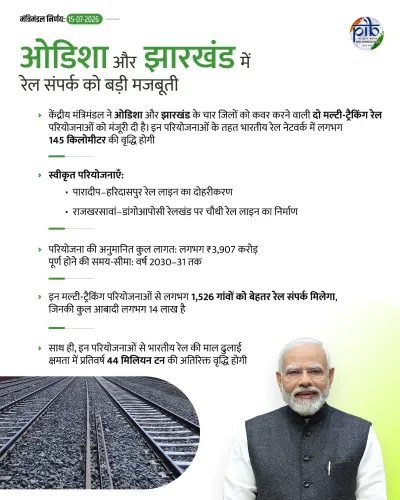
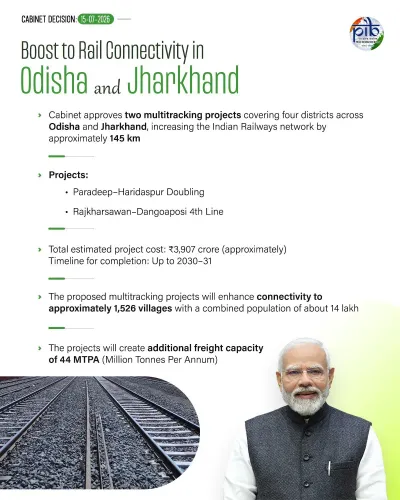
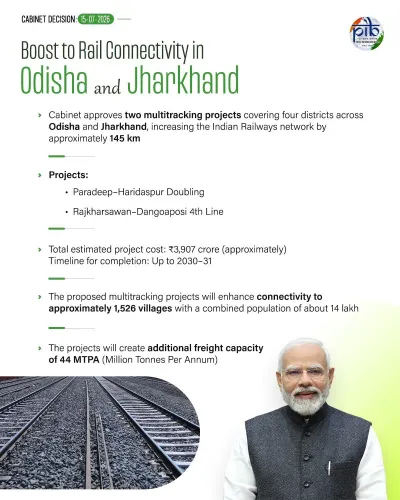
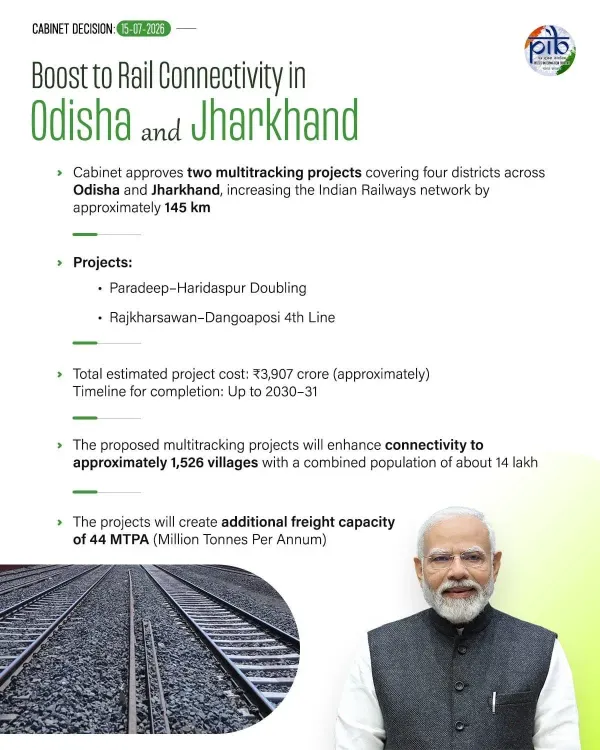
The Union Cabinet has cleared two multitracking rail projects across four districts in Odisha and Jharkhand, adding about 145 km to the Indian Railways network at a cost of ₹3,907 crore, with completion targeted by 2030–31.
Key Takeaways
The Union Cabinet approved two rail multitracking projects covering four districts across Odisha and Jharkhand .
The projects will add approximately 145 km to the existing Indian Railways network.
Combined estimated cost is ₹3,907 crore , to be funded through budgetary and extra-budgetary resources.
Targeted completion date is 2030–31 , aligned with Railways' medium-term modernisation roadmap.
The approvals fall under the PM Gati Shakti National Master Plan framework for multimodal infrastructure coordination.
Both states are high-freight corridors serving coal, iron ore, and steel industries, making capacity expansion strategically significant.
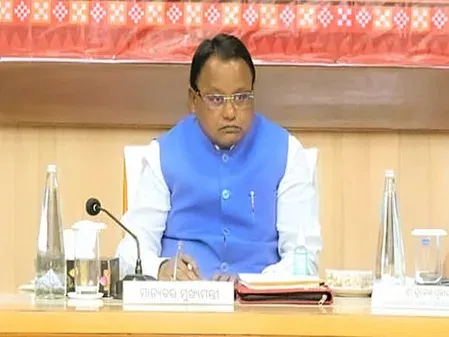
Union Parliamentary Affairs Minister Kiren Rijiju announced on Thursday, 16 July 2026 that the Union Cabinet has approved two multitracking rail projects spanning four districts across Odisha and Jharkhand, adding approximately 145 km to the existing Indian Railways network at an estimated cost of ₹3,907 crore, with a targeted completion by 2030–31.
Context
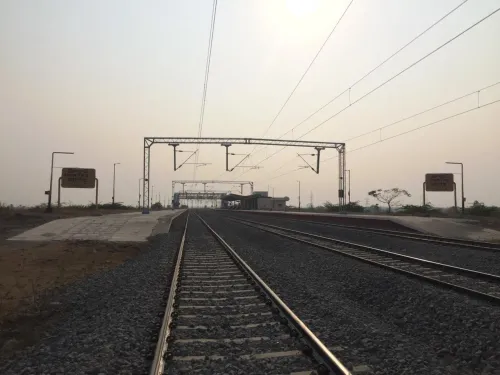
Rijiju credited the approvals to the leadership of Prime Minister Narendra Modi, framing the decision as part of the government's broader push to strengthen India's rail infrastructure. The Cabinet clearance covers two separate multitracking projects that together will expand rail capacity across four districts in the two mineral-rich eastern states. Multitracking — adding parallel tracks to existing rail corridors — directly increases line capacity for both freight and passenger movement without requiring entirely new alignments.
Policy Backdrop
The approvals sit within a well-established policy architecture. The PM Gati Shakti National Master Plan, launched in 2021, set out a framework for coordinating multimodal infrastructure investment, with rail multitracking a central pillar. Indian Railways has been pursuing an annual target of completing 5,000 km of track doubling and multitracking, a goal announced in the 2022–23 Union Budget.
Odisha and Jharkhand are among India's most freight-intensive rail zones, with corridors carrying coal, iron ore, steel, and other minerals from mines to ports and industrial hubs. Successive governments have prioritised capacity augmentation on these routes to ease congestion and reduce dependence on road freight. The Eastern Dedicated Freight Corridor, approved in 2006 and progressively commissioned from 2018 onward, forms a complementary spine to the kind of multitracking projects now being cleared through the Cabinet.
Stakeholders and Impact
The primary beneficiaries of expanded rail capacity in this corridor are freight operators serving the mining and steel sectors in both states, as well as rail passengers who stand to gain from reduced congestion on shared lines. Improved throughput on these routes is expected to support industrial logistics across eastern India, where road infrastructure often bears the overflow from saturated rail lines.
The ₹3,907 crore outlay will be funded through a combination of gross budgetary support and extra-budgetary resources, consistent with how Indian Railways finances its capital programme. Land acquisition and environmental clearances in both states will be critical milestones before construction can advance at scale.
What's Next
The 2030–31 completion horizon places these projects squarely within the Railways' medium-term network modernisation roadmap. Allocations for these specific projects in the Railway Budget 2027–28 will be an early indicator of execution pace. Parliamentary scrutiny — including questions on land acquisition timelines and environmental clearances in Odisha and Jharkhand — is likely as the projects move from approval to ground-level implementation. Progress on these corridors will also serve as a measure of the broader Gati Shakti framework's ability to translate Cabinet clearances into commissioned infrastructure within declared timelines.
Point of View
907 crore and a 2030–31 horizon, the projects are mid-scale by current Railways standards but cumulatively significant when viewed as part of a continuous pipeline of eastern corridor approvals. The announcement by Minister Rijiju — whose portfolio is Parliamentary Affairs, not Railways — signals the Cabinet's intent to amplify infrastructure messaging broadly across the BJP's ministerial ranks. The real test will be whether land acquisition and environmental clearances in these two states can be resolved quickly enough to keep the 2030–31 target credible.
NationPress
16 Jul 2026
Frequently Asked Questions
What rail projects did the Union Cabinet approve for Odisha and Jharkhand?
The Union Cabinet approved two multitracking rail projects spanning four districts across Odisha and Jharkhand, which will add approximately 145 km to the Indian Railways network at a combined cost of ₹3,907 crore.
What is the completion deadline for these railway projects?
Both projects are targeted for completion by 2030–31, in line with Indian Railways' medium-term network modernisation roadmap.
What is rail multitracking and why does it matter?
Multitracking means adding parallel tracks alongside existing rail lines, which increases the number of trains that can run simultaneously on a corridor without building an entirely new route — directly boosting freight and passenger capacity.
Why are Odisha and Jharkhand prioritised for rail capacity expansion?
Both states are mineral-rich and generate heavy rail freight traffic — coal, iron ore, and steel — making their corridors among the most congested in the country. Expanding capacity here supports industrial logistics and reduces pressure on road networks.
How does this fit into the PM Gati Shakti plan?
PM Gati Shakti, launched in 2021, is a national framework for coordinating multimodal infrastructure investment. Rail multitracking projects in eastern India are a core component of this plan, aimed at integrating freight movement across rail, road, and port networks.