Cabinet Clears ₹62,500 Cr Mobile Manufacturing Scheme
Synopsis
The Union Cabinet has approved the Mobile Phone Manufacturing Scheme (MPMS) with a ₹62,500 crore outlay, running from FY2026-27 to 2030-31. The scheme targets ₹39 lakh crore in mobile production, 60,000 direct jobs, and stronger Indian brands and R&D, deepening India's push to become a global electronics manufacturing hub.
Key Takeaways
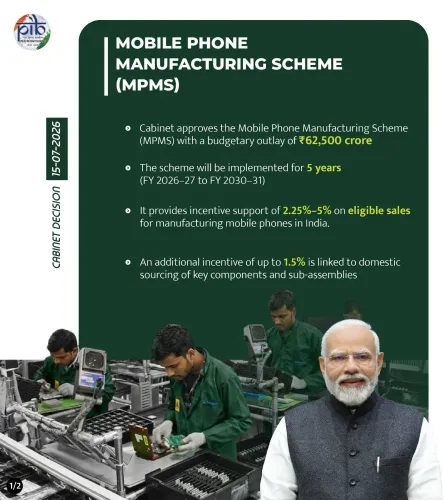
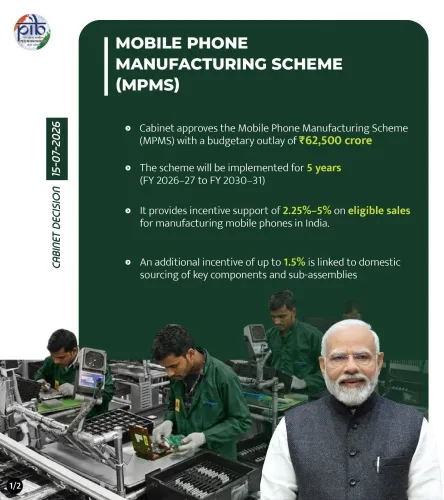
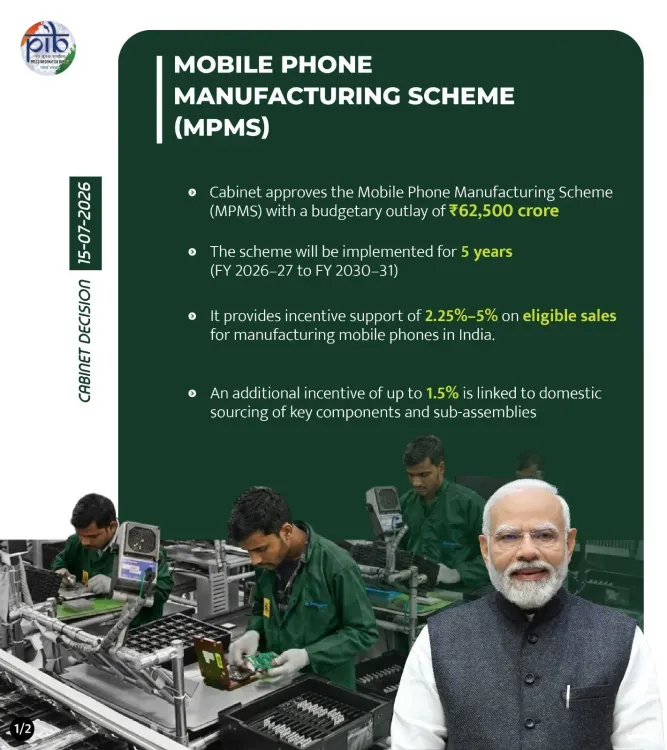
The Union Cabinet approved the Mobile Phone Manufacturing Scheme (MPMS) on 15 July 2026 with a budgetary provision of ₹62,500 crore .
The scheme runs from FY2026-27 to FY2030-31 , a five-year implementation period.
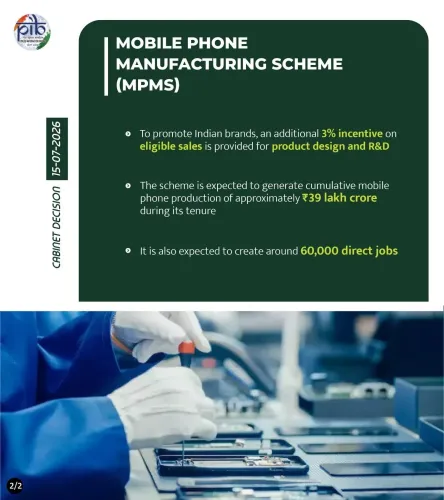
Projected mobile phone production over the scheme period is approximately ₹39 lakh crore .
The scheme is expected to create around 60,000 direct jobs in the mobile manufacturing sector.
Key focus areas include domestic value addition, supply chain strengthening, Indian brands , product design, and R&D.
The approval extends India's decade-long electronics manufacturing policy arc, building on the PLI scheme (2020) and the Make in India initiative launched in 2014 .
Union Agriculture Minister Shivraj Singh Chouhan announced on Wednesday, 15 July 2026 that the Union Cabinet, under the leadership of Prime Minister Narendra Modi, has approved the Mobile Phone Manufacturing Scheme (MPMS) with a budgetary provision of ₹62,500 crore, aimed at transforming India into a global electronics manufacturing hub.
Posting on X, Chouhan stated: 'आदरणीय प्रधानमंत्री श्री @narendramodi जी के नेतृत्व में आज केंद्रीय कैबिनेट ने ₹62,500 करोड़ के बजटीय प्रावधान के साथ मोबाइल फोन मैन्युफैक्चरिंग स्कीम (MPMS) को मंजूरी दी है।' ('Under the leadership of respected Prime Minister Shri Narendra Modi, the Union Cabinet today approved the Mobile Phone Manufacturing Scheme (MPMS) with a budgetary provision of ₹62,500 crore.')
Context
The MPMS will be operational from financial year 2026-27 through 2030-31, spanning a five-year implementation window. The scheme is designed to promote mobile phone production, strengthen domestic value addition and supply chains, encourage Indian brands, product design and research and development (R&D), and enhance global competitiveness.
Over its duration, the scheme is projected to generate mobile phone production worth approximately ₹39 lakh crore and create around 60,000 direct jobs. The Cabinet decision was shared widely by senior government ministers as a landmark step in India's electronics manufacturing journey.
Policy Backdrop
The MPMS builds on a decade-long policy architecture aimed at boosting domestic electronics output. The Make in India initiative, launched in 2014, set the foundation for attracting investment and encouraging assembly operations in the electronics sector. The Production Linked Incentive (PLI) scheme for mobile and electronics manufacturing, approved by the Union Cabinet in 2020, further accelerated domestic production and drew major global manufacturers to set up or expand operations in India.
India has progressively shifted its electronics policy focus from assembly-level operations toward higher value activities — component manufacturing, product design, and R&D. The MPMS represents the next step in that continuum, with an explicit emphasis on nurturing Indian brands and deepening the domestic supply chain rather than relying solely on foreign original equipment manufacturers.
Stakeholders and Impact
Mobile phone manufacturers — both domestic and international — operating in India stand to benefit directly from the scheme's incentive structure. Electronics workers and ancillary supply chain units are among the primary beneficiaries of the projected 60,000 direct employment opportunities the scheme is expected to generate over five years.
The emphasis on domestic value addition and Indian brands signals a policy intent to reduce import dependence on components and sub-assemblies, a persistent structural challenge for India's electronics sector. Strengthening R&D capabilities under the scheme could also support the emergence of Indian-origin mobile phone brands with global reach.
What's Next
The nodal ministry is expected to release detailed scheme guidelines, eligibility criteria, and implementation rules in the coming weeks. Stakeholders will closely track investment commitments from manufacturers, production milestones, and employment generation figures against the scheme's stated targets. India's ambition to position itself as a credible alternative in global electronics supply chains — particularly as companies diversify manufacturing bases — will be tested by the pace and quality of MPMS implementation.
Point of View
Multi-year incentive schemes that have defined India's electronics manufacturing strategy since 2014 — each successive scheme raising the ambition from assembly to design and brand-building. The explicit inclusion of Indian brands and R&D as policy targets marks a qualitative shift: the government is no longer content with being a production base for foreign OEMs and is now betting on indigenous capability. With global supply chains under pressure to diversify away from single-country dependence, the timing of a five-year, ₹62,500 crore commitment is strategically deliberate. The real test, as with the PLI before it, will be execution — translating approved outlays into verified investment, production, and employment on the ground.
NationPress
14 Oct 2026
Frequently Asked Questions
What is the Mobile Phone Manufacturing Scheme (MPMS)?
The Mobile Phone Manufacturing Scheme (MPMS) is a Union Cabinet-approved initiative with a ₹62,500 crore budgetary outlay, running from FY2026-27 to FY2030-31, designed to boost mobile phone production, domestic value addition, Indian brands, R&D, and global competitiveness in electronics manufacturing.
How much money has the government allocated for the MPMS?
The government has allocated a budgetary provision of ₹62,500 crore for the Mobile Phone Manufacturing Scheme over its five-year duration from FY2026-27 to FY2030-31.
How many jobs will the Mobile Phone Manufacturing Scheme create?
The MPMS is projected to generate approximately 60,000 direct jobs in the mobile phone manufacturing sector over the scheme's five-year period ending in FY2030-31.
What is the expected mobile phone production target under MPMS?
The scheme targets mobile phone production worth approximately ₹39 lakh crore over its implementation period from FY2026-27 to FY2030-31.
How is MPMS different from the earlier PLI scheme for mobile manufacturing?
While the PLI scheme approved in 2020 primarily incentivised production volumes, the MPMS places additional emphasis on domestic value addition, supply chain deepening, Indian brand development, and R&D — signalling a move beyond assembly toward higher-value manufacturing and indigenous product design.