Cabinet Approves ₹62,500 Cr Mobile Phone Manufacturing Scheme
Synopsis
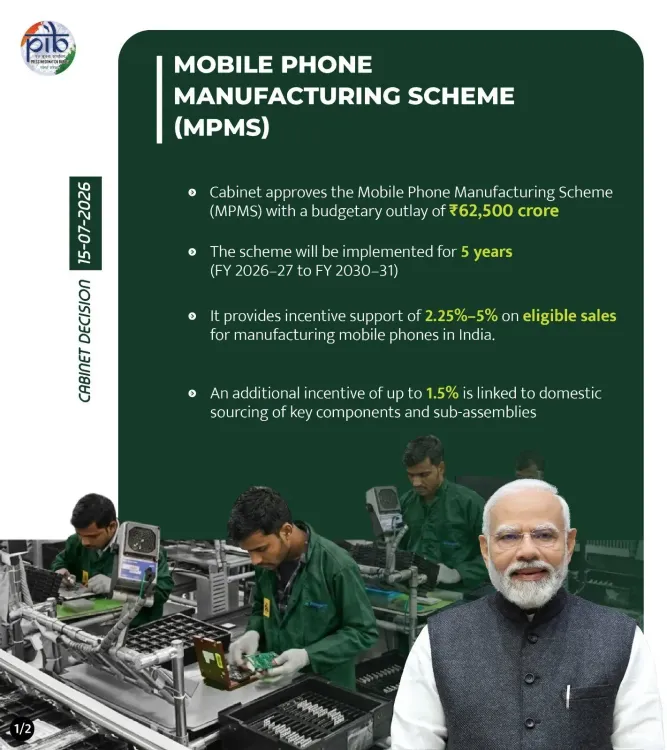
The Union Cabinet has approved the Mobile Phone Manufacturing Scheme (MPMS) with a ₹62,500 crore budgetary outlay, running from FY 2026–27 to FY 2030–31. The scheme extends India's long-standing push to deepen domestic mobile phone production under the Make in India framework, building on the PLI scheme approved in 2020.
Key Takeaways
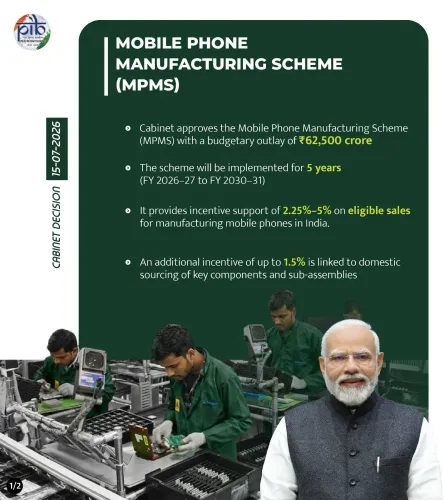
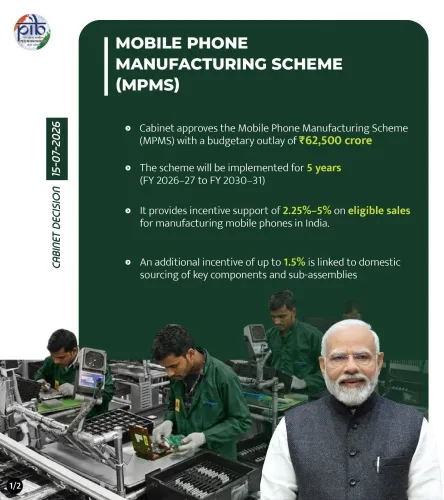
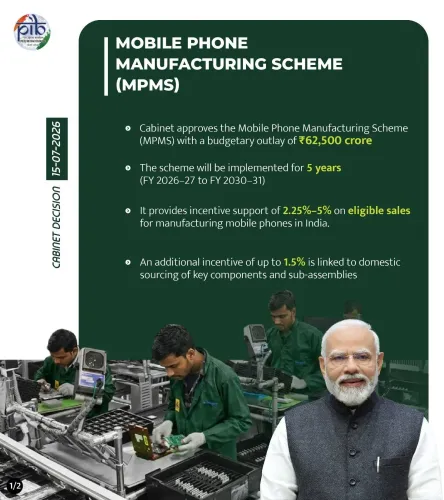
The Union Cabinet has approved the Mobile Phone Manufacturing Scheme (MPMS) with a budgetary outlay of ₹62,500 crore .
The scheme will run for five years, from FY 2026–27 to FY 2030–31 .
The announcement was made by Union Minister Dr.
Jitendra Singh on 15 July 2026 .
The MPMS follows the Production Linked Incentive (PLI) Scheme for large-scale electronics manufacturing, approved in 2020 .
Key beneficiaries include mobile phone companies and electronics manufacturers operating in India.
Operational guidelines, eligibility criteria, and any PLI transition arrangements are yet to be announced by the nodal ministry.
Union Science and Technology Minister Dr. Jitendra Singh on Wednesday, 15 July 2026 announced that the Union Cabinet has approved the Mobile Phone Manufacturing Scheme (MPMS) with a total budgetary outlay of ₹62,500 crore, to be implemented over five years from FY 2026–27 to FY 2030–31.
Context
The Cabinet decision marks a significant escalation in India's push to deepen domestic mobile phone manufacturing. Dr. Jitendra Singh shared the announcement on social media under the hashtag #CabinetDecisions, flagging the scheme as a major policy commitment. The ₹62,500 crore outlay — spread across five financial years — signals a long-term state commitment to the electronics sector beyond the current incentive architecture.
Policy Backdrop
The MPMS builds on the foundation laid by the Production Linked Incentive (PLI) Scheme for Large Scale Electronics Manufacturing, which the Cabinet approved in 2020 to incentivise domestic assembly of mobile phones and IT hardware. That scheme was a cornerstone of the broader Make in India framework, under which India's mobile phone output and exports have risen steadily since 2014, driven by global original equipment manufacturers and Indian contract manufacturers alike.
The new MPMS extends this policy approach into the 2026–31 period, suggesting either a successor arrangement to the PLI or a parallel, complementary programme. Operational guidelines from the nodal ministry — including eligibility criteria and any transition arrangements with the existing PLI framework — are expected to be issued separately.
Stakeholders and Impact
The primary beneficiaries of the scheme are expected to be electronics manufacturers and mobile phone companies operating in or looking to establish production capacity in India. Both global handset brands with assembly operations in the country and domestic contract manufacturers stand to gain from the multi-year budgetary support.
For the broader economy, a sustained government incentive programme of this scale is designed to attract fresh capital investment, generate employment in the electronics manufacturing ecosystem, and reduce India's dependence on imported finished handsets — a longstanding trade-balance concern. The scheme's five-year horizon also offers manufacturers the planning certainty needed for large capital expenditure decisions.
What's Next
Attention will now turn to the nodal ministry responsible for implementing the MPMS and the detailed operational guidelines that will define eligibility, disbursement timelines, and performance benchmarks. Industry stakeholders will also watch closely for any clarity on how the MPMS interacts with or supersedes the existing PLI commitments that companies are currently enrolled in.
If the scheme is executed on its stated timeline, the FY 2030–31 endpoint would coincide with India's broader ambition to become a global hub for electronics manufacturing — a goal that successive governments have pursued through coordinated industrial, trade, and technology policy since the mid-2010s.
Point of View
500 crore outlay represents the Indian government doubling down on electronics manufacturing as a strategic industrial priority, moving from the first-generation PLI architecture into what appears to be a more ambitious, longer-horizon successor. The five-year commitment provides the kind of policy continuity that capital-intensive manufacturers require before committing to large-scale domestic capacity expansion. Coming at a time when global electronics supply chains are being actively restructured, the scheme positions India to compete more aggressively for investment that might otherwise flow to Vietnam, Mexico, or other low-cost assembly destinations. The true test will lie in implementation — specifically, how quickly operational guidelines are issued and whether disbursement mechanisms avoid the bottlenecks that slowed parts of the earlier PLI rollout.
NationPress
14 Oct 2026
Frequently Asked Questions
What is the Mobile Phone Manufacturing Scheme (MPMS)?
The Mobile Phone Manufacturing Scheme (MPMS) is a Cabinet-approved government programme with a budgetary outlay of ₹62,500 crore, designed to incentivise domestic mobile phone manufacturing in India from FY 2026–27 to FY 2030–31.
How much money has been allocated for the MPMS?
The Cabinet has approved a total budgetary outlay of ₹62,500 crore for the Mobile Phone Manufacturing Scheme, to be disbursed over five financial years from 2026–27 to 2030–31.
How is the MPMS different from the PLI scheme for mobile phones?
The Production Linked Incentive (PLI) Scheme for mobile phones was approved in 2020 and covers the earlier incentive period; the MPMS appears to extend or succeed that framework for the 2026–31 period, though the exact relationship between the two schemes will depend on operational guidelines yet to be issued.
Who announced the Mobile Phone Manufacturing Scheme?
Union Minister of State (Independent Charge) for Science and Technology Dr. Jitendra Singh announced the Cabinet approval of the MPMS on 15 July 2026 via a post on X (formerly Twitter).
Which companies will benefit from the MPMS?
Mobile phone companies and electronics manufacturers operating in India — including both global handset brands with local assembly operations and Indian contract manufacturers — are the primary intended beneficiaries of the scheme.