CM Majhi calls for clean Rath Yatra, takes Swachhata Pledge
Synopsis
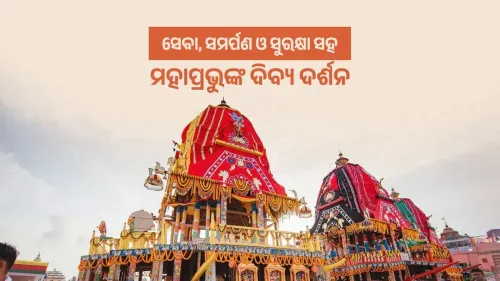
Odisha Chief Minister Mohan Charan Majhi has taken a 'Green and Clean Rath Yatra Pledge' on MyGov and called on devotees worldwide to keep Puri's Badadanda and temple precincts litter-free during the annual Jagannath Rath Yatra, framing cleanliness as a spiritual duty.
Key Takeaways
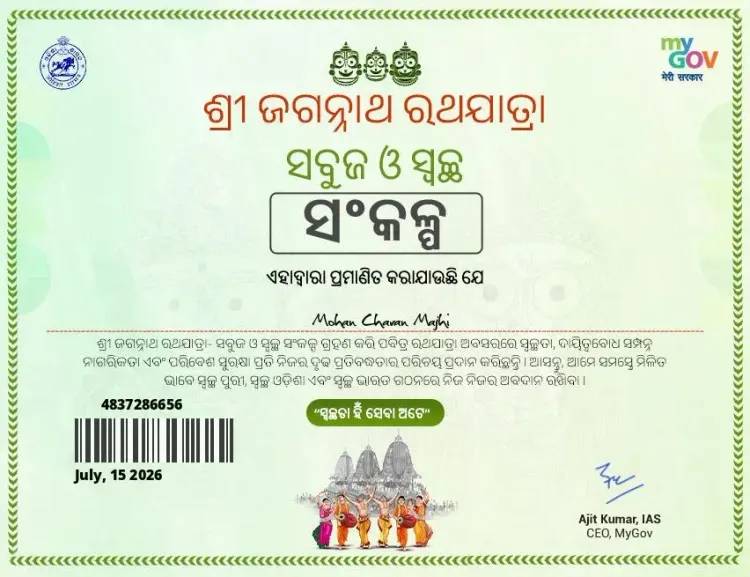
CM Mohan Charan Majhi personally took the Shri Jagannath Rath Yatra Sabuj evam Swachh Sankalp (Green and Clean Rath Yatra Pledge) on 15 July 2026 .
He called on all devotees and Odisha residents to take the pledge via the MyGov government portal.
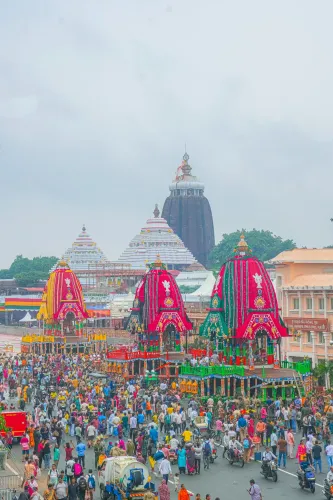
The campaign demands the Badadanda (Grand Road) and the Gundicha Temple route be kept completely litter-free during the procession.
Citizens are urged to segregate waste into wet, dry, and plastic categories and deposit them at designated points.
The initiative aligns with the national Swachh Bharat Mission launched in 2014 , extending its goals to one of India's largest religious gatherings.
The framing of cleanliness as 'Swachhata hi Seva' — 'Cleanliness is itself service' — positions sanitation as a spiritual act for Lord Jagannath's devotees.
Odisha Chief Minister Mohan Charan Majhi on Wednesday, 15 July 2026, called upon devotees across the world and residents of Odisha to join a cleanliness drive linked to the world-famous Rath Yatra of Lord Jagannath in Puri, framing sanitation as a spiritual duty rather than a civic obligation alone. Majhi announced that he has personally taken the 'Shri Jagannath Rath Yatra Sabuj evam Swachh Sankalp' — the 'Green and Clean Rath Yatra Pledge' — and urged citizens to do the same through the MyGov platform.
Context
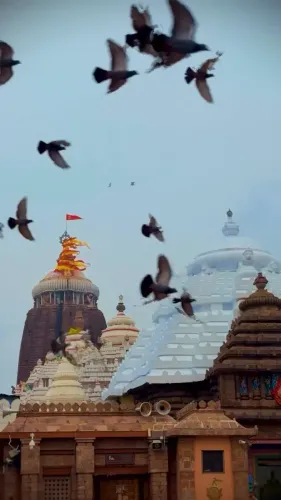
Posting in Odia, the Chief Minister declared: 'Swachhata hi Seva' ('Cleanliness is itself service'), positioning the upkeep of sacred spaces as an act of devotion. He specifically named Shrikshetra (the Jagannath Temple complex), the Badadanda (Grand Road — the main procession route), and the Gundicha Temple as sites that every citizen has a 'supreme spiritual duty' to keep clean during the festival period.
Majhi called for waste to be segregated into wet, dry, and plastic categories and deposited at designated collection points, urging that the entire procession route remain 'completely litter-free' during the chariot procession.
Policy Backdrop
The appeal draws directly from the Swachh Bharat Mission, the national cleanliness campaign launched in 2014, which has progressively extended its messaging to pilgrimage sites and large religious gatherings. State governments across India have used high-visibility cultural events to amplify sanitation goals, and Odisha under Majhi's BJP administration is following this established playbook.
The online pledge mechanism hosted on MyGov — the Union government's citizen-engagement portal — reflects a broader digital-governance approach: converting passive observers of policy into active, recorded participants. The convergence of cultural identity, religious fervour, and environmental governance in a single initiative is characteristic of BJP-led administrations post-2014.
Stakeholders and Impact
The Rath Yatra draws millions of pilgrims annually to Puri, generating enormous volumes of solid waste along the Badadanda and surrounding areas. The call for waste segregation at source — wet, dry, and plastic — signals an attempt to move beyond post-event clean-ups toward real-time crowd-sourced sanitation.
Residents of Puri, visiting devotees, vendors, and local civic bodies are the primary stakeholders. A successful on-ground response could reduce the environmental burden on Puri's coastal ecosystem, which faces pressure from large-scale pilgrim footfall each year.
What's Next
The immediate measure of the initiative's reach will be participation numbers on the MyGov pledge portal. On-ground outcomes — waste volumes collected, segregation compliance, and the cleanliness of the Badadanda during the procession — will determine whether the campaign moves from symbolic gesture to measurable policy outcome. If successful, the model could be replicated at other major Odia festivals, reinforcing the state government's positioning of cultural heritage and environmental governance as complementary priorities.
Point of View
CM Majhi is doing more than recycling a government cleanliness slogan — he is attempting to make waste segregation feel like an act of faith, which carries far greater motivational weight for a pilgrim crowd than civic instruction alone. The use of the MyGov pledge mechanism also creates a quantifiable participation metric, giving the administration a data point to cite as evidence of public engagement. This sits within a well-established BJP pattern of fusing cultural nationalism with governance deliverables, using high-visibility religious events as the delivery vehicle. Whether the initiative translates into measurable on-ground cleanliness or remains primarily a social-media moment will be the real test of its policy substance.
NationPress
14 Oct 2026
Frequently Asked Questions
What is the Swachh Rath Yatra pledge taken by CM Majhi?
It is the Shri Jagannath Rath Yatra Sabuj evam Swachh Sankalp , a 'Green and Clean Rath Yatra Pledge' hosted on the MyGov platform, through which citizens commit to keeping the Rath Yatra route and temple surroundings in Puri litter-free and to segregating waste during the festival.
Where can I take the Rath Yatra cleanliness pledge online?
The pledge can be taken at the MyGov portal link shared by CM Majhi: pledge.mygov.in/swachh-rath-yatra .
What does CM Majhi mean by 'Swachhata hi Seva'?
'Swachhata hi Seva' means 'Cleanliness is itself service.' CM Majhi used the phrase to frame keeping the Jagannath Temple complex and the Rath Yatra route clean as a spiritual act of service to Lord Jagannath, not merely a civic duty.
Which areas in Puri does the cleanliness drive cover?
The drive covers Shrikshetra (the Jagannath Temple complex), the Badadanda (Grand Road, the main chariot procession route), and the Gundicha Temple premises, as well as the broader surrounding environment of Puri .
How is the Rath Yatra cleanliness campaign connected to Swachh Bharat Mission?
The campaign draws on the principles of the Swachh Bharat Mission , the national sanitation drive launched in 2014 , which has progressively extended cleanliness messaging to major religious sites and large public gatherings across India.