CM Fadnavis Announces ₹95,000 Cr for Maharashtra Agriculture
Synopsis
The Chief Minister's Office of Maharashtra has announced a ₹95,000 crore provision for the agriculture sector, a move attributed to CM Devendra Fadnavis. The allocation signals a major state-level commitment to farmer welfare, irrigation and rural resilience in one of India's largest farm economies.
Key Takeaways
The Chief Minister's Office of Maharashtra announced a ₹95,000 crore budgetary provision for the agriculture sector on 15 July 2026 .
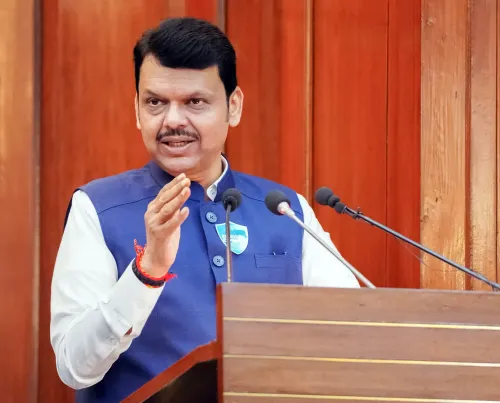
The allocation is attributed to Chief Minister Devendra Fadnavis , a senior BJP leader who has overseen multiple Maharashtra state budgets.
Maharashtra is a major agricultural state dependent on cotton, sugarcane, soybean and horticulture, with farm income highly sensitive to monsoon variability.
Regions such as Vidarbha , Marathwada and North Maharashtra — historically the most agrarian-distressed — are the expected primary beneficiaries.
A scheme-wise break-up of the ₹95,000 crore figure is awaited from official budget documents or legislative session disclosures.
The provision continues Maharashtra's pattern of large agricultural allocations aimed at drought-proofing, irrigation and input support for farmers.
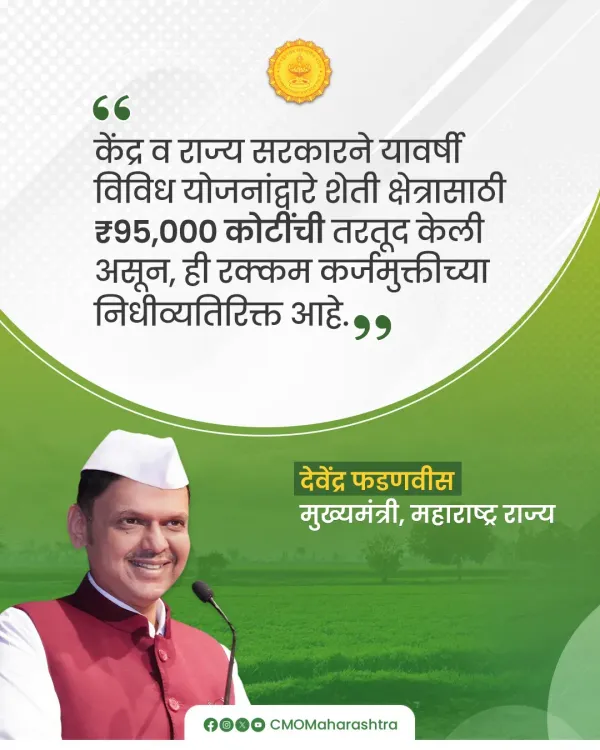
The Chief Minister's Office of Maharashtra announced on Wednesday, 15 July 2026 that the state has earmarked ₹95,000 crore for the agriculture sector, attributing the provision to Chief Minister Devendra Fadnavis. The announcement was made via the official CMO handle on X, signalling a significant budgetary commitment to the state's farming community.
Context
The post, written in Marathi, reads: 'शेती क्षेत्रासाठी ₹95,000 कोटींची तरतूद!' — translated as 'A provision of ₹95,000 crore for the agriculture sector!' The announcement was tagged to Devendra Fadnavis and carries the hashtags #Maharashtra and #DevendraFadnavis, indicating a deliberate push to amplify the policy signal.
Maharashtra is one of India's largest agricultural states, with farmers dependent on crops such as cotton, sugarcane, soybean and horticulture. The state's farm economy is highly sensitive to monsoon variability, making budgetary support a perennial political and policy priority.
Policy Backdrop
Maharashtra state budgets have routinely set aside large sums for agriculture to address rural distress, irrigation deficits and crop productivity. Successive governments have linked such allocations to drought-proofing measures and input-support schemes designed to cushion farmers against climate shocks.
Chief Minister Fadnavis, a senior Bharatiya Janata Party leader who has overseen multiple state budgets, has consistently positioned agricultural investment as central to the ruling coalition's rural outreach. A provision of this scale, if confirmed in official budget documents, would represent one of the larger single-sector commitments in Maharashtra's recent fiscal history.
Stakeholders and Impact
The primary beneficiaries of the allocation are Maharashtra's farmers, who have long demanded greater state support for irrigation infrastructure, crop insurance and input subsidies. Rural constituencies across Vidarbha, Marathwada and North Maharashtra — regions most exposed to drought and agrarian stress — stand to gain the most if the funds are disbursed effectively.
Agricultural economists and farmer bodies will be watching closely for a scheme-wise break-up of the ₹95,000 crore figure, as the impact depends heavily on how the allocation is distributed across irrigation, credit support, insurance and direct income schemes.
What's Next
The specifics of the allocation — including the fiscal year it covers and the individual schemes it funds — are expected to emerge from official budget documents or supplementary demands in the upcoming monsoon or winter legislative session. Scrutiny from the opposition and farm unions will likely focus on implementation timelines and actual disbursement records against past allocations.
If the ₹95,000 crore provision translates into ground-level action, it could set a benchmark for agricultural spending in large Indian states and reinforce Maharashtra's position as a test case for state-led farm-sector reform ahead of future electoral cycles.
Point of View
000 crore for agriculture is a headline number with significant political weight in a state where farmer distress has repeatedly shaped electoral outcomes. By amplifying the announcement through the official CMO handle, the Fadnavis administration is clearly targeting rural voters in Vidarbha and Marathwada — constituencies that have historically swung against incumbents during periods of agrarian crisis. The real test, however, lies in the scheme-wise break-up and actual disbursement, as Maharashtra has a mixed record of converting large budget lines into on-ground farm relief. This announcement fits a broader national pattern of state governments using agricultural spending as both a welfare instrument and a political signal ahead of electoral cycles.
NationPress
15 Jul 2026
Frequently Asked Questions
What is the ₹95,000 crore Maharashtra agriculture allocation?
The Chief Minister's Office of Maharashtra announced on 15 July 2026 that the state has earmarked ₹95,000 crore for the agriculture sector, a provision attributed to Chief Minister Devendra Fadnavis.
Who is Devendra Fadnavis?
Devendra Fadnavis is the Chief Minister of Maharashtra and a senior Bharatiya Janata Party leader who has previously held the post and overseen multiple state budgets.
Which farmers will benefit from Maharashtra's ₹95,000 crore agriculture fund?
Farmers across Maharashtra are the intended beneficiaries, with regions such as Vidarbha, Marathwada and North Maharashtra — historically most affected by drought and agrarian distress — expected to see the greatest impact.
What will the ₹95,000 crore be spent on in Maharashtra's agriculture sector?
A detailed scheme-wise break-up is yet to be released; historically, such allocations in Maharashtra have covered irrigation infrastructure, crop insurance, input subsidies and direct income support for farmers.
When will the details of Maharashtra's agriculture budget allocation be available?
Full details are expected to emerge from official budget documents or supplementary demands tabled during Maharashtra's monsoon or winter legislative session.