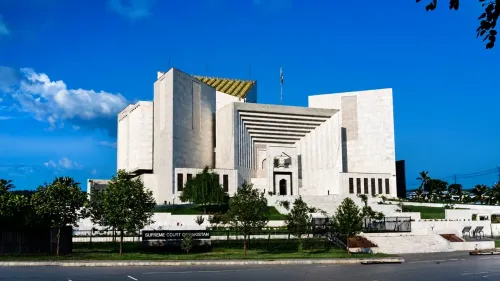
Pakistan judicial corruption systemic, risks grand corruption: FIDH report

Synopsis
A damning new FIDH report finds corruption in Pakistan's judiciary has gone systemic — potentially meeting the threshold of grand corruption. With the 26th and 27th Constitutional Amendments cited as accelerating political capture of the courts, the report warns that Pakistan's justice system is now being used to silence activists and dissidents, with minorities and the poor bearing the heaviest cost.
Key Takeaways
The International Federation for Human Rights (FIDH) has declared judicial corruption in Pakistan systemic, potentially amounting to grand corruption .
The report, 'Under the Bench: Mapping Corruption Risks in Pakistan's Justice System' , is based on interviews with 30 interlocutors including lawyers, judges, journalists, and civil society representatives.
The 26th and 27th Constitutional Amendments are cited as having a negative impact on judicial independence and fair trial rights.
Three enabling factors identified: weak administration of justice, cultural favouritism and nepotism, and erosion of judicial independence leading to state capture.
Low-income communities and minorities are disproportionately affected by due process violations stemming from judicial corruption.
Accountability institutions have reportedly been politicised and used for political victimisation rather than addressing systemic corruption.
The International Federation for Human Rights (FIDH) has warned that judicial corruption in Pakistan has reached a systemic scale that may amount to grand corruption, with the country's justice system increasingly vulnerable to political influence and institutional capture. The findings, published in a report titled 'Under the Bench: Mapping Corruption Risks in Pakistan's Justice System', carry serious human rights implications — particularly for low-income communities and minorities.
Key Findings of the Report
The FIDH report, based on interviews with 30 interlocutors — including lawyers, former and retired judges, journalists, and civil society representatives — concludes that corruption has become endemic throughout Pakistan's judicial system. It identifies three inter-related enabling factors: weak administration of justice across all levels, leading to bribery and corrupt practices; cultural dynamics that encourage favouritism and nepotism; and the erosion of judicial independence, resulting in what the report terms 'state capture' of the superior judiciary.
The report states that accountability institutions have been increasingly politicised and deployed for political victimisation rather than as mechanisms to address systemic corruption.
Constitutional Amendments Under Scrutiny
According to the report, the 26th and 27th Constitutional Amendments have had a negative impact on judicial independence and the protection of fair trial rights in Pakistan. It describes these developments as a 'regressive shift' in the country's legal and constitutional order, stripping away what limited independence the judiciary previously held. Judicial appointments, bench formation, and high-level case management now reportedly face political influence that contradicts international standards for judicial independence.
Human Rights Implications
The FIDH warned that the deteriorating state of Pakistan's judiciary has direct human rights consequences, including violations of due process and equality before the law. The report notes that low-income communities and minorities are disproportionately affected. It further states that Pakistan's democratic institutions — including the judiciary — have faced gradual weakening and capture by the executive branch over several years, accompanied by 'severe repression of fundamental freedoms' facilitated by repressive legislation.
'In this context, the judiciary has become a tool for repression and silencing of activists and dissidents,' the report stated.
Broader Context
This report arrives amid sustained international scrutiny of Pakistan's governance and rule-of-law frameworks. The FIDH's assessment aligns with concerns raised by several legal observers and civil society groups within Pakistan about the pace of institutional erosion. Notably, the report's findings were covered prominently by leading Pakistani daily Dawn, signalling domestic acknowledgement of the critique. The report adds to a growing body of documentation suggesting that the structural challenges facing Pakistan's judiciary extend well beyond individual misconduct to encompass systemic and politically enabled dysfunction.
Whether the Pakistani government responds to the FIDH's recommendations — or contests them — will be closely watched by international human rights bodies in the months ahead.
Point of View
The FIDH's documentation may serve as international leverage, but only if external pressure translates into domestic reform — a connection that has historically proved elusive.
NationPress
15 Jul 2026
Frequently Asked Questions
What is the FIDH report on Pakistan's judiciary about?
The FIDH report, titled 'Under the Bench: Mapping Corruption Risks in Pakistan's Justice System', concludes that judicial corruption in Pakistan has reached a systemic scale and may amount to grand corruption. It identifies political influence, institutional capture, and cultural nepotism as key drivers, and warns of serious human rights consequences for vulnerable communities.
How was the FIDH report compiled?
The report is based on interviews with 30 interlocutors, including lawyers, former and retired judges, journalists, and representatives of civil society organisations, four of whom were women. Their combined knowledge of Pakistan's justice system forms the evidentiary basis of the findings.
What role did the 26th and 27th Constitutional Amendments play?
According to the report, the 26th and 27th Constitutional Amendments negatively impacted judicial independence and fair trial protections in Pakistan. The FIDH describes them as marking a 'regressive shift' that stripped the judiciary of its limited remaining independence and opened judicial appointments and case management to political influence.
Who is most affected by judicial corruption in Pakistan?
The FIDH report specifically highlights low-income communities and minorities as the groups most disproportionately affected by violations of due process and equality before the law resulting from endemic judicial corruption.
What are the three factors enabling corruption in Pakistan's judiciary?
The report identifies three inter-related factors: weak administration of justice across all levels leading to bribery and corrupt practices; cultural dynamics encouraging favouritism and nepotism; and the erosion of judicial independence, resulting in state capture of the superior judiciary.