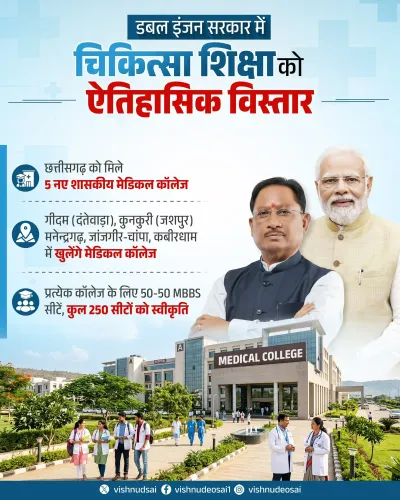
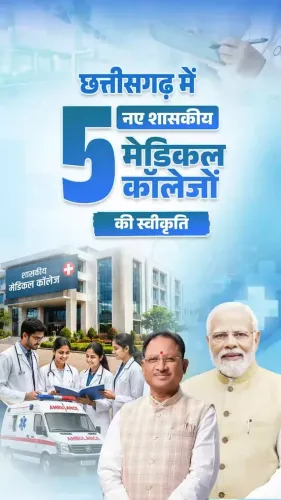
CM Sai Approves 50-Seat Govt Medical College for Kunkuri

Synopsis
Chhattisgarh CM Vishnu Deo Sai announced approval of a 50-seat government medical college in Kunkuri, Jashpur — a tribal district long underserved in healthcare and higher education. The move fulfils a BJP pre-election pledge and is expected to boost local medical education and specialist doctor availability across the region.
Key Takeaways
Chhattisgarh CM Vishnu Deo Sai announced approval of a new 50-seat government medical college in Kunkuri , Jashpur district , on 15 July 2026 .
The college fulfils a pre-election commitment made by the BJP government to the people of Kunkuri .
Jashpur is a tribal-majority district bordering Jharkhand and Odisha , historically lacking specialist healthcare and medical education infrastructure.
The college is expected to provide local MBBS opportunities for youth in Jashpur and surrounding areas, reducing the need to migrate to urban centres.
The project must still clear National Medical Commission approval before admissions can begin.
The announcement is part of Chhattisgarh's broader push to expand medical education in interior and Scheduled Tribe regions.
Chhattisgarh Chief Minister Vishnu Deo Sai announced on Wednesday, 15 July 2026 that the state government has approved a new 50-seat government medical college in Kunkuri, a town in the tribal-majority Jashpur district of northern Chhattisgarh. The move, shared by the Chief Minister on X, fulfils a pre-election commitment made to the people of Kunkuri and is aimed at expanding quality medical education and specialist healthcare access in one of the state's most underserved regions.
Context
In his post, CM Sai wrote: 'Kunkuri ki janta se kiya gaya ek aur vaada poora hua' ['Another promise made to the people of Kunkuri has been fulfilled']. He stated that the approval of the 50-seat government medical college will give the youth of Jashpur an opportunity to pursue quality medical education within their own region, while also strengthening healthcare services across the entire area and increasing the availability of specialist doctors at the local level.
Jashpur is a predominantly tribal district bordering Jharkhand and Odisha, historically underserved in both higher education and specialist medical care. The selection of Kunkuri as the site for the new college reflects the state government's stated focus on correcting geographic imbalances in doctor availability and educational infrastructure.
Policy Backdrop
After the December 2023 assembly elections, the BJP government in Chhattisgarh listed the establishment of new government medical colleges in interior and tribal districts as a priority commitment for regional equity. The Jashpur announcement is part of that broader push.
Across India, states have steadily expanded MBBS seats by opening government medical colleges in smaller towns to address the concentration of medical education in urban centres. Chhattisgarh's move in Jashpur follows a pattern seen in other BJP-ruled states targeting Scheduled Tribe regions, where the absence of local medical colleges has historically forced students to travel long distances or forgo professional medical education altogether.
Stakeholders and Impact
The most immediate beneficiaries are students from Jashpur and surrounding tribal districts who would now have access to an MBBS programme without relocating to distant cities. A government medical college also typically anchors a district hospital upgrade, which would expand specialist outpatient and inpatient services for the local population.
For the broader Jashpur region, a steady pipeline of locally trained doctors could address the persistent shortage of specialist physicians in primary and community health centres — a challenge common to remote tribal districts across central India. Residents, local health workers, and tribal community organisations are among the key stakeholders watching the project's progress.
What's Next
The new college will need to clear the National Medical Commission approval process before it can admit students, a regulatory step that involves inspection of infrastructure, faculty strength, and hospital bed capacity. Land acquisition and construction timelines will determine when the institution becomes operational.
The Chhattisgarh government's ability to move the project from approval to accreditation will be closely watched, both as a test of its delivery on electoral promises and as a signal of whether additional medical colleges or district hospital upgrades may follow in other underserved parts of the state.
Point of View
Who took office in December 2023, the announcement reinforces the narrative of promise-keeping ahead of any future electoral cycle. More broadly, it fits a national pattern of BJP-ruled states using medical college expansions in Scheduled Tribe districts to address both healthcare deficits and political optics simultaneously. The real test will come at the implementation stage — National Medical Commission clearance, construction timelines, and faculty recruitment in a remote district are hurdles that have stalled similar announcements elsewhere in India.
NationPress
15 Jul 2026
Frequently Asked Questions
Where will the new government medical college in Chhattisgarh be built?
The new 50-seat government medical college will be built in Kunkuri, a town in Jashpur district of northern Chhattisgarh.
How many MBBS seats will the Kunkuri medical college have?
The approved government medical college in Kunkuri will have 50 MBBS seats.
Why is a medical college being set up in Jashpur?
Jashpur is a tribal-majority district historically underserved in higher education and specialist healthcare; the college aims to provide local medical education and increase specialist doctor availability in the region.
Who announced the Kunkuri medical college approval?
Chhattisgarh Chief Minister Vishnu Deo Sai announced the approval on 15 July 2026 via a post on X.
What approvals are needed before the Kunkuri medical college can start admissions?
The college must receive approval from the National Medical Commission, which inspects infrastructure, faculty strength, and hospital bed capacity before permitting MBBS admissions.