CM Sai Flags 5 New Medical Colleges, 250 MBBS Seats in Chhattisgarh
Synopsis
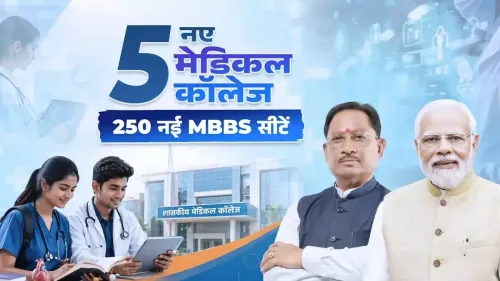
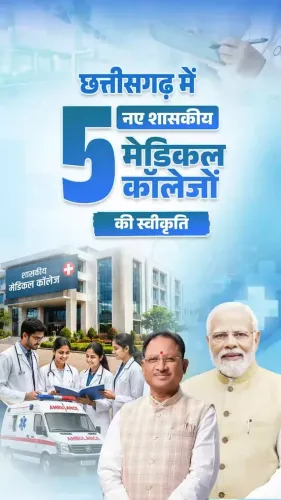
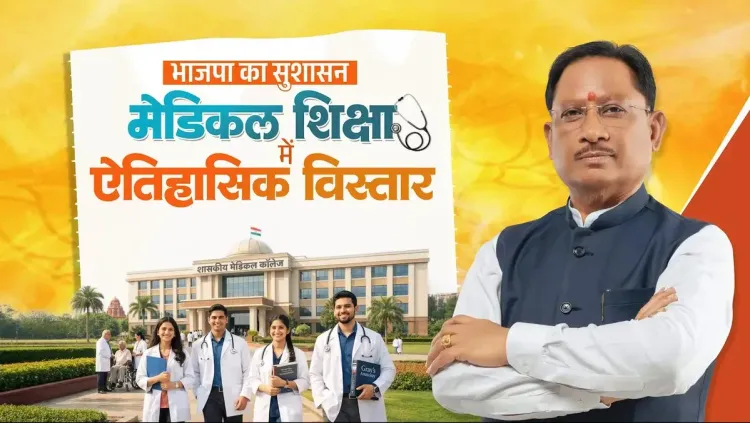
Chhattisgarh Chief Minister Vishnu Deo Sai announced approval of five new government medical colleges and 250 additional MBBS seats on 15 July 2026, attributing the expansion to the BJP's double-engine governance model and citing it as evidence of measurable development over two-and-a-half years in office.
Key Takeaways
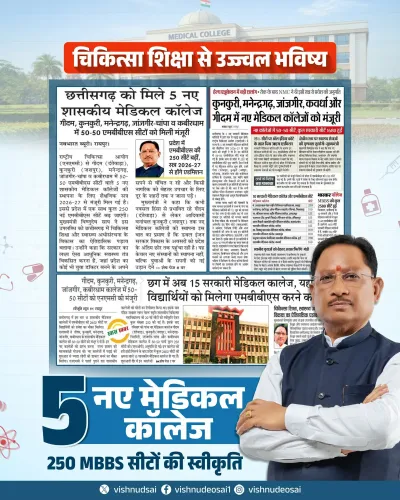
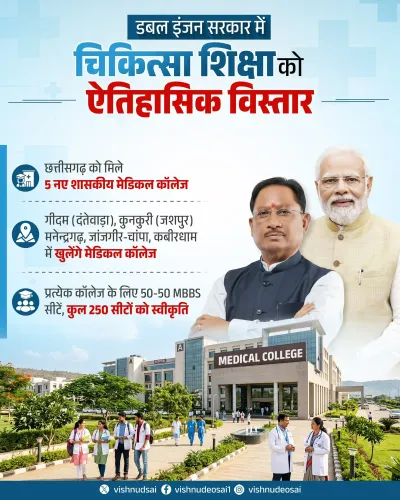
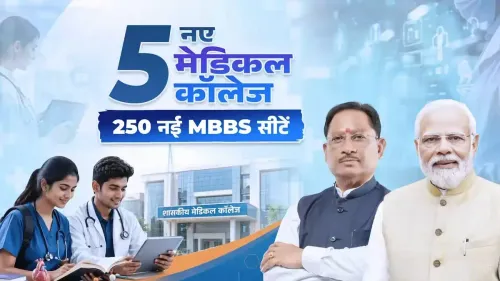
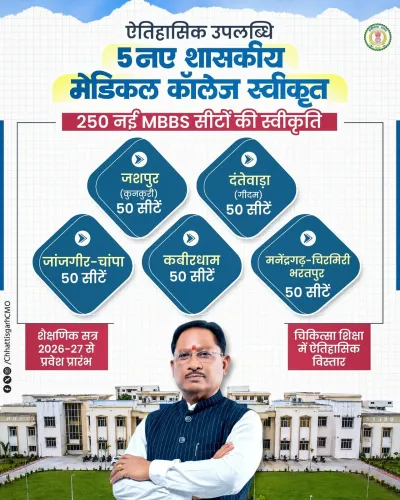
Five new government medical colleges have been approved in Chhattisgarh , according to Chief Minister Vishnu Deo Sai .
250 additional MBBS seats will be created alongside the new colleges, expanding the state's medical education capacity.
CM Sai credited the BJP's double-engine government model — aligned central and state administrations — for enabling faster approvals.
The announcement marks roughly two-and-a-half years since the BJP came to power in Chhattisgarh following the November 2023 assembly elections .
The expansion is aimed at addressing longstanding gaps in healthcare access and medical education affordability, particularly in rural and tribal areas .
Formal National Medical Commission clearances, construction timelines, and first-admission dates remain key milestones to watch.
Chhattisgarh Chief Minister Vishnu Deo Sai on Wednesday, 15 July 2026, credited the BJP-led 'double-engine' government with approving five new government medical colleges and 250 additional MBBS seats in the state, citing the move as evidence of development-oriented governance over the past two-and-a-half years.
Context
Posting in Hindi on X, Chief Minister Sai stated: 'भाजपा की राजनीति केवल वादों की नहीं, बल्कि विकासपरक परिणामों की है' ('BJP's politics is not merely of promises, but of development-oriented results'). He described the medical college approvals as proof of that claim, and said Chhattisgarh is now advancing at a new pace in education, health, and infrastructure, leaving behind 'years of neglect.'
The BJP won the Chhattisgarh assembly elections in November 2023, ending the Congress government's five-year tenure. Vishnu Deo Sai was sworn in as Chief Minister in December 2023, making this post's reference to 'the past two-and-a-half years' consistent with that timeline.
Policy Backdrop
Medical education expansion has been a stated priority of both the central and state BJP governments. Since 2014, the Union government has pursued a nationwide increase in medical college capacity, with several states receiving central approvals and funding support under health-infrastructure programmes.
The 'double-engine government' framing — a recurring BJP formulation — argues that states governed by the same party as the Centre benefit from faster clearances, aligned policy priorities, and smoother fund flows. Chhattisgarh, a state with historically limited medical infrastructure relative to its population, has been presented by the current administration as a key beneficiary of this model.
A shortfall in doctors and healthcare access in tribal and rural belts of Chhattisgarh has long been documented. Expanding MBBS seats through new government colleges is intended to address both the supply of trained doctors and the affordability of medical education for students from the state.
Stakeholders and Impact
The most immediate beneficiaries of the announced expansion would be medical aspirants from Chhattisgarh, particularly those from rural and economically weaker backgrounds who depend on government college seats to access affordable medical education. An addition of 250 MBBS seats across five institutions would meaningfully increase the state's annual intake capacity.
For rural healthcare seekers, new medical colleges typically anchor teaching hospitals, which in turn expand secondary and tertiary care access in underserved districts. The location of the proposed colleges will determine which communities see the most direct benefit.
Politically, the announcement reinforces the BJP's governance narrative ahead of future electoral cycles, contrasting the current administration's infrastructure record with what it characterises as the prior government's inaction.
What's Next
The key milestones to track will be formal central approvals — including clearances from the National Medical Commission — land allocation, construction timelines, and the academic year in which the first batch of students is admitted to each new college. Funding release schedules under relevant central health schemes will also be a marker of how quickly the approvals translate into operational institutions.
As Chhattisgarh approaches the midpoint of the current government's term, delivery on infrastructure pledges in health and education is likely to remain a central measure of the administration's performance.
Point of View
Using a concrete infrastructure number — five colleges, 250 seats — to anchor a broader governance claim. The double-engine framing is doing significant political work here: it ties state-level delivery to central BJP leadership, making the achievement a shared credit rather than a purely local one. Medical college expansion is particularly potent messaging because it simultaneously addresses aspirational middle-class concerns about education access and grassroots concerns about healthcare availability. Whether the announcement translates into operational institutions within the government's current term will determine how durable this narrative proves to be.
NationPress
14 Oct 2026
Frequently Asked Questions
How many new medical colleges has Chhattisgarh approved in 2026?
Chhattisgarh Chief Minister Vishnu Deo Sai announced approval of five new government medical colleges in the state, along with 250 additional MBBS seats, as of July 2026.
What is the double-engine government model BJP refers to in Chhattisgarh?
The 'double-engine government' is a BJP formulation describing states where both the state and central governments are BJP-led, arguing this alignment results in faster policy clearances, better fund flows, and coordinated development outcomes.
When did Vishnu Deo Sai become Chief Minister of Chhattisgarh?
Vishnu Deo Sai was sworn in as Chief Minister of Chhattisgarh in December 2023, after the BJP won the state assembly elections held in November 2023.
Who benefits from new government medical colleges in Chhattisgarh?
Medical aspirants from Chhattisgarh — especially those from rural and economically weaker backgrounds — benefit from more affordable MBBS seats. New colleges also typically anchor teaching hospitals, improving secondary and tertiary healthcare access in underserved areas.
What approvals are needed before the new Chhattisgarh medical colleges can begin admissions?
New government medical colleges in India require clearance from the National Medical Commission, along with land allocation, infrastructure completion, and faculty appointments before the first batch of students can be admitted.