Cabinet Clears ₹10,998 Cr Elevated Corridor for Varanasi
Synopsis
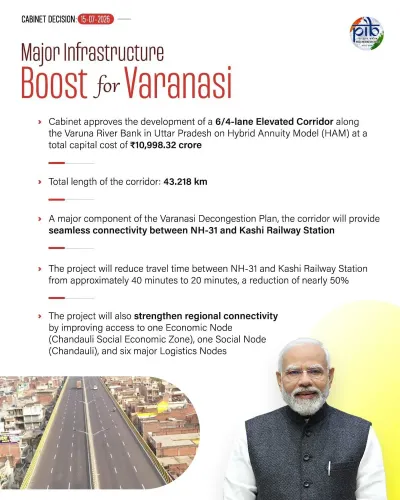
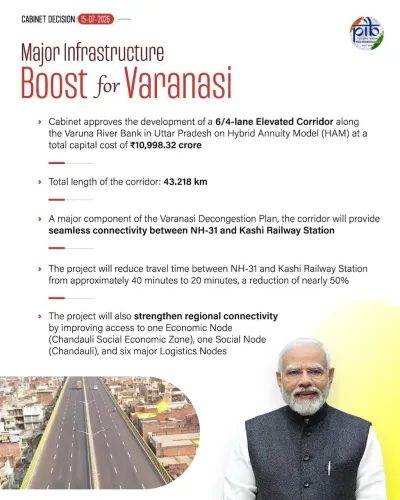
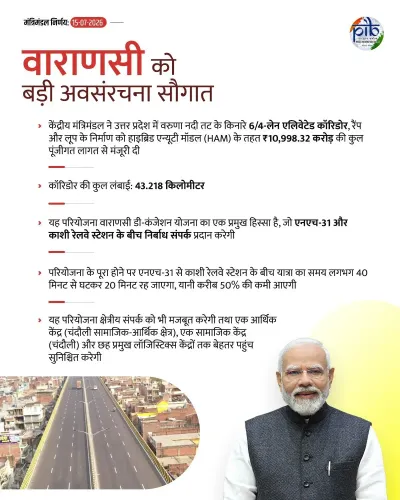
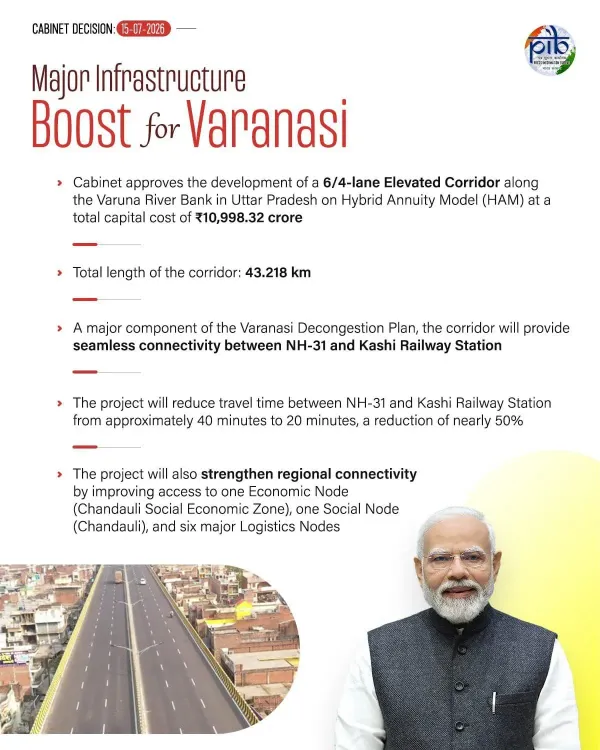
The Union Cabinet has approved a ₹10,998.32 crore, 43.218-km elevated corridor along River Varuna in Varanasi to connect NH-31 with the city's Ring Road, targeting chronic traffic congestion in PM Modi's Lok Sabha constituency.
Key Takeaways
The Cabinet, chaired by PM Narendra Modi , approved the project on 15 July 2026 .
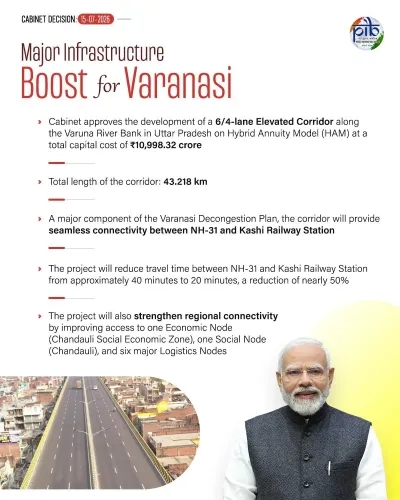
The elevated corridor will span 43.218 km with a 6/4-lane configuration along River Varuna in Varanasi .
Total capital cost is ₹10,998.32 crore .
The corridor connects NH-31 to the Varanasi Ring Road , aiming to decongest the city's core.
The project aligns with the Bharatmala Pariyojana framework for national highway and ring-road development.
Environmental clearances for the riverfront alignment and Uttar Pradesh land acquisition are the next critical milestones.
Union Minister Sarbananda Sonowal on Wednesday, 15 July 2026 announced that the Union Cabinet, chaired by Prime Minister Narendra Modi, approved the construction of a 43.218-km, 6/4-lane Elevated Corridor along the River Varuna in Varanasi, Uttar Pradesh, at a total capital cost of ₹10,998.32 crore. The corridor will connect NH-31 to the Varanasi Ring Road and is aimed at decongesting one of India's most densely trafficked ancient cities.
Context
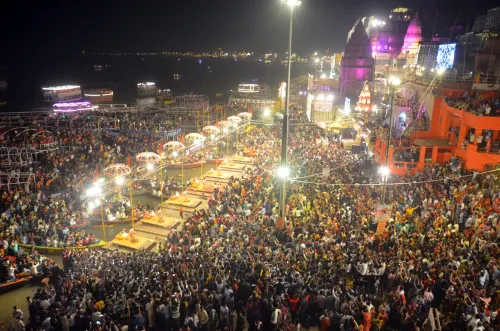
Varanasi, the Lok Sabha constituency of Prime Minister Modi, has been a focal point of large-scale urban and transport infrastructure investments since 2014. The city's narrow lanes and high pilgrim footfall have long made vehicular movement a chronic challenge, particularly around the ghats and the older quarters of the city.
The new elevated alignment runs along the River Varuna, a tributary of the Ganga, threading through the city's northern edge to stitch together two critical arterial links — NH-31, which connects Uttar Pradesh and Bihar corridors, and the Varanasi Ring Road — without cutting through the dense urban core.
Policy Backdrop
The project fits squarely within the Bharatmala Pariyojana framework, launched in 2015, which prioritises economic corridors, ring roads, and elevated alignments to reduce congestion on legacy national highways. Uttar Pradesh has consistently been among the largest recipients of national highway investment under successive Central budgets since 2014.
Varanasi has already seen major Central interventions, including the Kashi Vishwanath Corridor and multiple ring-road segments approved between 2018 and 2022. The latest Cabinet decision extends that infrastructure push into urban traffic management through a riverfront elevated alignment — a design approach increasingly preferred for heritage cities where ground-level widening is not feasible.
Road projects of this scale are typically executed by the Ministry of Road Transport and Highways, with the state government — here, Uttar Pradesh — providing support on land acquisition and utility relocation.
Stakeholders and Impact
Daily commuters, long-haul truckers using NH-31, and traders in Varanasi's commercial belts stand to benefit most directly from reduced travel times once the corridor is operational. The city's pilgrim economy — which draws millions of visitors annually to the ghats and the Kashi Vishwanath Temple — is also expected to see smoother last-mile connectivity.
Environmental scrutiny of the riverfront alignment along the Varuna will be a key procedural step, given the river's ecological and cultural significance. Local traders near the proposed approach roads may face transitional disruption during construction.
What's Next
The immediate pipeline includes issuance of Request for Qualification and Request for Proposal documents to shortlist construction contractors, followed by mandatory environmental and, where applicable, wildlife clearances for the Varuna riverfront stretch. Progress on land acquisition by the Uttar Pradesh government will set the pace for ground-breaking. Given the project's scale and cost, execution is expected to be phased over multiple years, with construction timelines to be specified in the concession agreement.
Point of View
000 crore elevated corridor in Varanasi reinforces the Central government's pattern of channelling flagship infrastructure spending into PM Modi's home constituency, lending political visibility to an otherwise technocratic road project. Choosing a riverfront elevated alignment is a pragmatic response to the impossibility of widening roads in a heritage city, but it also raises the environmental bar — clearances along the Varuna could become a flashpoint for civil society scrutiny. For Uttar Pradesh, which heads into the next assembly cycle, a high-value Central project of this kind adds to the BJP's infrastructure narrative in the state's most symbolically significant city. The announcement by Sonowal, a ports minister, rather than the roads ministry, signals the broad Cabinet-communication strategy the BJP deploys to amplify major spending decisions across its leadership.
NationPress
15 Jul 2026
Frequently Asked Questions
What is the Varanasi elevated corridor project approved by the Cabinet?
The Union Cabinet approved a 43.218-km, 6/4-lane elevated corridor along River Varuna in Varanasi, connecting NH-31 to the Varanasi Ring Road, at a total cost of ₹10,998.32 crore, to decongest the city.
How much will the Varanasi elevated corridor cost?
The total capital cost of the project is ₹10,998.32 crore, as approved by the Union Cabinet on 15 July 2026.
Which highway does the Varanasi corridor connect?
The elevated corridor connects NH-31 — which links Uttar Pradesh and Bihar — to the Varanasi Ring Road, providing a bypass around the city's congested core.
Why is an elevated corridor being built along River Varuna in Varanasi?
Varanasi's dense heritage urban fabric makes ground-level road widening impractical. An elevated alignment along the River Varuna allows a high-capacity bypass without demolishing the city's historic core or displacing large populations.
What happens next after Cabinet approval of the Varanasi elevated corridor?
The next steps include issuing tender documents to select construction contractors, obtaining environmental clearances for the riverfront alignment, and completing land acquisition by the Uttar Pradesh government.