Cabinet Clears ₹10,998 Cr Varanasi Varuna Corridor
Synopsis
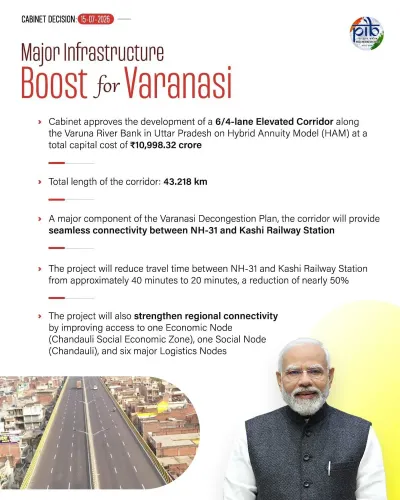
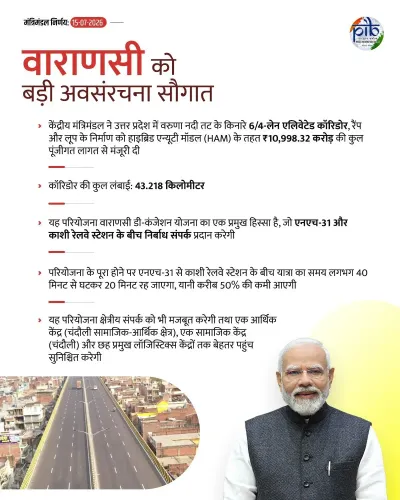
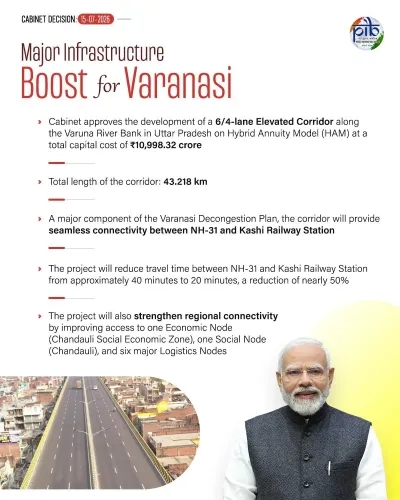
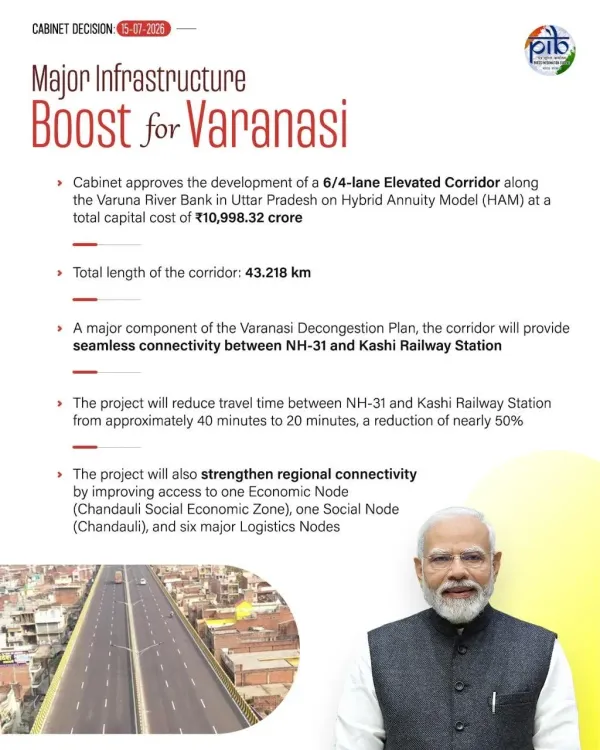
The Union Cabinet, chaired by PM Narendra Modi, has approved a 43.218-km link corridor connecting NH-31 with the Varanasi Ring Road along River Varuna. The ₹10,998.32 crore project will be built by NHAI under the Hybrid Annuity Model, boosting connectivity in the PM's constituency.
Key Takeaways
The Union Cabinet approved the 43.218-km Varanasi Varuna Link/Connector Corridor on 15 July 2026 .
The corridor will connect NH-31 with the Varanasi Ring Road , running along the River Varuna .
Total project investment is ₹10,998.32 crore , to be developed by NHAI .
The project will use the Hybrid Annuity Model (HAM) , a public-private partnership framework.
The project is expected to decongest urban traffic in Varanasi and boost the Uttar Pradesh logistics sector.
The announcement was made by Union Minister Bhupender Yadav under the #CabinetDecisions series.
Union Environment Minister and senior BJP leader Bhupender Yadav announced on Wednesday, 15 July 2026 that the Union Cabinet, chaired by Prime Minister Narendra Modi, has approved a major highway project connecting NH-31 with the Varanasi Ring Road along the River Varuna, at a total investment of ₹10,998.32 crore.
Context
The approved project entails the construction of a 43.218-km Link/Connector Corridor that will bridge NH-31 and the Varanasi Ring Road, running along the course of the River Varuna. The corridor is to be developed by the National Highways Authority of India (NHAI) under the Hybrid Annuity Model (HAM), a public-private partnership framework under which the government shares construction risk and pays annuities to the concessionaire after project completion.
Yadav shared the Cabinet decision on X under the hashtag #CabinetDecisions, describing the project as part of a broader push to strengthen national highway connectivity. The announcement positions Varanasi — the Prime Minister's own parliamentary constituency in Uttar Pradesh — as a focal point of the current phase of central infrastructure investment.
Policy Backdrop
The Varanasi Varuna Corridor fits within the framework of Bharatmala Pariyojana, the national highway programme launched in 2015 targeting the construction of 34,800 km of national highways with an emphasis on economic corridors and ring-road connectivity. Uttar Pradesh has consistently received the largest share of NHAI project allocations under both phases of Bharatmala, reflecting the state's scale and strategic freight importance.
The Hybrid Annuity Model was introduced specifically to de-risk highway projects for private developers by having the government fund 40 per cent of the project cost during construction and recover the balance through annuity payments over the concession period. This model has been widely used across NHAI's recent project pipeline to attract private capital while containing upfront budgetary outgo.
The broader National Infrastructure Pipeline, announced in 2019, earmarked ₹111 lakh crore for roads and highways through 2025, providing the fiscal scaffolding within which projects of this scale are sanctioned.
Stakeholders and Impact
The most immediate beneficiaries are Varanasi's residents and the city's substantial pilgrimage and tourism economy, which has long been constrained by urban traffic congestion. A dedicated connector corridor along the River Varuna is expected to divert heavy freight and inter-city traffic away from the city's older arterial roads, reducing travel times and improving air quality in the urban core.
The Uttar Pradesh logistics sector stands to gain from improved last-mile connectivity between the national highway network and the ring road, facilitating faster movement of goods in and out of one of the state's largest urban centres. Highway contractors and engineering firms will be the next stakeholder group in focus once NHAI opens the project for competitive bidding.
What's Next
NHAI is expected to initiate the tendering process following the Cabinet approval, with land acquisition along the River Varuna alignment likely to be the critical path item. Cost escalation and land-acquisition timelines will be closely tracked, particularly as parliamentary scrutiny of large infrastructure spends intensifies during the ongoing 2026 monsoon session.
The project's progress will also be watched as a signal of the pace at which Bharatmala Phase II commitments are being translated into on-ground execution, with Varanasi serving as a high-visibility test case for the government's urban-connectivity agenda in Uttar Pradesh.
Point of View
998.32 crore corridor in Varanasi — the Prime Minister's own constituency — underscores how high-visibility political geography continues to shape the sequencing of central infrastructure investment. The choice of the Hybrid Annuity Model signals the government's continued preference for de-risked PPP structures that attract private capital without large upfront budget commitments. Situated within the Bharatmala Pariyojana arc, the project is as much a statement of intent on urban decongestion as it is a freight-connectivity measure. How swiftly NHAI moves from approval to tendering to land acquisition will determine whether this becomes a template for similar urban-ring connectors elsewhere in Uttar Pradesh.
NationPress
14 Oct 2026
Frequently Asked Questions
What is the Varanasi Varuna Corridor project approved by the Cabinet?
The Union Cabinet approved the construction of a 43.218-km Link/Connector Corridor along the River Varuna, connecting NH-31 with the Varanasi Ring Road, at a total cost of ₹10,998.32 crore. It will be built by NHAI under the Hybrid Annuity Model.
What is the Hybrid Annuity Model used for this highway project?
The Hybrid Annuity Model (HAM) is a public-private partnership framework where the government funds 40 per cent of project costs during construction and pays the remaining amount to the private concessionaire as annuities after completion, reducing risk for private developers.
Why is Varanasi getting so many central infrastructure projects?
Varanasi is the parliamentary constituency of Prime Minister Narendra Modi and a major pilgrimage and cultural centre. It has consistently received significant central infrastructure investment, including under the Bharatmala Pariyojana highway programme.
Who announced the Varanasi Varuna Corridor Cabinet approval?
Union Environment Minister Bhupender Yadav announced the Cabinet decision on X on 15 July 2026 as part of the government's #CabinetDecisions communications series.
What is Bharatmala Pariyojana and how does this project relate to it?
Bharatmala Pariyojana is a national highway programme launched in 2015 targeting 34,800 km of new highways, with a focus on economic corridors and ring-road connectivity. The Varanasi Varuna Corridor aligns with Bharatmala's objective of improving urban and freight connectivity across major cities.