Cabinet Clears ₹10,998 Cr Varanasi Elevated Corridor
Synopsis
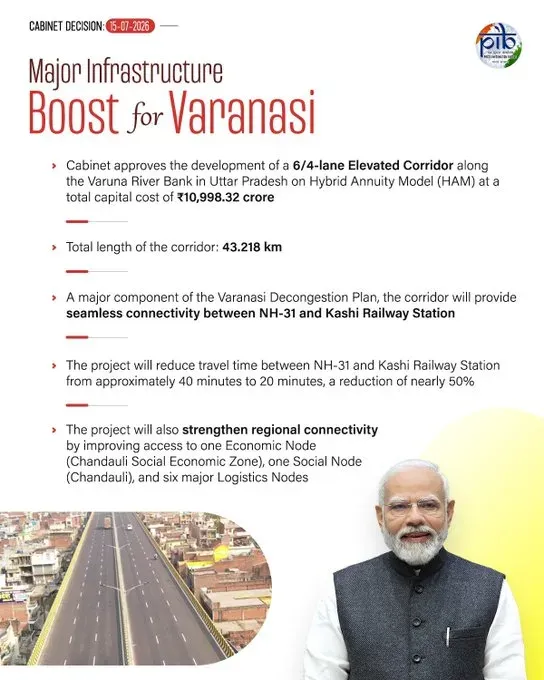
The Union Cabinet has approved a ₹10,998.32 crore, 43.218-km elevated corridor in Varanasi to connect NH-31 with the city's Ring Road along the River Varuna, aiming to ease chronic congestion in the pilgrimage city and PM Modi's parliamentary constituency.
Key Takeaways
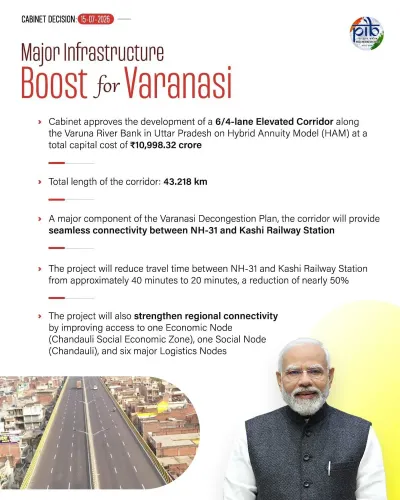
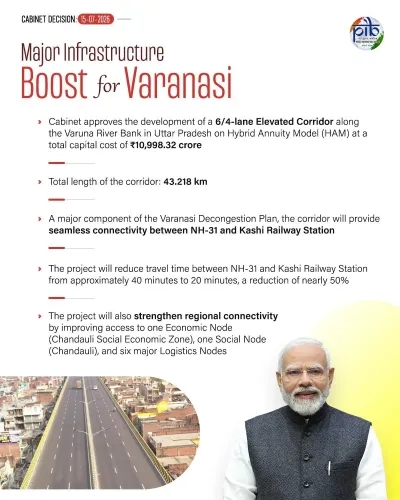
The Union Cabinet approved a 43.218-km, 6/4-lane Elevated Corridor in Varanasi on 15 July 2026 .
The corridor will connect NH-31 to the Varanasi Ring Road along the River Varuna .
Total capital cost is ₹10,998.32 crore .
The elevated riverbank alignment is designed to minimise land acquisition in the dense urban area.
The project aligns with the Bharatmala Pariyojana framework for national highway corridor development.
NHAI tendering and land acquisition are the next key milestones, expected over 12–18 months .
The Union Cabinet, chaired by Prime Minister Narendra Modi, on Wednesday, 15 July 2026, approved the construction of a 43.218-km, 6/4-lane Elevated Corridor in Varanasi, Uttar Pradesh, aimed at decongesting one of India's most densely trafficked pilgrimage cities. The project will connect NH-31 and the Varanasi Ring Road along the banks of the River Varuna, at a total capital outlay of ₹10,998.32 crore.
Context
Union Minister of State Dr. Jitendra Singh, who regularly communicates Cabinet infrastructure decisions, shared the announcement on X, noting the corridor's twin objectives: linking key national highway infrastructure and providing relief to Varanasi's chronically congested road network. The elevated alignment along the River Varuna has been chosen to minimise land acquisition, a recurring challenge in the ancient city's dense urban core.
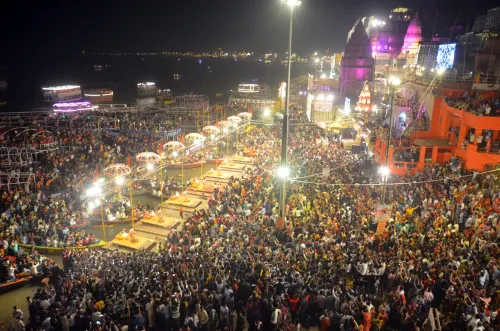
Varanasi, the parliamentary constituency of Prime Minister Modi, is among India's foremost Hindu pilgrimage and tourism destinations, drawing millions of visitors annually. The city's road network has long struggled to absorb the combined load of residents, pilgrims, and freight traffic.
Policy Backdrop
The approval fits within the broader Bharatmala Pariyojana framework, launched in 2015, which targets the development of expressways, national highway corridors, and ring roads to ease freight and passenger movement across India. Varanasi Ring Road Phase-I had received earlier Cabinet clearances in the late 2010s as part of the same connectivity push in Uttar Pradesh.
The central government has pursued a consistent pattern of sanctioning elevated corridors in high-density pilgrimage and tourist cities across Uttar Pradesh, with similar projects approved in Lucknow and Prayagraj. The riverbank alignment strategy has emerged as a preferred engineering solution to expand national highway capacity without large-scale displacement of residents.
Stakeholders and Impact
Varanasi's daily commuters and the city's substantial pilgrim and tourist inflows stand to benefit most directly from reduced travel times and improved connectivity to the national highway network. Freight operators using NH-31 are also expected to gain from smoother access to the ring road, bypassing the city centre.
The project's scale — spanning over 43 km at a cost of nearly ₹11,000 crore — positions it among the larger urban corridor investments in Uttar Pradesh, India's most populous state, which has seen sustained central infrastructure allocations since 2014. The National Highways Authority of India (NHAI) is expected to handle project execution.
What's Next
Tendering by NHAI and land acquisition proceedings in Varanasi district are the immediate milestones to watch over the next 12 to 18 months. The pace of these processes will determine whether the corridor can break ground within the current financial year.
With Varanasi continuing to receive priority infrastructure attention, the elevated corridor approval signals that the city's role as both a pilgrimage hub and a showcase constituency will remain central to the government's urban connectivity agenda in Uttar Pradesh.
Point of View
000 crore elevated corridor in Varanasi is not an isolated infrastructure decision — it is the latest instalment in a sustained pattern of large-ticket central investments in Prime Minister Modi's own parliamentary constituency. The choice of an elevated alignment along the River Varuna reflects a maturing playbook: maximise capacity addition while sidestepping the politically and logistically costly process of land acquisition in a heritage city. Placed alongside similar elevated projects in Lucknow and Prayagraj, the approval reinforces Uttar Pradesh's position as the single largest beneficiary of the Bharatmala-era highway push. The real test will be execution speed — Varanasi's complex urban fabric and the scale of the project mean that tendering and ground-breaking timelines will be watched closely by both infrastructure analysts and the city's voters.
NationPress
14 Oct 2026
Frequently Asked Questions
What is the Varanasi Elevated Corridor approved by the Cabinet?
It is a 43.218-km, 6/4-lane elevated road project connecting NH-31 and the Varanasi Ring Road along the River Varuna, approved by the Union Cabinet on 15 July 2026 at a cost of ₹10,998.32 crore to decongest Varanasi city.
What is the total cost of the Varanasi elevated corridor project?
The total capital cost of the project is ₹10,998.32 crore, as approved by the Union Cabinet.
Why is the Varanasi corridor being built along the River Varuna?
The riverbank alignment is a deliberate engineering choice to minimise land acquisition in Varanasi's densely populated urban core, a strategy also used in other UP corridor projects.
Which highways does the Varanasi elevated corridor connect?
The corridor connects NH-31 to the Varanasi Ring Road, providing a continuous elevated link that bypasses the city's congested interior.
Who will build the Varanasi elevated corridor?
The National Highways Authority of India (NHAI) is expected to handle tendering and execution of the project, with the process anticipated to begin over the next 12 to 18 months.