Cabinet Clears 6-Lane Greenfield Elevated Corridor for Varanasi
Synopsis
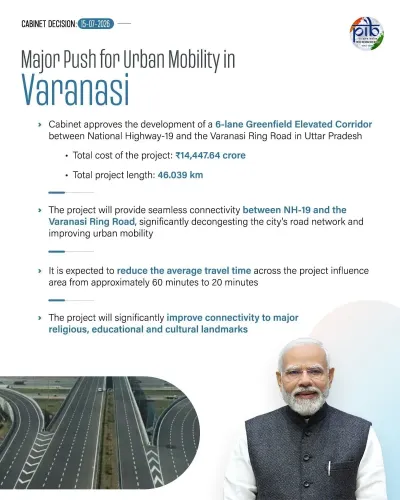
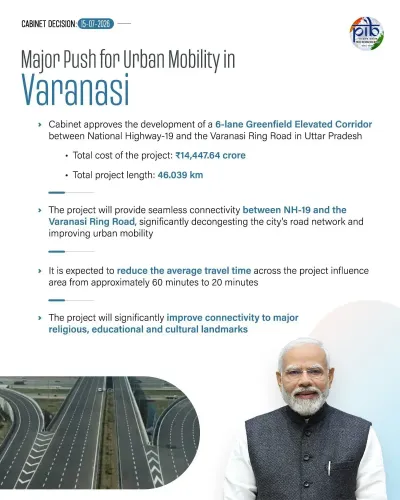
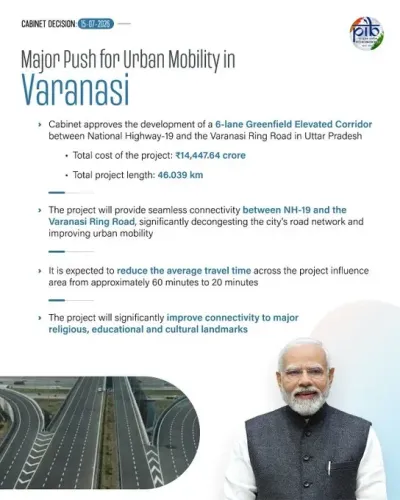
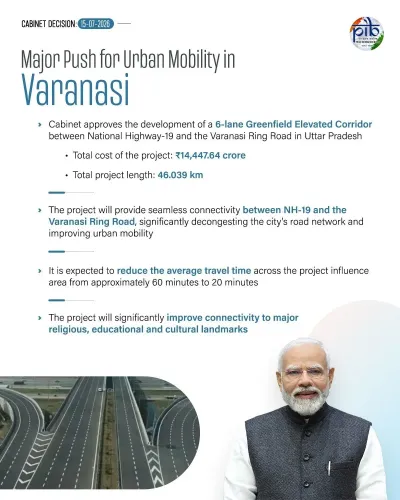
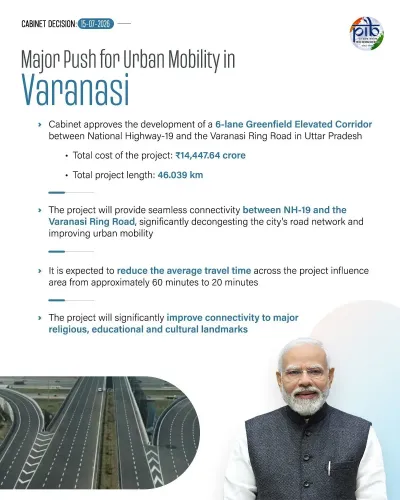
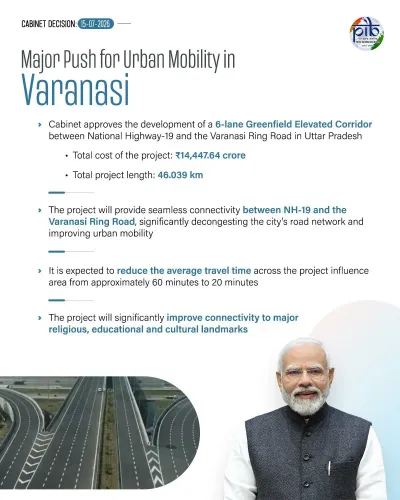
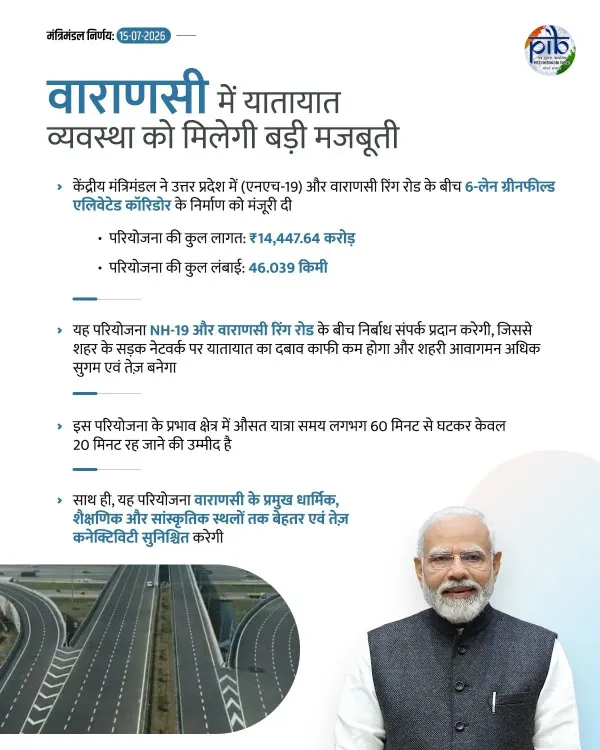
The Union Cabinet has cleared a 6-lane Greenfield Elevated Corridor linking NH-19 and the Varanasi Ring Road under the Hybrid Annuity Model. The project aims to ease traffic in Kashi and improve access to its religious, educational, and cultural sites for residents, pilgrims, and tourists.
Key Takeaways
The Union Cabinet approved a 6-lane Greenfield Elevated Corridor connecting NH-19 and the Varanasi Ring Road .
The project will be executed under the Hybrid Annuity Model (HAM) , a public-private partnership framework introduced in 2016 .
The corridor is designed to ease traffic congestion in Varanasi (Kashi) and improve access to key religious, educational, and cultural sites.
Beneficiaries include city residents, pilgrims visiting sites such as the Kashi Vishwanath Temple , tourists, and students of institutions like BHU .
The approval aligns with the Bharatmala Pariyojana framework for national highway and urban corridor development.
Next steps include tendering, land acquisition, and environmental clearances before construction can begin.
Union Education Minister Dharmendra Pradhan on Wednesday, 15 July 2026 announced that the Union Cabinet has approved the construction of a 6-lane Greenfield Elevated Corridor connecting NH-19 and the Varanasi Ring Road, to be built under the Hybrid Annuity Model (HAM). The project is aimed at easing traffic movement in Varanasi (Kashi) and improving access to the city's key religious, educational, and cultural landmarks.
Context
Pradhan shared the Cabinet decision on X, writing that the corridor will ensure 'यातायात को अधिक सुगम' (smoother traffic flow) and provide 'तेज, सुरक्षित एवं सुविधाजनक आवागमन' (faster, safer, and more convenient movement) for residents, pilgrims, and tourists. The elevated structure will link two critical arterial routes — NH-19, a major highway connecting northern and eastern India, and the Varanasi Ring Road — reducing pressure on the city's congested surface roads.
Varanasi is home to the Kashi Vishwanath Temple, the Banaras Hindu University (BHU), and the Ganga ghats, all of which attract millions of visitors annually. Improved connectivity to these sites has long been a civic and administrative priority.
Policy Backdrop
The approval falls within the broader framework of the Bharatmala Pariyojana, the national highway development programme approved in 2015, which includes urban elevated corridors as part of its mandate. The Hybrid Annuity Model, introduced in 2016, was designed to revive stalled public-private partnership highway projects by distributing revenue risk between the government and private developers — with the government paying a fixed annuity during construction and operation phases.
Since 2016, HAM has been applied to elevated corridor projects in multiple Indian cities, making it a tested instrument for urban highway infrastructure. Its use in Varanasi signals continuity with this national approach rather than a departure from established practice.
Stakeholders and Impact
Varanasi's residents stand to benefit from reduced daily commute times once the corridor is operational, while the city's large pilgrim economy — drawing devotees to sites such as the Kashi Vishwanath Corridor — could see logistical friction ease significantly. Tourism operators and hospitality businesses dependent on smooth movement between the railway station, ghats, and temples are also among the key beneficiaries.
Educational institutions, particularly BHU and its affiliated colleges, which draw students and faculty from across the country, will gain better road access. The project is also expected to reduce freight transit delays on NH-19, which serves as a critical artery for goods movement in the region.
What's Next
Following Cabinet clearance, the project will move to the tendering stage, where private developers will be invited to bid under HAM terms. Land acquisition status and environmental clearances will be the critical near-term milestones determining the construction timeline. Varanasi has seen successive infrastructure investments in recent years, and this corridor will be watched as a test of execution speed for urban elevated highway projects in heritage cities.
The pace at which the National Highways Authority of India (NHAI) moves from approval to ground-breaking will be a key indicator of how quickly Varanasi's connectivity transformation can be delivered at scale.
Point of View
Where congestion directly affects both civic life and the pilgrim economy. Executing it under HAM reflects a settled government preference for risk-sharing with the private sector on urban highway projects. For Pradhan — primarily the Education Minister — amplifying this infrastructure announcement signals the BJP's broader effort to associate the party with Varanasi's transformation, a city that carries significant political symbolism. The real test will be whether tendering and land acquisition proceed without the delays that have historically slowed urban elevated corridor projects in India.
NationPress
14 Oct 2026
Frequently Asked Questions
What is the 6-lane Greenfield Elevated Corridor approved for Varanasi?
It is a new elevated road project connecting NH-19 and the Varanasi Ring Road, approved by the Union Cabinet to ease traffic and improve access to religious, educational, and cultural sites in Varanasi (Kashi).
What is the Hybrid Annuity Model (HAM) used for this project?
HAM is a public-private partnership model introduced in 2016 for highway projects, where the government shares construction costs through fixed annuity payments and splits revenue risk with the private developer.
How will the Varanasi elevated corridor benefit pilgrims and tourists?
The corridor will provide faster, safer, and more convenient road access to key sites such as the Kashi Vishwanath Temple and the Ganga ghats, reducing travel time and easing congestion for the millions who visit Varanasi annually.
What is NH-19 and why does it matter for Varanasi?
NH-19 is a major national highway linking northern and eastern India that passes through the Varanasi region. Connecting it to the Ring Road via an elevated corridor will improve both local commuting and long-distance freight movement.
What are the next steps after Cabinet approval of the Varanasi corridor?
After Cabinet clearance, the project moves to the tendering stage under HAM, followed by land acquisition and environmental clearances before construction work can begin.