Cabinet Clears Two Elevated Corridors for Varanasi Worth Rs 25,445 Cr
Synopsis
The Union Cabinet has approved two elevated corridor projects in Varanasi — a 6-lane NH-19 to Ring Road greenfield corridor at Rs 14,447.64 crore and a Varuna River Bank corridor at Rs 10,998.32 crore — both under the Hybrid Annuity Model, totalling over Rs 25,445 crore to decongest PM Modi's constituency.
Key Takeaways
The Union Cabinet approved two elevated corridor projects in Varanasi, Uttar Pradesh on 15 July 2026 .
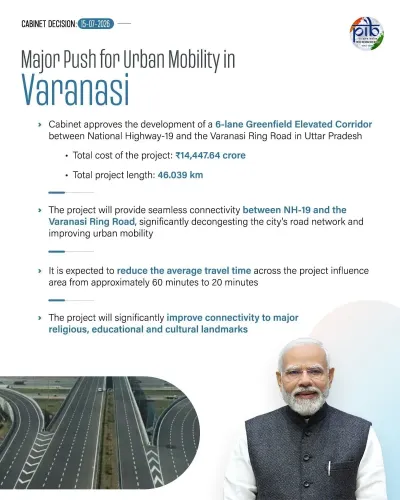
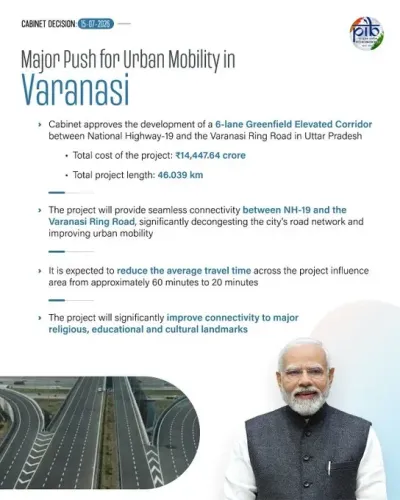
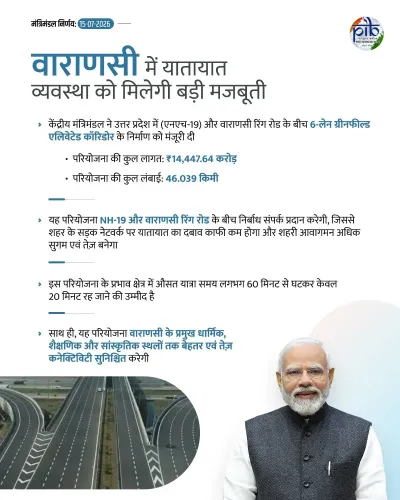
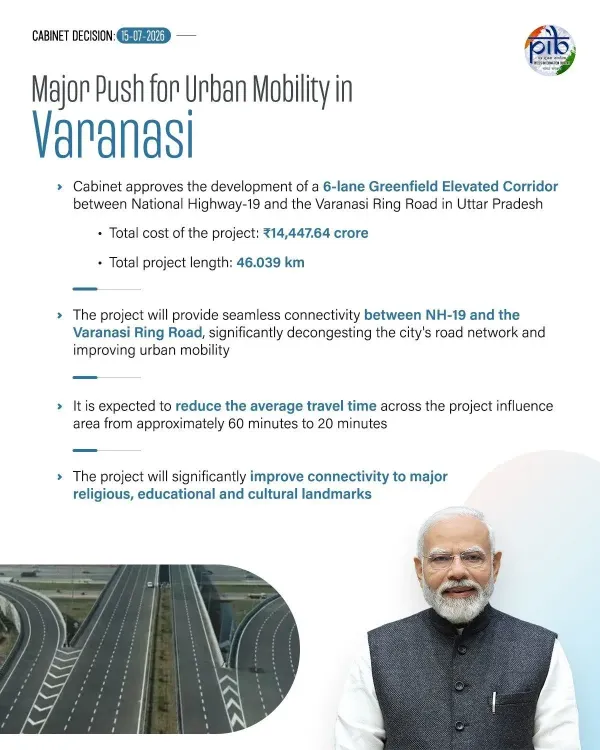
The first is a 6-lane Greenfield Elevated Corridor linking NH-19 to the Varanasi Ring Road at a capital cost of Rs 14,447.64 crore .
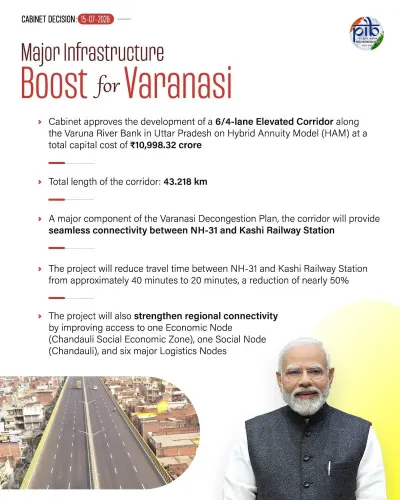
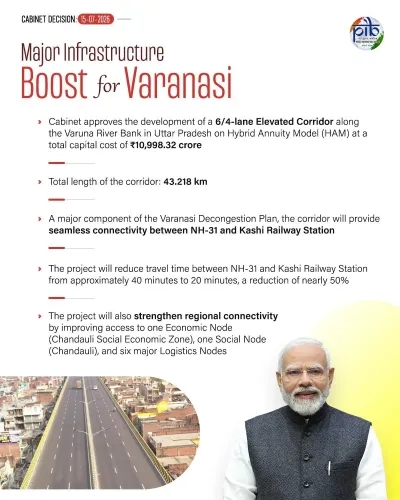
The second is a 6/4-lane Elevated Corridor along the Varuna River Bank at a capital cost of Rs 10,998.32 crore .
Both projects will be executed under the Hybrid Annuity Model (HAM) , a public-private partnership framework.
Combined capital outlay for both corridors exceeds Rs 25,445 crore .
The approvals align with the Bharatmala Pariyojana and the government's Viksit Bharat infrastructure vision.
Union Consumer Affairs Minister Pralhad Joshi announced on Wednesday, 15 July 2026 that the Union Cabinet, chaired by Prime Minister Narendra Modi, has approved two major elevated corridor projects in Varanasi, Uttar Pradesh, with a combined capital outlay of over Rs 25,445 crore aimed at decongesting the historic city and transforming its road connectivity.
Context
The Cabinet cleared two distinct projects under the Hybrid Annuity Model (HAM), a public-private partnership framework that distributes construction risk between the government and private developers. The first is a 6-lane Greenfield Elevated Corridor with ramps, loops, and a foot over bridge connecting National Highway-19 (NH-19) to the Varanasi Ring Road, approved at a total capital cost of Rs 14,447.64 crore under NH(O). The second is a 6/4-lane Elevated Corridor along the Varuna River Bank, also with ramps and loops, sanctioned at a capital cost of Rs 10,998.32 crore.
Joshi described the decisions as 'a major step towards seamless connectivity, modern infrastructure and the vision of #ViksitBharat' (Developed India), framing them within the broader national development agenda of the Modi government.
Policy Backdrop
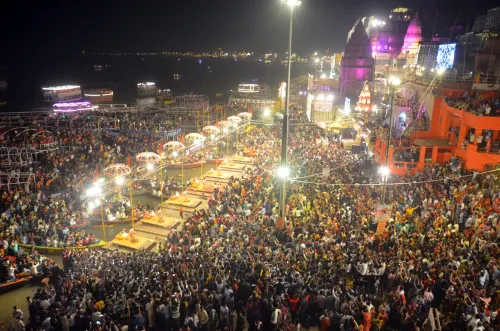
Varanasi is Prime Minister Modi's parliamentary constituency and has been a focal point for central infrastructure investment since 2014. The city's dense historic core and growing traffic volumes have long strained its road network, making elevated and bypass infrastructure a priority. NH-19, the major east-west corridor linking Delhi to Kolkata, passes near Varanasi and forms part of the Bharatmala Pariyojana network — a flagship highway development programme approved in 2015 targeting over 34,000 km of national highways, including ring roads and elevated corridors.
The Hybrid Annuity Model has been the preferred delivery mechanism for Uttar Pradesh highway projects since 2017, allowing the National Highways Authority of India (NHAI) to attract private capital while retaining public oversight over project execution.
Stakeholders and Impact
Varanasi's daily commuters and the city's significant pilgrimage and tourism traffic stand to benefit most directly from the two corridors. The Varuna River Bank alignment is expected to ease movement along one of the city's most congested arterial stretches, while the NH-19 to Ring Road corridor will create a new high-speed link bypassing the urban core entirely.
Uttar Pradesh-based logistics and freight operators, who rely on NH-19 for east-west cargo movement, are also key stakeholders. Smoother connectivity through and around Varanasi could reduce transit times and lower freight costs for goods moving between northern and eastern India.
What's Next
The projects will now move toward tendering by NHAI, followed by land acquisition processes and environmental clearances — particularly relevant for the Varuna River Bank corridor, which runs alongside a riverine ecosystem. Progress on these administrative milestones will determine when construction can begin in earnest.
With Varanasi continuing to receive concentrated central investment, these two approvals reinforce the pattern of using elevated infrastructure to modernise India's historically significant but congested urban centres, setting a template that could be replicated in other pilgrimage and heritage cities under the #ViksitBharat framework.
Point of View
Channelling over Rs 25,000 crore into a single city in one sitting. Deploying the Hybrid Annuity Model for both projects reflects a settled preference for risk-sharing frameworks that keep private capital engaged without ceding public control — a formula refined across dozens of Uttar Pradesh highway projects since 2017. The Varuna River Bank alignment, in particular, will draw scrutiny from environmental regulators, and how swiftly NHAI navigates those clearances will test whether the government's execution pace matches its announcement cadence. Broader reading: Varanasi is increasingly functioning as a policy laboratory where central schemes — from urban renewal to highway modernisation — are fast-tracked and then held up as replicable models for other heritage cities under the Viksit Bharat agenda.
NationPress
14 Oct 2026
Frequently Asked Questions
What are the two elevated corridor projects approved for Varanasi?
The Cabinet approved a 6-lane Greenfield Elevated Corridor connecting NH-19 to the Varanasi Ring Road at Rs 14,447.64 crore, and a 6/4-lane Elevated Corridor along the Varuna River Bank at Rs 10,998.32 crore — both under the Hybrid Annuity Model.
What is the total cost of the Varanasi elevated corridor projects?
The combined capital cost of both projects is over Rs 25,445 crore — Rs 14,447.64 crore for the NH-19 to Ring Road corridor and Rs 10,998.32 crore for the Varuna River Bank corridor.
What is the Hybrid Annuity Model used for these projects?
The Hybrid Annuity Model (HAM) is a public-private partnership framework for national highway projects in which the government and a private developer share construction risk and costs, allowing NHAI to attract private capital while retaining public oversight.
Why is Varanasi getting so much infrastructure investment from the Centre?
Varanasi is Prime Minister Narendra Modi's parliamentary constituency and a major pilgrimage and tourism hub. Its dense historic core has long faced severe traffic congestion, making it a priority for elevated corridor and bypass projects under the Bharatmala Pariyojana programme.
What happens next after Cabinet approval for the Varanasi corridors?
Following Cabinet approval, NHAI will initiate tendering for both projects. Land acquisition and environmental clearances — especially for the Varuna River Bank alignment — are the key milestones that will determine when construction begins.