PM Modi Hails Rs 62,500 Cr Mobile Manufacturing Scheme
Synopsis
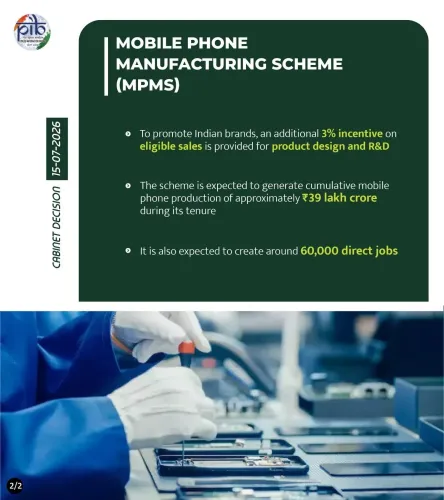
The Union Cabinet has approved a Mobile Phone Manufacturing Scheme worth Rs 62,500 crore, which Prime Minister Narendra Modi says will scale production, deepen domestic value addition, and strengthen India's electronics supply chains — a major escalation of the Make in India and Atmanirbhar Bharat agendas.
Key Takeaways
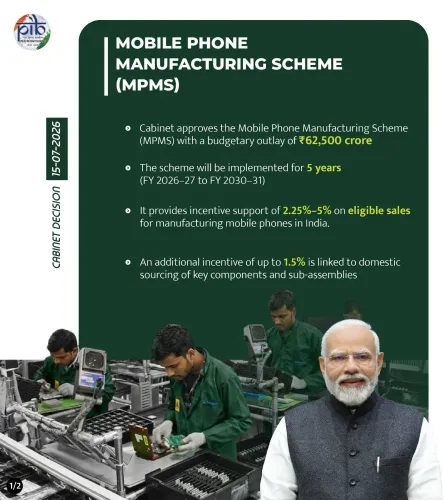
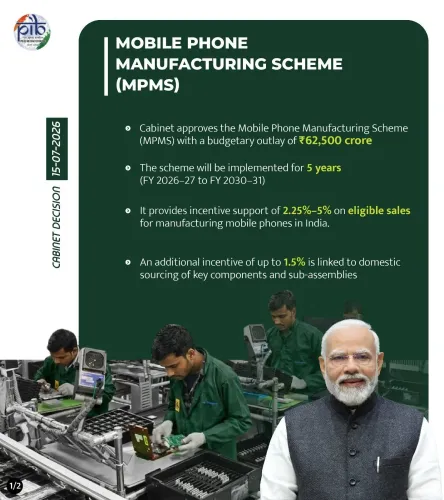
The Union Cabinet approved the Mobile Phone Manufacturing Scheme with an outlay of Rs 62,500 crore .
Prime Minister Narendra Modi described it as 'a massive boost' to Make in India and the electronics manufacturing ecosystem.
The new outlay is significantly larger than the Rs 38,454 crore committed under the original PLI Scheme for Large Scale Electronics Manufacturing approved in April 2020 .
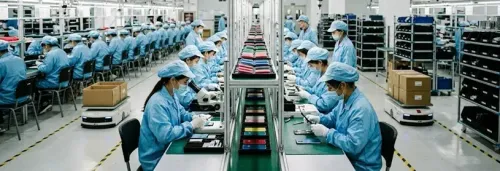
The scheme aims to scale up production, deepen domestic value addition, and strengthen supply chains — moving beyond final assembly.
Key manufacturing states including Tamil Nadu , Karnataka , and Uttar Pradesh are expected to attract fresh investment under the scheme.
Detailed guidelines and eligibility criteria are awaited from the Ministry of Electronics and IT .
Prime Minister Narendra Modi on Wednesday, 15 July 2026 welcomed the Union Cabinet's approval of a major new mobile phone manufacturing scheme, calling it 'a massive boost' to the Make in India initiative and India's broader electronics manufacturing ecosystem. The scheme carries an outlay of Rs 62,500 crore and is designed to scale up production, deepen domestic value addition, and strengthen supply chains across the sector.
Context
In his post on X, Prime Minister Modi described the Cabinet's approval of the Mobile Phone Manufacturing Scheme as a landmark step, stating it would 'scale up production, deepen domestic value addition, strengthen supply chains and create' — the post indicating further downstream benefits for employment and the ecosystem. The announcement positions the scheme as a direct extension of India's decade-long manufacturing ambitions anchored in the Make in India programme, launched in September 2014.
The scale of the new outlay — Rs 62,500 crore — is substantially larger than the Rs 38,454 crore committed under the original Production Linked Incentive (PLI) Scheme for Large Scale Electronics Manufacturing approved by the Union Cabinet in April 2020, signalling a significant escalation in state support for the sector.
Policy Backdrop
India's push to build a domestic mobile phone manufacturing base has unfolded in successive policy layers over the past decade. The Make in India programme set the strategic direction in 2014, the PLI scheme in 2020 provided targeted fiscal incentives tied to incremental production, and the India Semiconductor Mission launched in 2021 extended the framework to components and chips.
Global contract manufacturers have progressively expanded facilities in states including Tamil Nadu, Uttar Pradesh, and Karnataka in response to these incentives, and cumulative mobile phone exports from India have risen sharply since the first PLI round. The new scheme appears designed to push beyond final assembly toward a deeper, more integrated domestic supply chain — a long-stated objective of the Atmanirbhar Bharat agenda.
The Ministry of Electronics and Information Technology is expected to release detailed scheme guidelines, eligibility criteria, and disbursement milestones in the coming weeks.
Stakeholders and Impact
The scheme's primary beneficiaries span the full electronics value chain: mobile handset manufacturers, electronics component suppliers, and state governments that host manufacturing clusters. For manufacturers, the Rs 62,500 crore outlay represents a substantial production-linked fiscal incentive pool that could underwrite capacity expansion and localisation of components currently imported, particularly from China.
State governments in Tamil Nadu, Karnataka, and Uttar Pradesh — which already host significant mobile manufacturing infrastructure — stand to attract additional investment and employment as companies scale to meet scheme eligibility thresholds. Suppliers of sub-components such as display modules, batteries, and printed circuit boards are also expected to benefit as original equipment manufacturers seek to meet domestic value-addition requirements.
What's Next
Industry attention will now shift to the detailed guidelines that the Ministry of Electronics and IT is expected to notify, including the production thresholds, value-addition benchmarks, and disbursement timelines that will determine which companies qualify and how incentives are structured. Quarterly mobile production and export data from the Ministry of Commerce will serve as the primary scorecard for the scheme's early performance.
If the new scheme succeeds in pushing domestic value addition beyond assembly — as its architects intend — India could meaningfully reduce its dependence on imported mobile components and strengthen its position as a global electronics export hub over the next five years.
Point of View
500 crore Mobile Phone Manufacturing Scheme represents the most ambitious single fiscal commitment India has made to electronics manufacturing, dwarfing the original 2020 PLI outlay. Prime Minister Modi's framing of the announcement — emphasising domestic value addition and supply-chain depth rather than just assembly volumes — signals a policy maturation from the earlier, simpler incentive model. The move fits a clear pattern: each successive scheme layer has tried to pull more of the global mobile supply chain onshore, reducing the structural import dependence on East Asian component ecosystems. Whether the new scheme can achieve that deeper integration will depend heavily on the eligibility architecture the Ministry of Electronics and IT notifies in the coming weeks.
NationPress
14 Oct 2026
Frequently Asked Questions
What is the Mobile Phone Manufacturing Scheme approved by the Cabinet?
The Mobile Phone Manufacturing Scheme is a new Union Cabinet-approved initiative with an outlay of Rs 62,500 crore aimed at scaling up mobile phone production in India, deepening domestic value addition, and strengthening electronics supply chains under the Make in India programme.
How does the new scheme compare to the earlier PLI scheme for electronics?
The original Production Linked Incentive Scheme for Large Scale Electronics Manufacturing, approved in April 2020, had an outlay of Rs 38,454 crore. The newly approved Mobile Phone Manufacturing Scheme at Rs 62,500 crore is considerably larger, indicating a significant escalation in government support.
Which states will benefit most from the mobile manufacturing scheme?
States with existing mobile manufacturing infrastructure — particularly Tamil Nadu, Karnataka, and Uttar Pradesh — are expected to attract the most investment and employment as manufacturers scale up to meet the new scheme's production and value-addition requirements.
What is Make in India and how does this scheme relate to it?
Make in India is a flagship programme launched by Prime Minister Narendra Modi in September 2014 to boost domestic manufacturing, attract foreign direct investment, and reduce import dependence. The new mobile phone scheme is a direct extension of this initiative, focused on the electronics sector.
When will the scheme guidelines be released?
The Ministry of Electronics and IT is expected to notify detailed scheme guidelines, eligibility criteria, and disbursement milestones after the Cabinet approval, though a specific date has not yet been announced publicly.