CM Fadnavis Cabinet Clears Push for ₹89,000 Cr Investment

Synopsis
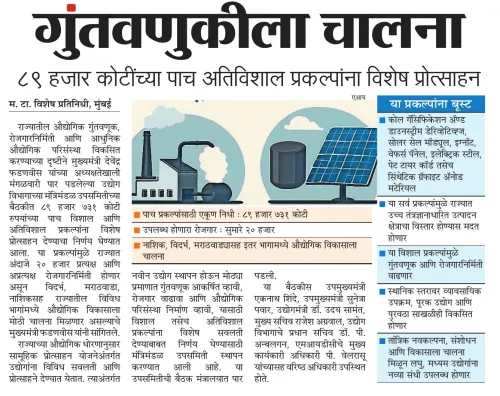
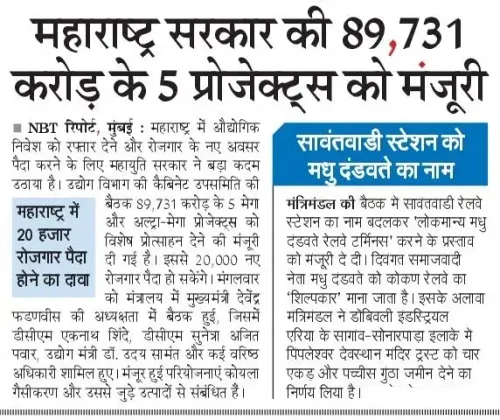
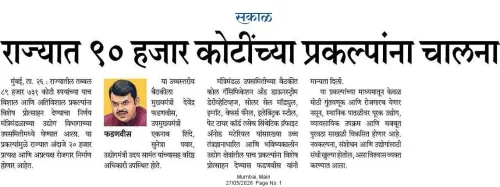
The Chief Minister's Office of Maharashtra announced on 26 May 2026 that the state cabinet has approved special incentives for five ultra-large projects aimed at catalysing ₹89,000 crore in investment, reinforcing the Fadnavis government's industrial growth agenda.
Key Takeaways
The Maharashtra cabinet on 26 May 2026 approved special incentives targeting five ultra-large projects .
The move is projected to catalyse investments worth ₹89,000 crore in the state.
The decision was announced by the Chief Minister's Office of Maharashtra via its official X account as part of the day's cabinet summary.
Chief Minister Devendra Fadnavis is the driving force behind the incentive package, continuing Maharashtra 's competitive industrial policy stance.
Full cabinet decision details were published on the state's official portal, Mahasamvad .
Detailed project lists and disbursement schedules are expected to be tabled in the upcoming monsoon session of the Maharashtra legislative assembly.
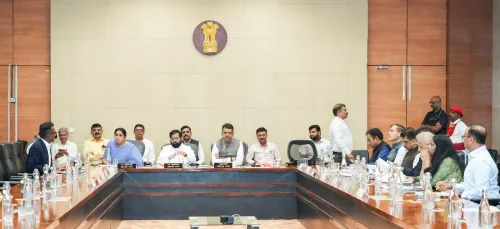
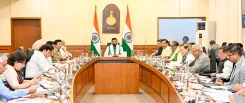
The Chief Minister's Office of Maharashtra on Tuesday, 26 May 2026, released the day's summary of key decisions, highlighting that the state cabinet has moved to catalyse investments worth ₹89,000 crore by extending special incentives to five ultra-large projects under Chief Minister Devendra Fadnavis.
Context
The official post, shared by the Chief Minister's Office of Maharashtra late on 26 May 2026, summarises the day's cabinet outcomes in Marathi: '₹89,000 कोटींच्या गुंतवणुकीला चालना मिळणार; 5 अतिविशाल प्रकल्पांना विशेष प्रोत्साहन' — translated as 'Investment of ₹89,000 crore to receive a boost; special incentives for 5 ultra-large projects.' The announcement signals a concerted push by the Fadnavis-led government to fast-track large-scale industrial and infrastructure commitments in the state.
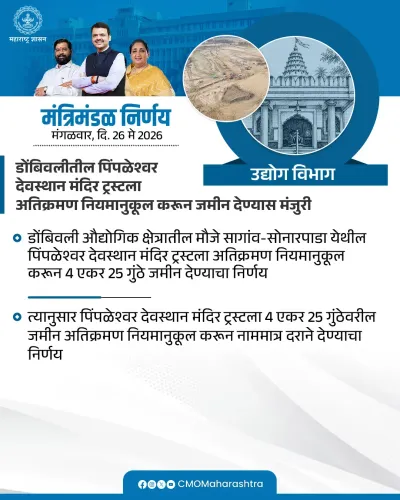
The cabinet also passed a set of separate decisions, the full details of which were published on the state government's official communication portal, Mahasamvad. These decisions collectively form part of Maharashtra's ongoing effort to sharpen its competitive edge in attracting manufacturing and infrastructure capital.
Policy Backdrop
Maharashtra has a long track record of deploying cabinet-level incentive packages — including capital subsidies, power tariff concessions, and single-window regulatory clearances — to draw large investors. The state notified a revised Industrial Policy as far back as 2019, which introduced structured incentive tiers for mega and ultra-mega projects, laying the groundwork for the kind of targeted approvals announced on 26 May 2026.
The broader strategic context is Maharashtra's sustained competition with states such as Gujarat and Tamil Nadu for marquee investments in sectors ranging from semiconductors and electric vehicles to data centres and logistics parks. Successive state governments have linked such cabinet decisions directly to GDP growth targets and large-scale employment generation, a framing that the Fadnavis administration has continued. The approach also aligns with the national Make in India framework, which emphasises easing land acquisition, power availability, and regulatory compliance for high-value projects.
Stakeholders and Impact
The primary beneficiaries of the incentive package are large industrial developers and institutional investors who have proposed or are in the process of finalising project commitments in Maharashtra. For these stakeholders, special cabinet-level incentives typically translate into reduced capital costs, faster environmental and regulatory approvals, and assured infrastructure support from the state.
At the ground level, ultra-large projects of this scale are expected to generate significant direct and indirect employment. Ancillary industries, logistics providers, and local supply-chain vendors in the project catchment areas stand to benefit as capital expenditure flows through the regional economy. The state exchequer, in turn, anticipates a return through enhanced GST collections, stamp duty revenues, and long-term expansion of the industrial tax base.
What's Next
The immediate next steps will involve the release of detailed project profiles, incentive disbursement schedules, and implementation timelines — disclosures that are typically tabled during the state budget session or the monsoon session of the Maharashtra legislative assembly. Investors and industry bodies will closely track whether the five ultra-large projects proceed to formal memoranda of understanding and ground-breaking ceremonies within the current fiscal year.
Analysts will also watch whether the cabinet's decisions on 26 May 2026 are followed by complementary announcements on land allocation, power purchase agreements, and environmental clearances — the operational bottlenecks that have historically slowed the translation of headline investment figures into on-ground project execution in Maharashtra.
Point of View
Whose political identity is closely tied to Maharashtra's economic performance, a headline investment figure of ₹89,000 crore serves both a governance and an electoral signalling function. The decision fits a broader pattern in which large Indian states use cabinet-level approvals as instruments of investor confidence, often ahead of global investor summits or budget cycles. The real test, as with previous Maharashtra mega-project announcements, will be the pace at which these commitments convert into operational capacity on the ground.
NationPress
10 Oct 2026
Frequently Asked Questions
What did the Maharashtra cabinet decide on 26 May 2026?
The Maharashtra cabinet on 26 May 2026 approved special incentives for five ultra-large projects intended to catalyse investments worth ₹89,000 crore in the state, as announced by the Chief Minister's Office.
What is the ₹89,000 crore Maharashtra investment about?
The ₹89,000 crore figure refers to the projected investment that the Maharashtra government expects to attract through special cabinet-approved incentives extended to five ultra-large industrial or infrastructure projects.
Who announced the Maharashtra cabinet investment decision?
The announcement was made by the official Chief Minister's Office of Maharashtra on its X account, attributing the decision to Chief Minister Devendra Fadnavis.
What kind of incentives does Maharashtra offer to mega projects?
Maharashtra typically offers mega and ultra-large projects a combination of capital subsidies, power tariff concessions, single-window regulatory clearances, and infrastructure support, as established under its Industrial Policy framework.
Where can I find the full details of the Maharashtra cabinet decisions of 26 May 2026?
The complete cabinet decisions were published on Mahasamvad, the official communication portal of the Maharashtra government, with links shared in the Chief Minister's Office post on X.