Rijiju: Cabinet clears ₹62,500 cr Mobile Manufacturing Scheme
Synopsis
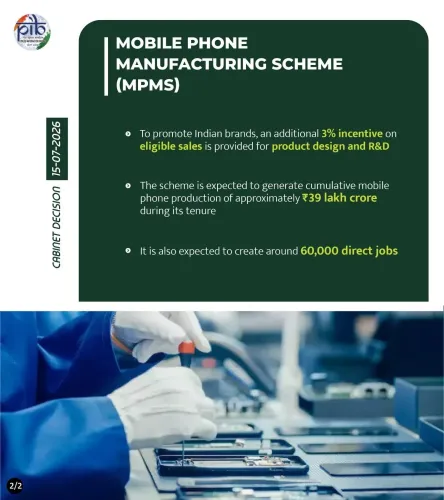
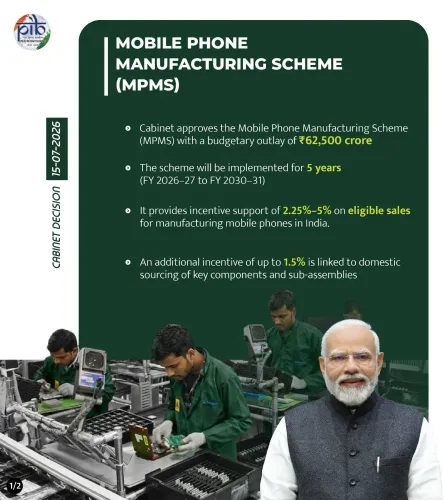
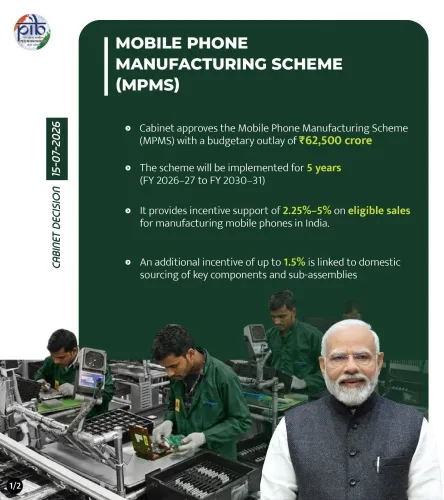
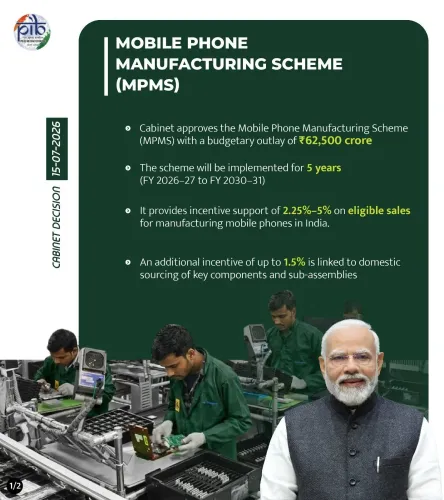
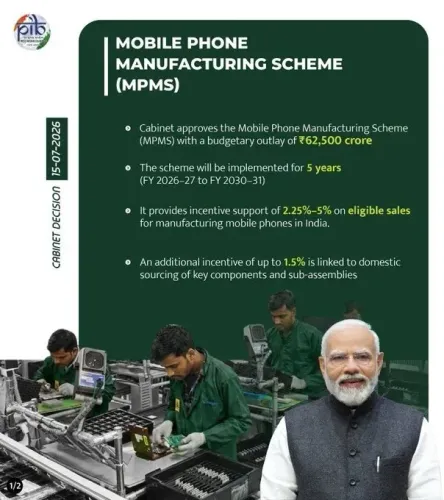
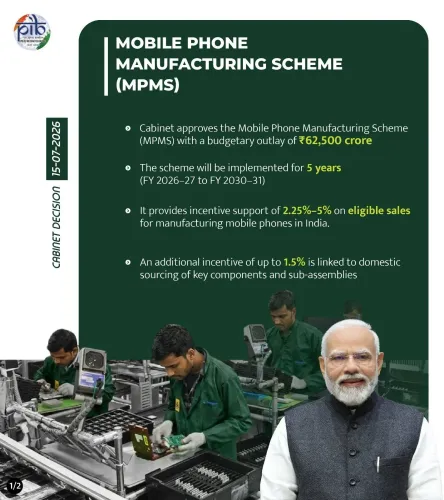
The Union Cabinet, chaired by PM Narendra Modi, has approved the Mobile Phone Manufacturing Scheme (MPMS) with a ₹62,500 crore outlay. Union Minister Kiren Rijiju announced the decision, calling it a transformative step toward making India a global mobile manufacturing hub, building on the PLI scheme legacy since 2020.
Key Takeaways
The Union Cabinet , chaired by PM Narendra Modi , approved the Mobile Phone Manufacturing Scheme (MPMS) on 16-17 July 2026 .
The scheme carries a budgetary outlay of ₹62,500 crore , making it one of the largest single allocations for electronics manufacturing in India.
The MPMS is aimed at strengthening India's mobile manufacturing ecosystem and positioning the country as a global hub.
The scheme builds on the PLI scheme for mobile phones launched in 2020 with an initial outlay of ₹15,000 crore , which attracted investment from Apple , Samsung , and Foxconn .
Rollout details, including eligibility and incentive structures, are expected to be notified by MeitY in the coming weeks.
Union Minister Kiren Rijiju described the Cabinet decision as 'a transformative step towards making India a global mobile manufacturing hub.'
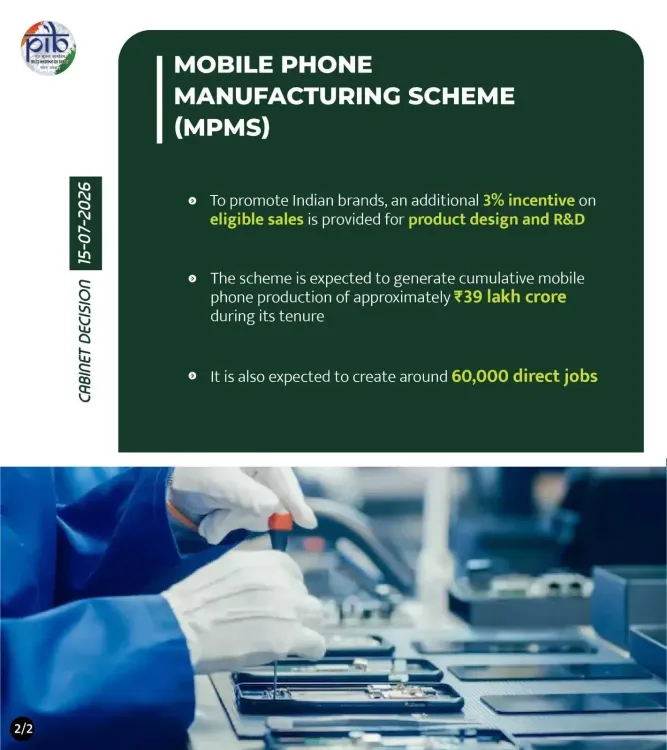
Union Parliamentary Affairs Minister Kiren Rijiju on Thursday, 17 July 2026, announced that the Union Cabinet, chaired by Prime Minister Narendra Modi, has approved the Mobile Phone Manufacturing Scheme (MPMS) with a budgetary outlay of ₹62,500 crore to strengthen India's domestic mobile manufacturing ecosystem.
Context
Rijiju, posting on X, described the decision as 'a transformative step towards making India a global mobile manufacturing hub.' The Cabinet approval marks one of the largest single-scheme outlays directed at the electronics manufacturing sector, nearly four times the initial allocation under the earlier Production Linked Incentive (PLI) scheme for mobile phones launched in 2020.
The announcement came as part of a broader set of #CabinetDecisions cleared in the meeting chaired by PM Modi, signalling continued government emphasis on domestic electronics production under the Make in India and Atmanirbhar Bharat frameworks.
Policy Backdrop
India's push to become a global electronics manufacturing destination has been a central policy theme since 2014, when the Make in India initiative was launched. The PLI scheme for mobile phones and IT hardware, approved in 2020 with an outlay of ₹15,000 crore, is widely credited with attracting large-scale investment from firms including Apple, Samsung, and contract manufacturer Foxconn, driving a sharp rise in both domestic production and mobile phone exports.
The MPMS, with its ₹62,500 crore outlay, appears to extend and scale that incentive architecture to cover the broader mobile value chain — components, sub-assemblies, and finished devices — rather than targeting only large manufacturers. The scheme is expected to be administered by the Ministry of Electronics and Information Technology (MeitY).
Stakeholders and Impact
The primary beneficiaries of the MPMS are expected to be domestic and foreign mobile phone manufacturers, component suppliers, and electronics industry players already operating or seeking to establish operations in India. The scheme's scale suggests it is designed to attract fresh foreign direct investment and anchor global supply chains more firmly on Indian soil.
For consumers, a deeper domestic manufacturing base could over time reduce dependence on imports, exert downward pressure on device prices, and create significant employment across the electronics value chain. India is currently the world's second-largest mobile phone market and has been rapidly growing as an export base, particularly for premium smartphones assembled locally.
What's Next
Attention will now turn to MeitY issuing detailed rollout notifications, including eligibility criteria, incentive structures, and application timelines for companies wishing to participate in the MPMS. Investment proposals from existing and new manufacturers are expected to follow once the scheme's operational guidelines are published.
Export data from MeitY and the Ministry of Commerce in subsequent quarters will serve as early indicators of the scheme's traction. The allocation may also face scrutiny in parliamentary sessions, with opposition members likely to question disbursement mechanisms and benchmarks for measuring the scheme's success in building genuine manufacturing depth rather than final-stage assembly.
Point of View
500 crore represents a significant escalation in India's electronics manufacturing ambition, quadrupling the financial firepower of the original PLI framework. The timing reflects confidence in the PLI model's demonstrated ability to draw global manufacturers to India, while the larger outlay signals a strategic intent to move beyond assembly and build genuine value-chain depth. For the ruling BJP, the announcement reinforces the Atmanirbhar Bharat narrative ahead of future electoral cycles, tying economic nationalism to tangible industrial policy. The real test will lie in implementation — whether incentive disbursements are swift and criteria are broad enough to attract mid-tier component makers, not just marquee brands.
NationPress
16 Jul 2026
Frequently Asked Questions
What is the Mobile Phone Manufacturing Scheme (MPMS)?
The Mobile Phone Manufacturing Scheme (MPMS) is a Cabinet-approved government initiative with a ₹62,500 crore budgetary outlay designed to strengthen India's domestic mobile phone manufacturing ecosystem and help position India as a global mobile manufacturing hub.
How much money has been allocated under the MPMS?
The Union Cabinet has approved a budgetary outlay of ₹62,500 crore for the Mobile Phone Manufacturing Scheme (MPMS).
How does the MPMS differ from the earlier PLI scheme for mobile phones?
The earlier PLI scheme for mobile phones , approved in 2020 , had an outlay of ₹15,000 crore . The MPMS at ₹62,500 crore is nearly four times larger and is expected to target the broader mobile value chain, including components and sub-assemblies.
Who announced the MPMS Cabinet approval?
Union Parliamentary Affairs Minister Kiren Rijiju announced the Cabinet approval of the MPMS on X (formerly Twitter) , attributing the decision to the Union Cabinet chaired by PM Narendra Modi .
Which ministry will implement the Mobile Phone Manufacturing Scheme?
The Mobile Phone Manufacturing Scheme (MPMS) is expected to be implemented by the Ministry of Electronics and Information Technology (MeitY) , which oversees India's electronics manufacturing policy.