Trump Taps Pennsylvania as Hub for US Defence Manufacturing
Synopsis
President Trump on 15 July 2026 designated Pennsylvania a cornerstone of US defence manufacturing, invoking the 'arsenal of freedom' to signal a major domestic military-industrial expansion echoing Roosevelt-era mobilisation rhetoric.
Key Takeaways
President Trump announced on 15 July 2026 that Pennsylvania will play a central role in US defence manufacturing expansion.
The White House framed the initiative as building the 'arsenal of freedom,' a deliberate echo of FDR's 1940 'arsenal of democracy' fireside chat.
Pennsylvania hosts Army depots and private-sector munitions plants with existing federal contract relationships across multiple administrations.
Executive Order 13806 (2017) first directed agencies to strengthen the US defence industrial base, laying groundwork for current policy.
The initiative responds to strategic competition with China and supply-chain pressures from sustained support to Ukraine .
Follow-on DoD contract announcements and state-level workforce and tax packages are expected in the coming weeks.
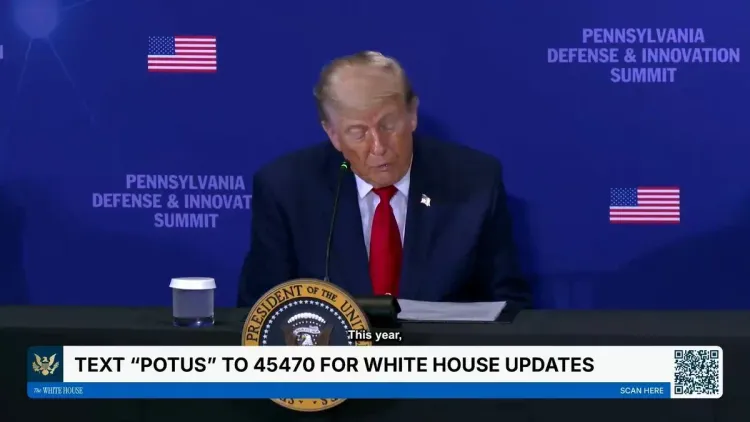
President Donald J. Trump on Wednesday, 15 July 2026, announced a defence manufacturing initiative that positions Pennsylvania as a central node in what he called the 'arsenal of freedom' — the administration's framework for expanding domestic military-industrial capacity to meet modern security demands.
Quoting the President directly, The White House posted: 'With today's announcement, Pennsylvania will play a key role in building the arsenal of freedom to defend our nation in the modern world.' The phrase deliberately echoes President Franklin D. Roosevelt's landmark 1940 fireside chat in which he described the United States as the 'arsenal of democracy,' a call for industrial mobilisation to support Allied forces ahead of American entry into World War II.
Context
Pennsylvania has long been woven into the fabric of American defence production. The state hosts Army depots, private-sector munitions plants, and a skilled manufacturing workforce that has received federal contracts across successive administrations. Its geographic position, existing industrial infrastructure, and supply-chain links make it a recurring choice in Department of Defense (DoD) assessments of scalable domestic capacity.
The Trump administration's invocation of the 'arsenal of freedom' framing signals a deliberate ideological lineage — tying current rearmament priorities to the wartime mobilisation legacy that reshaped the American economy in the 1940s.
Policy Backdrop
The push to onshore defence manufacturing is not new. Executive Order 13806, issued in 2017 during Trump's first term, directed federal agencies to assess and strengthen the US defence industrial base, with specific incentives for domestic production of munitions and precision components. That order laid institutional groundwork that subsequent administrations maintained and expanded.
Amid intensifying strategic competition with China and sustained military support to Ukraine, successive administrations have worked to reduce dependence on foreign suppliers for critical weapons components. Pennsylvania has been repeatedly flagged in DoD supply-chain reviews as a state with the industrial base to scale production of modern precision weapons.
Stakeholders and Impact
The announcement carries direct implications for Pennsylvania's manufacturing workforce, defence contractors operating in the state, and the broader US armed forces supply chain. Workers at munitions facilities and component plants stand to benefit from new or expanded federal contracts, while prime defence contractors are likely to see increased sub-contracting activity routed through the state.
For India, which has deepened defence-industrial ties with the United States under successive bilateral frameworks, a more robust American manufacturing base could affect co-production timelines, technology-transfer negotiations, and the availability of platforms and munitions under existing or future defence agreements.
What's Next
Analysts will watch for follow-on DoD contract announcements that specify facilities, production lines, and dollar values tied to the Pennsylvania initiative. State-level responses — including potential tax incentives, workforce development packages, and infrastructure investments — are also expected as Pennsylvania positions itself to absorb new federal defence spending.
The administration's framing of the initiative as an 'arsenal of freedom' suggests it will be woven into a broader political and strategic narrative heading into the next defence budget cycle, with Pennsylvania likely to feature prominently in both policy documents and campaign messaging.
Point of View
Including New Delhi, the acceleration of US defence-industrial capacity carries real consequences for co-production timelines and technology-transfer negotiations under existing bilateral frameworks. The key variable is whether contract specifics follow the rhetoric, or whether the announcement remains a policy marker awaiting budgetary follow-through.
NationPress
14 Oct 2026
Frequently Asked Questions
What is Trump's 'arsenal of freedom' announcement about?
President Trump used the phrase 'arsenal of freedom' on 15 July 2026 to describe a defence manufacturing initiative that positions Pennsylvania as a key production hub for the US military, expanding domestic munitions and weapons-component capacity.
Why is Pennsylvania chosen for US defence manufacturing?
Pennsylvania has longstanding Army depots, private munitions plants, and a skilled manufacturing workforce with existing federal contract relationships, making it a recurring choice in Department of Defense supply-chain assessments.
What is the origin of the phrase 'arsenal of freedom'?
The phrase echoes President Franklin D. Roosevelt's 1940 fireside chat in which he called the United States the 'arsenal of democracy,' urging industrial expansion to support Allied forces before America entered World War II.
How does this affect India-US defence ties?
A stronger US defence-industrial base could influence co-production timelines, technology-transfer terms, and platform availability under India-US defence agreements, potentially accelerating or complicating ongoing bilateral negotiations.
What should I watch for after Trump's Pennsylvania defence announcement?
Watch for specific Department of Defense contract awards naming Pennsylvania facilities, dollar values, and production lines, as well as state-level tax incentives and workforce development packages tied to the new initiative.